49 works in this view — arrow keys or swipe to move between them.
Dance in Art
Bal masque
Unknown artist
- Collection:
- Prints depicting dance
- Source:
- New York Public Library
- Rights:
- Public domain — free to use, share and adapt.
- Recorded as:
- Public Domain
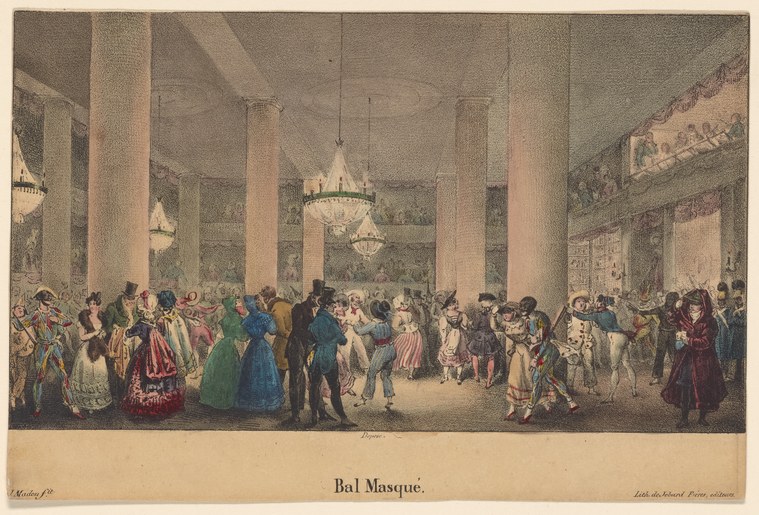
The image is evidence of how the waltz—scandalous and newly acceptable in the 1820s–30s—had become the emblem of refined social dancing by mid-century. It also captures the masquerade tradition as a crucial context for social dance: the masks permitted a controlled form of anonymity that made more intimate partner contact acceptable. For historians of dance, costume, and social manners, the print shows the physical reality of ballroom dancing—posture, frame, proximity, and the gendered choreography of leading and following—at a moment when these norms were still being negotiated.
What you are looking at
A grand masquerade ball in a monumental neoclassical interior, with soaring columns supporting a coffered ceiling. Hundreds of costumed revelers fill the space—women in long dresses of vivid colours (deep greens, blues, reds, yellows) alongside men in dark suits and domino masks. The crowd is in motion: figures waltz, promenade, cluster in conversation, and gesture animatedly across the vast floor. Chandeliers hang from the ceiling, casting warm light across the scene. In the middle distance, couples execute ballroom figures while onlookers line the perimeter or pause in groups. The architectural grandeur—the forest of columns, the height and depth of the space—emphasises the scale and formality of the occasion. The hand-colouring picks out the brilliant fabrics and masks that individualise the dancers against the monochrome architecture.
The dancing
The dancers are mostly in closed ballroom position—couples holding at frame, the woman's left hand on the man's shoulder, his right hand at her waist. Their posture is upright and formal, with a steady frame characteristic of nineteenth-century couple dances. Bodies are shown at various angles as the couples rotate through the floor. Several figures gesture with unoccupied arms, adding liveliness and sociability to the scene. The weight is centred and controlled, typical of ballroom deportment. Masked faces peer toward each other or turn outward; the masks themselves—dominoes and fantastical designs—are a visual motif that animates faces without allowing individual identity.
The dance depicted
This is a Romantic-era masquerade ball, a social dance event at the heart of nineteenth-century European society. The dancers are engaged in the waltz and quadrille, the twin pillars of ballroom culture from roughly 1830 to 1900. The closed-position couples and the density of the floor suggest the waltz, which had only recently become acceptable in polite society (it was denounced as scandalously close in the 1810s). The formal attire and the architectural setting indicate this is an elite urban event, likely a Parisian or Viennese ball of the Romantic period. The masquerade tradition—where masks permit a degree of anonymity and role-play—allowed dancers a subtle freedom within strict social codes.
How it was made
This is a hand-coloured lithograph, a print technique that allowed rapid reproduction and broad circulation. The lithographic stone would have been drawn by an artist and then printed in black, with colour added by hand afterwards—evidenced by the slight bleeding and imprecision of the colours at edges and the watercolour-like finish. Lithography was the dominant commercial medium for popular prints in the nineteenth century, making images like this affordable to a broad middle-class audience. The technique allowed fine detail (the figures' postures, the architectural lines) to coexist with bold colour fields.
About this work
Bal Masque is a snapshot of Romantic-era social life, frozen at the moment of maximum gaiety and movement. The print documents not just a dance style but a whole social apparatus: the costume, the courtship ritual, the architectural theatre in which elite society performed itself. Masquerade balls were a staple of nineteenth-century urban life, celebrated in literature, opera, and visual culture as spaces of transgression, flirtation, and temporary social inversion. This image is both documentary—recording how couples actually held and moved on the ballroom floor—and celebratory, recording the glamour and excitement that ballroom culture held for contemporaries. It belongs in a gallery of dance because it shows the waltz and quadrille not as abstract technique but as lived social practice, embedded in architecture, costume, and the collective experience of the ballroom.
How to look at it
Observe the geometry of the couples: how the artists has staggered them across the deep space to suggest the constant rotation of the waltz. Notice the closed position that was still relatively daring at this period. Look at the masks—some dominoes (simple black eye-masks), others fantastical—and how they allow the print to show a crowd of distinct individuals without the constraint of portraiture. The architecture is not mere backdrop: the columns and coffered ceiling establish the ballroom as a formal, even sacred space for social ritual. The hand-colouring is key to the sense of vivacity; the women's bright dresses pop against the neutral tones of the architecture and men's suits.
The period
The masquerade ball was a fixture of European, especially Viennese and Parisian, society throughout the nineteenth century. The waltz itself had emerged in Vienna in the late eighteenth century but faced moral censure well into the nineteenth; the close partner hold was seen as improper. By the 1830s–40s, the waltz had become socially acceptable among the elite and was spreading rapidly through Europe. The quadrille, imported from France, coexisted with the waltz as a set-piece group dance performed at formal balls. Lithography, perfected in the 1820s, made images of fashionable life widely available to a growing urban middle class. Masquerade balls, with their costumes and masks, offered a theme well suited to the visual drama of the printed image.
Where it lives
The work is held in the New York Public Library's collection of prints depicting dance. It is catalogued by title only, with no artist attribution recorded. The print source line reads 'Lith. de [Langlois?] Paris, actif' (possibly the Langlois lithography firm, active in Paris), but this is uncertain. It is a representative example of popular commercial prints of ballroom scenes produced in nineteenth-century France.
Dance in this work
Questions about this work
Why are so many people wearing masks at a ball?
The masquerade tradition, rooted in Venetian carnival, was revived in European ballrooms of the nineteenth century. Masks permitted a degree of anonymity and temporary role-play that made social interaction freer and more playful. They were not worn continuously through the evening but were part of the festive costume. The masks also added visual drama and theatricality to the ballroom, which is partly why they appealed to artists depicting these scenes.
Is this the waltz?
The couples in closed position are dancing the waltz, the dominant partner dance of the nineteenth century. Some groups may also be executing figures of the quadrille, a set dance, but the waltz is the primary dance shown here. The waltz's intimate hold—one arm around the partner's waist—was a major point of social anxiety when the dance arrived in Europe from Vienna, but by the time this print was made it was the standard of refined ballroom dancing.
How do I know this is from the nineteenth century?
Multiple visual clues: the women's waistlines are high and empire-style (circa 1830s–40s) or, if later, still relatively high; the men wear tailcoats and bow ties rather than earlier styles; the neoclassical architecture (columns, coffers) was favoured for ballrooms from the 1800s onwards; and the lithographic hand-colouring technique was at its peak from the 1820s to 1880s. The costumes and architectural style both point to the Romantic era, roughly 1830–60.
What is a lithograph?
A lithograph is a print made from a stone surface treated with grease and water so that ink adheres only to the drawn areas. The stone was drawn by hand, then printed. This example was then hand-coloured. Lithography was the dominant medium for commercial prints in the nineteenth century because it was cheaper and faster than engraving and could be reproduced many times, making images affordable to a broad audience.
More dance artwork





