49 works in this view — arrow keys or swipe to move between them.
Dance in Art
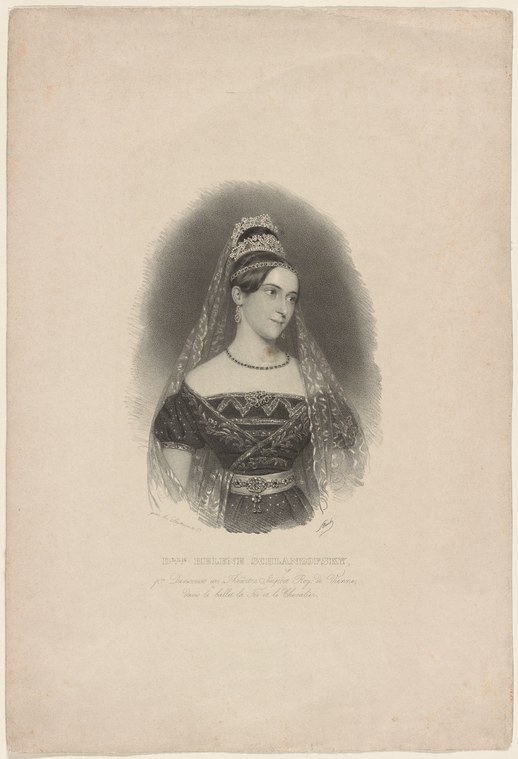
Dlle Helene Schlanzofsky: premiere danseuse au Théâtre Imp. et Roy. de Vienne, dans le ballet la Fée et le Chevalier
Unknown artist
- Collection:
- Prints depicting dance
- Source:
- New York Public Library
- Rights:
- Public domain — free to use, share and adapt.
- Recorded as:
- Public Domain
This image is an essential document of how Romantic ballet roles were costumed and how principal dancers were publicly presented. It shows the specific visual language—the tiara, veil, embroidered bodice, and ethereal pose—that audiences in Vienna associated with supernatural female characters in ballet. For historians of dance, theater, and material culture, it preserves a record of a specific dancer and role that would otherwise be lost to text alone.
What you are looking at
A bust-length portrait of a young woman in theatrical costume, rendered as an engraving with soft aquatint shading that creates a luminous halo effect around the figure. She faces three-quarter left, her gaze directed upward and away. Her dark hair is arranged in an elaborate style typical of mid-19th-century Vienna, with a jeweled circlet or tiara and a delicate lace veil cascading down her back. She wears a low-cut theatrical bodice with ornate embroidered or beaded decoration across the chest, and a dark fabric (possibly velvet) that suggests the costume of a Romantic-era ballet or pantomime character. A pearl necklace encircles her throat. The soft modeling of her face and the ethereal quality of the image—created through careful tonal gradation—emphasizes her youth and the idealized beauty conventions of the period. The composition is intimate and focused entirely on her face and upper body against a plain background.
The dancing
A single figure, head and shoulders only, positioned in a contemplative upward gaze. The neck is elongated and graceful, the shoulders relaxed and turned slightly away. The arm is not visible, allowing the focus to remain on the face and the elaborate costume detail. The posture suggests the refined, ethereal quality prized in Romantic ballet—an interiority and spiritual lift rather than active movement. This is a portrait of a dancer in character, not a depiction of dance action.
The dance depicted
The catalogue names this as Mlle Hélène Schlanzofsky, premier danseuse (principal dancer) at the Imperial and Royal Theatre in Vienna, in the role of the Fairy in the ballet *La Fée et le Chevalier* (The Fairy and the Knight). The costume and pose are consistent with Romantic ballet of the 1840s–1860s: the ethereal, upward-gazing quality, the jeweled tiara, the richly decorated bodice, and the gauzy veil all signal the supernatural feminine roles that dominated European ballet in this period. The character type—a fairy or sylph—typically required the dancer to embody otherworldliness through elongated lines, pointe work, and an otherworldly presence. The image captures not the dancer in motion but in the theatrical character, emphasizing the idealized beauty and refinement the role demanded.
How it was made
This is an engraving with aquatint, a printmaking technique that creates soft tonal passages and subtle modeling. The technique required a copper plate and skilled hand-working to produce the velvety grays and shadows that model the face and create the luminous effect around the head. Aquatint was favored in the 19th century for high-quality theatrical portraits and fashion imagery because it could render fine detail and atmospheric effects. The print would have been distributed to audiences, theater patrons, and collectors of theatrical memorabilia—it served both as a promotional image of a celebrated dancer and as a collectible artwork. The quality of execution suggests a professional printmaker working from a drawing or painting.
About this work
This is a portrait engraving of a Romantic-era ballet dancer in character as a fairy, from a Viennese imperial theater production. It belongs to a rich tradition of 19th-century theatrical portraiture that celebrated celebrated dancers and preserved images of celebrated roles. The work documents both the costume and aesthetic conventions of Romantic ballet and the celebrity culture that surrounded prima ballerinas in mid-19th-century Europe. It is a primary historical source for understanding how Romantic ballet characters were visualized, dressed, and marketed to the public.
How to look at it
Notice the direction of the gaze—upward and away, creating an inward, spiritual quality rather than direct engagement with the viewer. This was a convention of Romantic ballet portraiture: the dancer-as-character is absorbed in feeling or vision, not present to the audience. Observe the elaborate costume detail: the tiara, veil, necklace, and embroidered bodice were elements the dancer would have worn on stage in full costume and pointe shoes. The soft tonal modeling, achieved through aquatint, creates an almost sculptural quality—the face emerges from shadow, suggesting both the theatrical lighting of the stage and the idealized beauty the era prized.
The period
This portrait dates to the Romantic era in European ballet (roughly 1830s–1870s), when ballets centered on supernatural, exotic, or tragic female characters and when the cult of the prima ballerina reached its peak. Vienna's Imperial and Royal Theatre was one of the major opera and ballet houses of Europe, and dancers like Schlanzofsky were celebrated celebrities. The aquatint engraving was a standard medium for distributing images of famous performers to a broad public—theater-goers could purchase prints as souvenirs and collect images of their favorite dancers. This image reflects both the artistic ideals of Romanticism (ethereality, interiority, the elevation of emotion over action) and the emerging modern culture of celebrity and mass-produced theatrical imagery.
Where it lives
This engraving is held in the NYPL's collection of prints depicting dance. It is a theatrical souvenir and portrait print, circulated to the public in the 19th century as a collectible image of a celebrated performer.
Dance in this work
Questions about this work
What was La Fée et le Chevalier?
It was a ballet performed at Vienna's Imperial and Royal Theatre, likely in the mid-19th century. The title translates as 'The Fairy and the Knight,' indicating a Romantic-era narrative ballet with supernatural elements. No detailed record of this ballet's plot, choreography, or premiere date is recorded in standard dance histories, but the production was prestigious enough to generate theatrical portraits of its principal dancers.
Who was Hélène Schlanzofsky?
She was a principal dancer (première danseuse) at Vienna's Imperial and Royal Theatre. Beyond her name and rank, little is documented, but her celebrity was sufficient to warrant a high-quality engraved portrait—an indicator of her status as a celebrated performer. She represents the class of 19th-century prima ballerinas who were public figures and objects of cultural fascination.
Why are there so many theatrical portraits of dancers?
In the 19th century, famous dancers were celebrities, and printed portraits were distributed as souvenirs, in newspapers, in theater programs, and to collectors. These prints served as advertisements for performances, as keepsakes for fans, and as fashion and beauty references. They were also a form of artistic practice—portraiture was a prestigious genre, and capturing a celebrated dancer in character was considered worthy of a professional artist's time.
What does the upward gaze mean?
In Romantic-era portraiture and theater, an upward or inward gaze signaled spiritual elevation, interiority, and escape from the mundane world. For a dancer portraying a fairy or supernatural character, the gaze away from the viewer emphasized the otherworldly nature of the role and aligned with Romantic aesthetics that valued emotion, mystery, and transcendence over realism or direct address.
More dance artwork





