49 works in this view — arrow keys or swipe to move between them.
Dance in Art
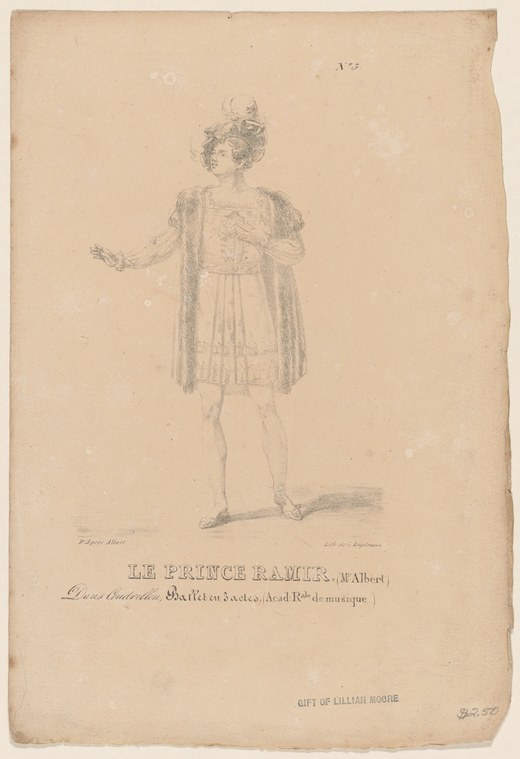
Le prince Ramir (Mr. Albert) dans Cendrillon, ballet en 3 actes
Unknown artist
- Collection:
- Prints depicting dance
- Source:
- New York Public Library
- Rights:
- Public domain — free to use, share and adapt.
- Recorded as:
- Public Domain
This print is a primary source for the visual and sartorial conventions of romantic ballet male roles. For historians and dancers, it documents what the prince was meant to look like, how he carried himself, and what the audience expected to see—information that survives nowhere else for many productions. It also reveals the gendered aesthetics of the era: the prince is ornately dressed but stands still and composed, in striking contrast to the ethereal, weightless ideal assigned to the ballerina.
What you are looking at
A single male figure stands center stage in a formal three-quarter pose against a plain background. He wears the costume of a romantic-era prince: a short tunic or doublet with ornamental detailing at the chest, layered with a long flowing cape or cloak draped from the shoulders and sweeping behind him. His legs are bare or clad in tights, extending to pointed shoes. His posture is upright and regal, with one arm extended outward in a gesture of address or acknowledgment, the other at his side. His hair is styled in curled waves typical of mid-19th-century fashion. The composition is a study of the figure in repose, not mid-leap or mid-turn—this is a formal costume portrait rather than a captured moment of dancing action.
The dancing
The dancer is pictured in profile-to-three-quarter view, standing with weight evenly distributed, not in any recognisable balletic position. The extended arm suggests declaration or courtly gesture rather than an active dance frame. There is no visible turnout, no rise to the balls of the feet, no dynamic tension in the body. The posture is that of an actor in costume, presenting the role to the audience, not executing technique.
The dance depicted
This is a costume print for a romantic ballet, most likely documenting Albert (surname unknown from the print alone) in the role of Prince Ramiro in Cinderella. The ballet *Cendrillon* existed in multiple choreographic versions across the 19th century; the most famous is Petipa's 1893 Russian version, though earlier French versions existed. Without a date on the print, it is impossible to determine which version is depicted. The image documents the theatrical costume and character type rather than any specific choreographic moment or technique. The emphasis on the princely costume—the rich fabric, the dramatic drape of the cape, the formal bearing—tells us this was a role of nobility and spectacle.
How it was made
This is a lithograph or engraving, printed in black ink on paper with hand-applied or printed tone. The linear hatching visible in the fabric folds and the precision of the outline suggest engraving or fine lithography. The technique allowed for mass production of costume documentation and was the standard medium for theatrical prints of this period, circulating widely to audiences, other theatres, and historians. The delicacy of line and the control of tone suggest a skilled professional printmaker working from a sketch or painting.
About this work
This is a theatrical costume print documenting a 19th-century romantic ballet production. It serves as evidence of how the Prince role was staged, what was considered appropriate costume and bearing for the character, and who danced the part. Such prints were commercial products and promotional materials, circulating in theatrical communities and among ballet enthusiasts. They are invaluable records of performance practice, costume design, and the visual aesthetics of romantic ballet, since choreography itself was not systematically notated and no film survives. The work sits within a large tradition of ballet portraiture that peaked in the 1800s, capturing both the glamour of the stage and the technical requirements of the role.
How to look at it
Attend to the costume detail: the specific cut and ornament of the tunic, the weight and flow of the cape, the styling of hair and shoes. These are clues to the production's date and the designer's vision. Notice the stillness of the figure—this is not a leap or a turn, but a presentation. The artist has chosen a moment of address, a formal introduction of the character to the audience, capturing the prince as a figure of rank and presence rather than as a moving dancer. This reflects the conventions of costume portraiture: the figure should be legible, recognisable, and admirable at a glance.
The artist
The artist is not recorded on this impression. The print is credited only to 'Albert' as the performer and to 'Cendrillon' as the production. The print was likely made by a staff lithographer or engraver working for a theatrical print publisher; such prints were often produced anonymously or with credit given only to the subject or the theatre.
The period
This print dates to the heyday of romantic ballet in France, when *Cendrillon* was a repertoire staple and male stars were celebrated in print and popular memory. The 1830s–1860s saw intense commercial production of theatrical prints, especially of famous dancers in iconic roles. The rise of lithography made such prints affordable and widespread. This was also the era in which romantic ballet moved away from the purely symmetrical grace of the classical period toward more expressive, narrative-driven spectacle—the prince as a character with presence and dignity, not merely a partner.
Where it lives
This print is held in the Library of Congress Prints collection. It came to the Library as part of a gift from Lillian Moore, a major collector of dance prints and ephemera. Moore's collection (now split across several institutions) is foundational to dance history research and reflects her systematic effort to document theatrical dance through prints, playbills, and photographs.
Dance in this work
Questions about this work
Who was Albert?
The print identifies him only as 'Albert,' a dancer who performed the role of Prince Ramiro in a production of *Cendrillon*. Without a date on the print or more context, it is difficult to identify him precisely. There were several notable male dancers named Albert active in the 19th century; further research would be needed to establish which one this is.
Which version of Cinderella is this?
That cannot be determined from the print alone. *Cendrillon* existed in several choreographic versions across the 1800s, with significant productions by Petipa (St. Petersburg, 1893) and others earlier in France. Without a date, theatre name, or other documentation, it is impossible to assign this to a specific version.
Why isn't the dancer shown jumping or turning?
Costume prints typically presented the figure in a formal, legible pose rather than mid-movement. The goal was to document the costume, the character type, and the dignity of the role so the image could be read clearly from a distance and appreciated as a portrait. This was a convention of theatrical print design in the 19th century.
What does the cape tell us?
The dramatic, full cape signals rank and spectacle. In romantic and classical ballet, princes and nobility wore such cloaks to convey status and to create a visual impression of grandeur and movement even when standing still. The cape would have been used dynamically in performance—draped, swept, gestured with—but here it is shown in a settled, composed state.
More dance artwork





