49 works in this view — arrow keys or swipe to move between them.
Dance in Art
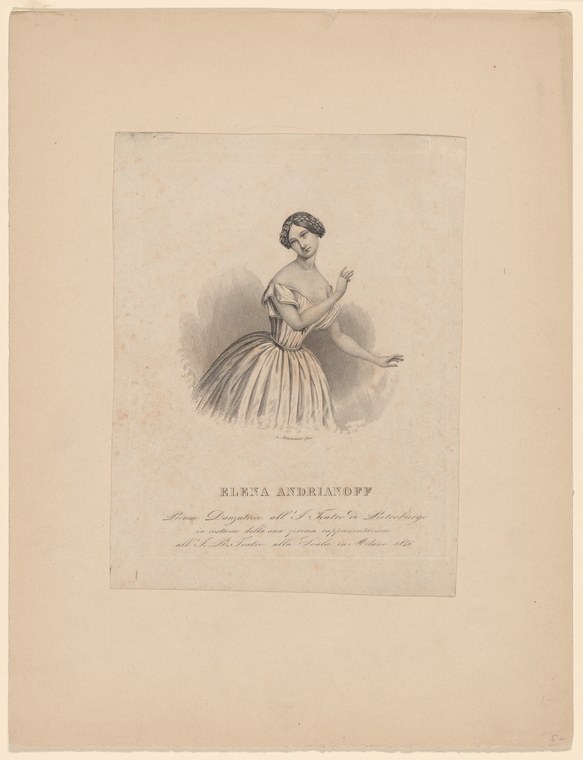
Elena Andrianoff, prima danzatrice all'I Teatro di Pietroburgo in costume della sua prima rappresentazione all'i. r. Teatro alla Scala in Milano 1846
Unknown artist
- Collection:
- Prints depicting dance
- Source:
- New York Public Library
- Rights:
- Public domain — free to use, share and adapt.
- Recorded as:
- Public Domain
For dance historians and performers, this engraving is a precise visual record of Romantic ballet costume and posture in the 1840s, showing the silhouette, sleeve construction, and classical stance that defined the era. For art historians, it exemplifies how engraving functioned as a technology for creating and distributing celebrity imagery before photography, making the dancer a public figure whose image could circulate widely.
What you are looking at
A single female dancer is shown in three-quarter view against a plain background, her figure emerging from subtle shading. She wears the costume of early 19th-century Romantic ballet: a white tulle skirt of moderate length (well above the ankle), fitted bodice with off-shoulder sleeves, and her dark hair styled in the period fashion with a center part. Her posture is upright and dignified; her right arm extends gracefully to the side at approximately shoulder height, fingers extended, while her left arm hangs naturally. Her weight appears to rest on her left leg, with the right leg positioned slightly forward and turned outward in a classical stance. The engraving technique renders the fabric with careful attention to the translucency and volume of the tulle, with fine cross-hatching to suggest shadow and form. The composition is a formal portrait of the dancer in performance dress, presenting her as the subject rather than capturing a moment of choreographic action.
The dancing
The dancer's body shows the posture and turnout required of classical ballet: her legs are turned out from the hip, her carriage is upright, and her arms frame her body in a position consistent with early Romantic-era ballet vocabulary—neither dramatically raised nor tightly held. The slight forward placement of her right leg and the extension of her right arm suggest a moment between movements rather than mid-leap or turn. Her facial expression is calm and directed outward, meeting the viewer's gaze. The figure's proportions and pose indicate an understanding of ballet technique appropriate to the 1840s.
The dance depicted
This is a portrait of Elena Andrianoff, identified in the inscription as a prima ballerina (prima danzatrice) of the Imperial Theatre in Saint Petersburg, depicted here in the costume of her debut performance at the La Scala theatre in Milan in 1846. The work documents the Romantic ballet tradition of the 1840s, a period when the ethereal, pointe-work-based aesthetic had reached its height in Europe. Andrianoff's costume—the white tulle skirt, fitted bodice, and off-shoulder sleeve design—is authentic to Romantic ballet costuming of the period. The pose suggests the classical vocabulary of the era: turned-out positions, elongated line, and an aesthetic of effortless grace. This is a commemorative portrait rather than an action study, designed to preserve the image of a celebrated performer for circulation among ballet audiences.
How it was made
This is an engraving, a reproductive medium that allowed multiple impressions to be made from a single plate, facilitating wide distribution. The technique is evident in the fine parallel lines (hatching and cross-hatching) used to create tone and shadow, particularly in the background and the modeling of the costume. The clarity and precision of line engraving made it the standard medium for theatrical and celebrity portraiture in the 19th century, especially before photographic reproduction became common. The quality of execution suggests this was a professional production, likely created for sale to ballet enthusiasts and theatre audiences—a common practice for promoting celebrated dancers across Europe.
About this work
This engraving documents Elena Andrianoff, a prominent Russian prima ballerina, in the costume of her 1846 Milan debut. It is both a portrait and a record of Romantic ballet aesthetics at mid-century: the ethereal white tulle skirt, the classical posture, and the formal presentation of the dancer as a celebrated artist. The work belongs to a tradition of theatrical portraiture that used engraving to distribute images of famous performers, allowing audiences outside the theatre to own a memento of the dancers they admired. In the context of dance history, it serves as material evidence of how Romantic ballet was costumed, how dancers presented themselves publicly, and how the medium of print shaped the celebrity of performers in the pre-photographic era.
How to look at it
Observe the careful rendering of the tulle skirt and the precision of the dancer's posture: the turned-out legs, the elongated line of the torso, and the graceful extension of the arm are all conventions of Romantic ballet technique and presentation. The engraving captures not a moment of dramatic action but a formal presentation pose—the dancer as a consummate professional. Notice how the shading and cross-hatching create the illusion of three-dimensionality and fabric texture despite the linear medium; this technical skill was essential to making the dancer convincing and appealing to print audiences. The artist has frozen the dancer in a moment that conveys both classical restraint and the ethereal quality that Romantic ballet audiences prized.
The period
The 1840s were the height of Romantic ballet in Europe. The movement had developed in France in the 1830s (with works like *La Sylphide*) and spread rapidly eastward to Italy, Russia, and beyond. Elena Andrianoff's career in the Imperial Theatre of Saint Petersburg placed her at the center of Russian ballet, which was rapidly becoming a major center of the art form. The costume shown here—the white skirt, off-shoulder bodice, and refined silhouette—became the standard visual language of Romantic ballet and would define the aesthetic for decades. In the same period, engraving remained the primary medium for theatrical portraiture and celebrity documentation, before photography displaced it in the 1860s. This work dates to the moment when Romantic ballet had achieved its canonical visual form and when dancers were beginning to be known internationally through such prints.
Where it lives
This engraving is held in the New York Public Library's collection of prints depicting dance. It is a reproductive print, likely one of many impressions made from the same plate and distributed to ballet audiences and collectors in the 19th century.
Dance in this work
Questions about this work
Who was Elena Andrianoff?
Elena Andrianoff was a prima ballerina of the Imperial Theatre in Saint Petersburg in the 19th century. This engraving commemorates her debut performance at La Scala in Milan in 1846, indicating she was a dancer of significant status and international reputation. Beyond what is inscribed on this print, her full biographical details would require further research in Russian ballet archives.
Why is she wearing a white skirt?
The white tulle skirt was the signature costume of Romantic ballet, which dominated the 1840s. White symbolized the ethereal, supernatural quality that Romantic choreographers and audiences valued—the illusion of weightlessness and otherworldliness. The skirt length, floating silhouette, and off-shoulder bodice were all essential markers of the Romantic aesthetic and of a dancer's membership in the elite of her profession.
Why make an engraving instead of a painting?
Engraving was the standard reproductive medium of the 19th century, allowing a single image to be printed many times and sold to a broad audience. A painting would be unique and expensive; an engraving could be distributed to theatres, collectors, and fans across Europe. For promoting a dancer's celebrity and reaching an international audience, engraving was far more practical and economical than any other medium available in 1846.
Is this a historically accurate representation of Romantic ballet?
Yes. The costume, posture, and styling are consistent with documented Romantic ballet practice of the 1840s. The dancer's turned-out legs, upright carriage, and arm position reflect the classical ballet technique of the era. The engraver has rendered the tulle with attention to how it actually appeared on stage—a sign that this is a portrait made from life or reliable documentation.
More dance artwork





