49 works in this view — arrow keys or swipe to move between them.
Dance in Art
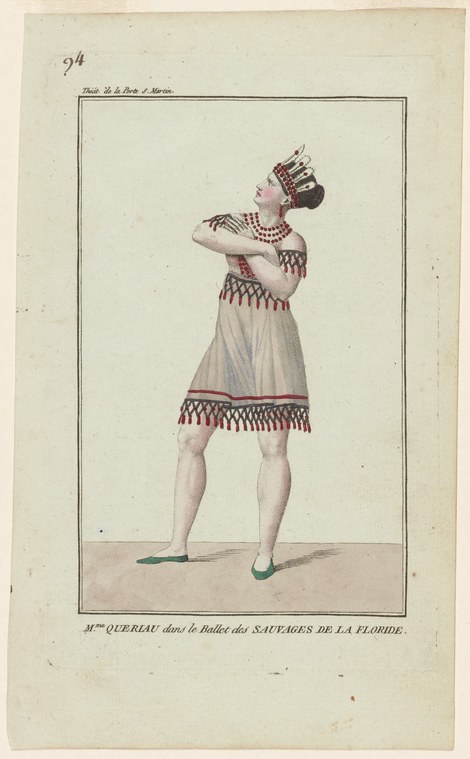
Mme. Queriau dans le ballet des Sauvages de la Floride
Unknown artist
- Collection:
- Prints depicting dance
- Source:
- New York Public Library
- Rights:
- Public domain — free to use, share and adapt.
- Recorded as:
- Public Domain
This print is primary evidence for the aesthetic and commercial machinery of 18th-century theatrical dance: what ballets were staged, who performed them, how they were promoted, and what audiences expected to see. It documents a moment when exotic and colonial subjects were fashionable in European ballet, a taste that shaped the repertory and visual culture of dance for decades. The named performer and the specificity of the costume detail make it a rare survival of an individual dancer's identity and presence on the stage.
What you are looking at
A single female dancer is shown in a standing pose against a plain background, presented in the manner of a theatrical costume study. She wears an elaborately decorated costume suggestive of Native American dress: a sleeveless tunic with red and brown geometric patterns across the chest and waist, a knee-length skirt with a deep red decorative border at the hem, and what appears to be beaded or patterned armbands. On her head she wears a tall headdress of dark feathers or plumage. Her pose is frontal, with her weight on her left leg and her right leg slightly bent, her right arm raised and bent at the elbow near her face as if in a gestural or expressive moment, while her left arm rests at her side. She wears dark shoes or stockings on her feet. The figure is rendered in a delicate hand-colored print technique with careful attention to the patterning of textiles.
The dancing
The dancer stands in a relatively static, formal pose rather than in active motion. Her raised right arm and tilted head suggest a moment of expression or acknowledgment rather than vigorous movement. The weight distribution is asymmetrical, with one leg supporting and the other slightly bent, a common pose for theatrical portraiture of the period. There is no partner or ensemble; the focus is entirely on the individual dancer's costume and bearing. The overall attitude is presentational rather than kinetic—this is a pose for viewing and appreciation of the outfit rather than a captured moment of dancing.
The dance depicted
The title identifies this as Mme. Queriau performing in 'le ballet des Sauvages de la Floride' (The Ballet of the Savages of Florida). This would have been a theatrical spectacle of the 18th or early 19th century, part of the broader European fashion for exotic and colonial subjects in ballet and pantomime. The costume is an imaginative European interpretation of Native American dress rather than an ethnographic representation—the geometric patterning and overall silhouette are shaped by contemporary theatrical conventions. Queriau's pose and the careful documentation of her costume suggest this was a significant role in a fashionable entertainment, and the print served to publicize both the ballet and the performer.
How it was made
This is a hand-colored engraving or etching, typical of theatrical prints from the late 18th century. The fine line work defining the geometric patterns and the careful gradation of the hand coloring—particularly visible in the flesh tones and the subtle shading of the costume—are characteristic of high-quality theatrical costume documentation. The technique allowed for multiple impressions to be hand-finished, making it affordable for a theatre-going public but still refined enough for display. The precision of the rendering indicates this was made from a careful original drawing, possibly made during or after a performance.
About this work
This is a theatrical costume print documenting a named performer, Mme. Queriau, in an exotic ballet from the late 18th-century Parisian or European stage. The work belongs to a rich tradition of prints that publicized theatrical spectacles and made performers visible to a broad public beyond those who could attend the theatre. It is both a work of theatrical promotion and a record of how European dance audiences encountered imaginative representations of indigenous peoples—a common subject in the period's popular entertainment. The print preserves not only a visual memory of how the role was costumed and performed, but also the name and fame of a performer who might otherwise have left almost no trace.
How to look at it
Notice the care taken in rendering the geometric patterning of the costume—each element of the decoration is distinct and legible, suggesting that the costume's visual impact was central to the performance. The pose is formal and composed, not candid; this is how the performer wanted to be remembered and seen. The tall feathered headdress dominates the composition and would have created a striking silhouette on stage. The hand-coloring, though delicate, is intentionally placed to emphasize the costume's architecture rather than create naturalism—the colors are bold and patterned, not subtle.
The period
In the late 18th century, European ballet and pantomime were fascinated by exotic and foreign subjects—Turkish dancers, Chinese scenes, African and indigenous American characters. These spectacles reflected both the expansion of European colonial interests and a taste for the picturesque and the strange among theatre audiences. The 'ballet des sauvages' was one expression of this aesthetic. Simultaneously, theatrical prints became a major industry: engravers working with or from theatre companies produced thousands of costume studies and scene prints that were sold to the public, creating a visual record of ephemeral performances and making theatrical celebrities recognizable beyond the theatre building itself.
Where it lives
This print is part of the New York Public Library's collection of prints depicting dance. It is catalogued as a theatrical costume print, a category of commercial popular prints made to document and publicize stage performances.
Dance in this work
Questions about this work
Who was Mme. Queriau?
The print records her name and role but little else is documented in this record. She was a performer in a Parisian or European theatrical ballet, probably in the late 18th century, significant enough to warrant a portrait print. Many performers of this era are now known to us primarily through such prints and theatrical archives. Further research in theatre history and archival sources might establish her career more fully.
Was this a real Native American dance?
No. This is a European theatrical fantasy, using imaginative costume and movement to represent an exotic and colonized people for the entertainment of European audiences. The costume shows theatrical convention more than ethnographic knowledge. Such spectacles tell us much about what Europeans wanted to see and imagine, and very little about actual Native American cultures and dances.
How was this print made and distributed?
It was engraved or etched on a metal plate, printed in black line, and then carefully hand-colored by assistants. Multiple copies could be printed from the plate and individually colored, making theatrical prints relatively affordable for middle-class theatre-goers. They were sold in theatres, in print shops, and through dealers, and served as souvenirs and mementos of performances.
More dance artwork





