49 works in this view — arrow keys or swipe to move between them.
Dance in Art
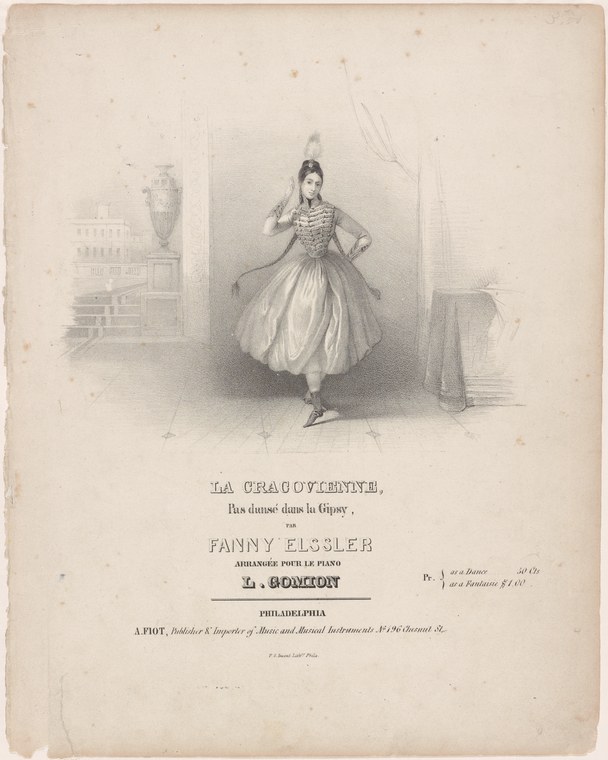
La cracovienne, pas dansé dans La gypsy
Unknown artist
- Collection:
- Prints depicting dance
- Source:
- New York Public Library
- Rights:
- Public domain — free to use, share and adapt.
- Recorded as:
- Public Domain
Fanny Elssler was one of the most celebrated dancers of the romantic ballet era, and this portrait documents a specific role and costume from her American tour, offering concrete visual evidence of how national folk dances were adapted for theatrical performance in the 19th century. For historians of theatrical dance, romantic-era costume, and the circulation of European dance culture through America, this engraving is a primary source of how the cracovienne looked on stage and how it was publicized and sold to the public.
What you are looking at
A young female dancer stands alone in a theatrical interior, posed in a moment of graceful stillness. She wears a pale tulle skirt of mid-calf length with a fitted bodice decorated with a corseted, jeweled or braided front panel in a darker tone; her dark hair is styled up with what appears to be a decorative plume or feather. The setting suggests a grand interior—architectural elements including a classical urn or vase on a pedestal appear to the left, and draped fabric hangs to the right, framing the figure. The composition is intimate rather than narrative; the dancer is isolated against a softly rendered background executed in light washes of tone. The print employs stippled and linear shading to create volume and shadow, giving the figure substantial presence despite the ethereal quality of her costume.
The dancing
The dancer stands with her weight on one leg, the other bent slightly, suggesting a pose rather than a moment of active movement. Her arms frame the body in an open, presentation-like position—one arm extended outward and slightly upward, the other at the side or across the body, creating an attitude of dignified repose. The posture suggests training and control; there is no sense of vigorous motion but rather a deliberate, statuesque moment. The tulle skirt falls smoothly without significant movement lines, implying a held position rather than a turn or leap.
The dance depicted
This is a theatrical dance portrait, likely a souvenir or advertisement for a specific performance rather than a scene depicting movement in progress. The title identifies this as a *cracovienne*—a Polish folk dance form that became popular in European theatrical contexts during the 19th century, particularly as a character or national specialty number within larger theatrical works. The notation "dansée dans La gypsy" indicates this dancer performed it as part of the opera or theatrical piece *La Gypsy*. The single-figure format and the pose—restful yet elegant—suggest this is a portrait of the performer, Fanny Elssler, captured in her stage costume rather than mid-dance. The cracovienne is a moderate-paced, stately dance with characteristic Polish stepping patterns, but this image shows the dancer in a moment of poise, emphasizing her beauty and the costume rather than the kinetic nature of the dance.
How it was made
This is an engraving or steel engraving, a reproductive print technique that was standard for theatrical portraiture and dance documentation in the mid-19th century. The technique creates clean lines and subtle tonal gradations through cross-hatching and stipple, allowing fine detail in costume and physiognomy while maintaining the formal, refined quality appropriate to celebrity theater portraiture. Engravings of this type circulated widely and inexpensively, serving as souvenirs for theater-goers, promotional materials for performers, and illustrations for printed matter including sheet music. The arranger's name (D. Boniton) and publisher information (A. Piot, Philadelphia) are clearly marked, indicating this is a published print meant for commercial distribution in North America.
About this work
This is a theatrical portrait engraving of Fanny Elssler performing the cracovienne, a Polish character dance, from the opera *La Gypsy*. It dates from the mid-19th century and was published in Philadelphia by A. Piot, one of the major American music and theater publishers of the era. The work sits at the intersection of dance documentation and celebrity portraiture—it records the costume and the performer's image far more than it documents the actual dance. The cracovienne was a popular specialty number for romantic-era dancers, often used as a vehicle for display of technique and national character, and this engraving preserves evidence of how the dance appeared on stage and how it was marketed to American audiences.
How to look at it
The artist has chosen to freeze the dancer in a moment of posed stillness rather than mid-leap or in the midst of a turn. This was a conventional choice for theatrical portraiture of the era—the goal was to show the performer's beauty, the costume's detail, and the elegance of her bearing rather than to capture dynamic movement. Notice the care taken with the costume details: the corseted bodice, the graduation of the tulle skirt, the styling of the hair and plume. Notice also the formal, almost statuesque quality of the pose—this is presentation rather than action. The architectural setting grounds the figure in a theatrical world but does not tell a narrative; we are meant to focus on the solitary, idealized body of the dancer.
The artist
The artist and engraver are not recorded in the catalogue. The arranger is noted as D. Boniton, likely the arranger of the musical score for piano ("arrangé pour le piano"), and the publisher is A. Piot of Philadelphia. This type of theatrical portrait engraving was a major commercial enterprise in 19th-century America; Philadelphia and New York were centers of music and theater publishing, and it was common for major roles and performers to be memorialized in engravings suitable for framing or inclusion in bound collections of music and theater memorabilia.
The period
This print dates to the romantic era of ballet, roughly 1830s–1860s, when European dancers like Elssler toured America to considerable acclaim and theatrical entertainment was a major social and cultural event. The cracovienne became fashionable as a character dance during this period, deployed in large ensemble works and as a featured solo to display technique and national color. National and folk dances, often performed in tutus and pointe shoes, were a staple of romantic ballet, representing exoticism and "character" through costume and music while being executed in academic ballet technique. The rise of commercial theater publishing meant that celebrated dancers became marketed celebrities, their images mass-produced as prints for sale to the public, creating an early form of theatrical merchandising.
Where it lives
This engraving is held in the New York Public Library's Prints collection and is catalogued as part of their holdings of theatrical and dance imagery. It is a published print, not a unique artwork; multiple impressions would exist and may be held in other institutions and private collections.
Dance in this work
Questions about this work
Who was Fanny Elssler?
Fanny Elssler (1810–1884) was an Austrian dancer and one of the most celebrated performers of the romantic ballet era, known for her technical brilliance, beauty, and versatility in both classical ballet and character dances. She toured Europe and America extensively; her American tour (1840–1842) was a major cultural sensation. She was renowned for her performance of national dances and character roles alongside classical ballet, and she retired from performance as one of the most famous dancers of her time.
What is a cracovienne?
The cracovienne is a Polish folk dance in moderate tempo, characterized by stately stepping patterns and a proud, dignified bearing. It became popular in European theatrical contexts during the 19th century, often performed as a national character dance by trained ballet dancers in tutus and pointe shoes, rather than in its original folk costume. It was frequently used as a featured solo or specialty number to display both technique and national or exotic character.
What is *La Gypsy*?
La Gypsy is a theatrical work (likely an opera or ballet) from the mid-19th century in which Elssler performed the cracovienne. The title suggests a plot centered on Romani or gypsy themes, which were popular subjects in romantic-era theater and opera, often as vehicles for spectacle, national dances, and display pieces.
Why did they publish engravings of dancers?
Engravings of celebrated performers served multiple purposes: they were souvenirs for theater-goers to remember a performance or favorite dancer; advertisements for the performer and the theater; and illustrations for published sheet music and theatrical programs. They were inexpensive to produce and circulate compared to paintings, making them accessible merchandise that helped build a performer's celebrity and marketability.
More dance artwork





