49 works in this view — arrow keys or swipe to move between them.
Dance in Art
Excelsior at the Éden Théâtre, Paris
Unknown artist
- Collection:
- Prints depicting dance
- Source:
- New York Public Library
- Rights:
- Public domain — free to use, share and adapt.
- Recorded as:
- Public Domain
*Excelsior* represents a peak moment of 19th-century European ballet before modern dance fundamentally challenged its aesthetic, and this print is one of few visual records of how the work actually looked. The range and elaboration of these costumes reveal how theatrical ballet in the 1880s depended on visual narrative and character specificity as much as pure dance technique. For historians of costume, narrative ballet, and theatrical production, this sheet documents the scale and ambition of a work that influenced European and Russian ballet practice for decades.
What you are looking at
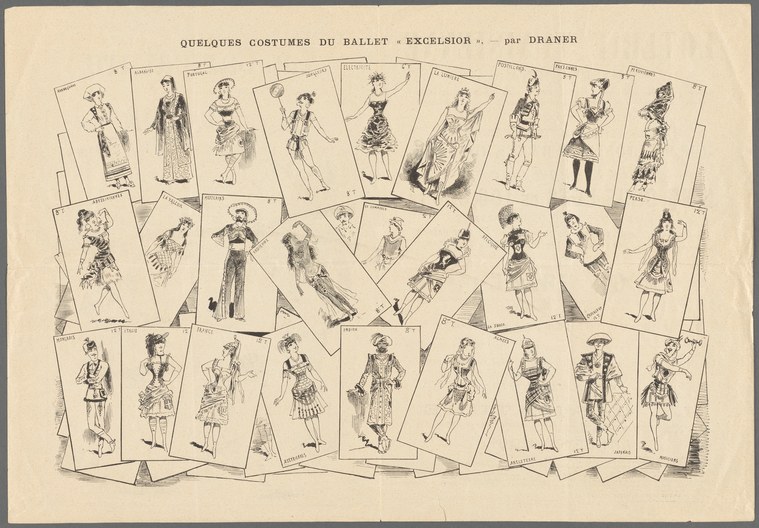
This is a composite sheet of costume designs arranged in a three-row grid, each figure drawn on its own small rectangular card as if laid out for display or reference. The designs are numbered and show thirty different costumed figures, apparently characters or dancers from the 1880s Paris production of *Excelsior*, a spectacular ballet-pantomime choreographed by Luigi Manzotti. The figures are rendered in pen or pencil with fine hatching to suggest fabric texture and pattern. Many wear elaborate historical, exotic, or fantastical dress: Orientalist silhouettes, classical Greek and Roman draping, Renaissance gowns, military uniforms, and extravagant elaborations of skirts and headpieces. Some figures stand in profile, others front-facing or in three-quarter view. The variety of costumes suggests the narrative scope of *Excelsior*, which celebrated human progress and ingenuity through a succession of historical and geographical tableaux. A few figures appear to be in active dance pose with legs extended or body weight shifted, though most are shown standing relatively still, as if for costume approval or a visual catalogue.
The dancing
Most figures are shown in an upright, presentation stance—essentially costume displays rather than caught mid-movement. A few show more active body alignment: a woman in the second row appears to be in a lifted leg position or near-arabesque, and several others have arms raised or extended, suggesting gesture rather than weight-bearing dance posture. The bodies are slender and elongated in the style of late 19th-century fashion illustration, with particular attention to the silhouette created by corseted waists and layered or draped skirts. Legs are typically shown with defined musculature, and feet are often pointed or positioned with balletic precision, indicating these are professional theatrical dancers rather than costume extras.
The dance depicted
*Excelsior* was Luigi Manzotti's monumental 1881 ballet-pantomime, first performed at La Scala in Milan and subsequently staged in Paris at the Théâtre de l'Éden and across Europe. It was a landmark work of the Romantic and early Imperial ballet tradition, known for its vast ensemble scenes, intricate pantomime narrative, and celebration of technological and human progress. The costumes here represent the diverse character roles and corps de ballet formations that populated its elaborate tableaux, including allegorical figures, historical characters, and exotic peoples encountered in the narrative's journey. The work was danced by trained ballet company members and required considerable technical skill; the precision of the feet and carriage visible in these designs confirms the balletic vocabulary employed.
How it was made
This is a lithograph or engraving (likely a reproductive print), printed from a single stone or plate and reproduced as a sheet document. The technique allows for fine linear detail and subtle tonal gradation through crosshatching. The regular arrangement of numbered costume designs on a page suggests this was made for publication—either as a record for the production, a souvenir for audiences, or an illustration in a theatrical journal or book. The small individual framing of each figure, and the title printed at the head of the sheet, indicates this was a deliberate editorial or curatorial choice to present *Excelsior*'s visual identity as a gallery of characters rather than a narrative scene.
About this work
This is a costume design sheet from Luigi Manzotti's *Excelsior*, one of the grandest and most ambitious ballets of the late 19th century. Manzotti was an Italian choreographer who specialized in large-scale spectacle and narrative ballet, and *Excelsior* exemplified his style: a quasi-historical-allegorical narrative celebrating progress, featuring dozens of dancers in elaborate character costumes. The work premiered in Milan in 1881 and was rapidly exported to Europe; this print records the Paris production at the Théâtre de l'Éden, establishing how the work was adapted and presented for French audiences. The costumes themselves—mixing historical accuracy, Orientalism, classicism, and pure fantasy—were central to the work's spectacle and narrative clarity. Seen as a whole, this sheet is both a historical record and a visual argument about what late 19th-century Imperial ballet was: a fusion of classical dance technique, pantomime, and costume spectacle.
How to look at it
Approach this sheet as both a dance document and a theatrical design record. Note how many of the figures, despite their ornate costumes, show careful attention to balletic carriage: the turned-out legs, the lifted spine, the pointed feet. The range of character types—from classical goddesses to exotic warriors to allegorical figures—illustrates how *Excelsior*'s narrative unfolded through visual and pantomimic variety rather than through abstract ensemble work. Look at the proportions and silhouettes: the exaggerated waists and full skirts show how corseting and layered petticoats shaped the female dancer's body and movement in ways radically different from modern ballet. The numbered arrangement suggests this was a reference tool as much as an artwork—a way of cataloguing the production's visual vocabulary.
The artist
The artist is not recorded in the catalogue, but the title attribution "par Draner" (shown at the head of the print) likely refers to a costume designer or theatrical illustrator responsible for rendering these designs. Draner may have been involved in the original costume design, the published illustration, or both. Late 19th-century Parisian theatrical prints often featured credited costume designers or illustrators whose work was valued as artistic documentation in its own right, contributing to the popular press and souvenir culture surrounding major ballet productions.
The period
The 1880s were a period of consolidation and spectacle in European ballet. The Romantic era's emphasis on ethereal, supernatural female figures was giving way to a renewed interest in historical narrative and ensemble display, influenced partly by the emergence of Russian Imperial Ballet under the direction of Marius Petipa, who himself borrowed heavily from Italian spectacle ballet. *Excelsior* exemplified this turn toward grand narrative and technical display. At the same time, this era saw the rise of colour lithography and reproductive printing as tools for popularizing theatrical imagery, making ballet accessible to a broader, non-aristocratic audience through prints, journals, and published souvenir books.
Where it lives
This print is held in the New York Public Library's collection of dance-related prints and ephemera. It is a commercial reproductive print, likely published as a souvenir or record of a Paris production of *Excelsior* in the early-to-mid 1880s, and would have circulated among theatregoers, artists, and the broader ballet-interested public.
Dance in this work
Questions about this work
Was *Excelsior* a famous ballet? Why don't people dance it now?
*Excelsior* was genuinely famous and influential across Europe in the 1880s and 1890s. It was full of spectacle, complex pantomime, and large ensemble work, and it required extensive scenery and resources. It fell out of favour partly because modernism (Diaghilev, Fokine, later Graham and Balanchine) rejected the narrative-and-spectacle model it represented, and partly because its narrative and aesthetic are now difficult to stage. A few complete or partial revivals have been attempted, but it remains a historical work rather than a living repertoire piece.
How do I know these are real dancers and not just costume models?
Several clues: the carefully observed balletic positions (turned-out legs, pointed feet, lifted carriage), the variety of ages and body types visible, and the context of the work itself. *Excelsior* employed large corps de ballet; these designs record the actual dancers who performed the roles. The precision of the drafted anatomy and positioning also suggests the illustrator was working from live dancers or detailed rehearsal notes, not generic fashion models.
Why is the title 'Excelsior at the Éden Théâtre'? Where was it first performed?
*Excelsior* premiered at La Scala in Milan in 1881, choreographed by Luigi Manzotti. It was then exported to other European venues, including Paris (where this print originates), Vienna, and Russia. The Éden Théâtre in Paris was one of several Paris theatres that mounted major ballet productions. Each city's version might have had slightly different casts and costumes, which is why the print specifies the Paris venue.
More dance artwork





