49 works in this view — arrow keys or swipe to move between them.
Dance in Art
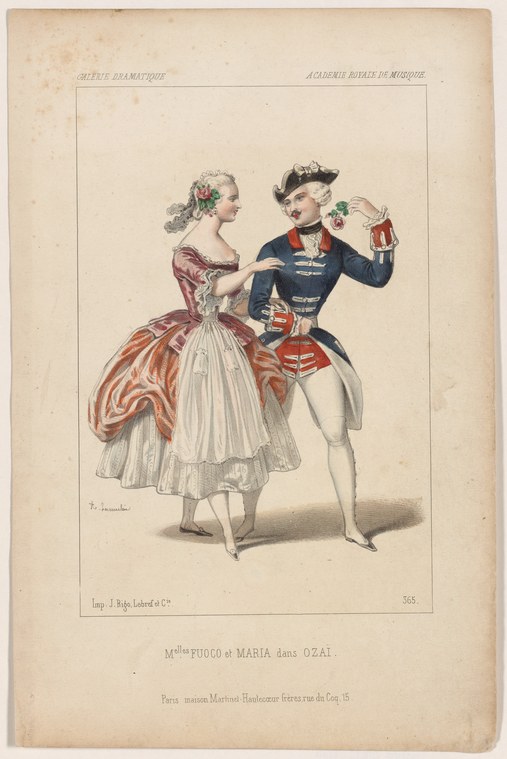
Academie Royale de Musique. Melles Fuoco et Maria dans Ozaï
Unknown artist
- Collection:
- Prints depicting dance
- Source:
- New York Public Library
- Rights:
- Public domain — free to use, share and adapt.
- Recorded as:
- Public Domain
This is evidence of how Romantic ballet was experienced and remembered in its own time—not primarily as moving bodies but as theatrical spectacle, costume, and narrative. The print shows that even celebrated dancers at the pinnacle of their art were documented first as characters in costume, occupying the intersection of dance, drama, and fashion. For historians of dance practice, the figure's refined posture and restrained gesture reveal the stylistic norms of the period, which privileged elegance and dramatic presence over the acrobatic display that would later define ballet technique.
What you are looking at
A young military officer in dress uniform—dark blue coat with gold braiding, white breeches, and a bicorne hat—stands beside a woman in an elaborate ball gown. Her dress features a striking two-toned skirt: the upper layer a deep rust or coral silk caught up to show a white underskirt, creating dramatic swags and volume. She wears her hair styled high with flowers or feathers, and a low décolletage typical of Romantic-era evening wear. The officer holds aloft a decorative fan or plumed object, perhaps a theatrical property, while gazing at the woman. The two figures occupy a shallow stage space against a neutral background, positioned in the three-quarter view typical of theatrical prints. The lighting is even and the execution meticulous, suggesting this documents a specific moment from a staged performance rather than an imagined scene.
The dancing
The woman stands in a relaxed, social posture facing slightly stage-left, her weight on one leg, the opposite knee softly bent in the manner of ballroom deportment. The officer leans slightly toward her in a posture of courtship or attention, his body angled to face her while his elevated arm suggests theatrical gesture or the presentation of a gift. Neither figure is caught mid-leap or in virtuosic movement; both maintain the upright frame and refined stance expected of ballroom or court dance of the period. Their proximity and orientation suggest a pas de deux or narrative duet moment rather than ensemble or solo display.
The dance depicted
This appears to document a scene from *Ozaï*, a theatrical work performed at the Académie Royale de Musique (the Paris Opera) featuring dancers Melles Fuoco and Maria. The costumes and staging suggest a Romantic-era ballet or opera-ballet, likely from the second quarter of the nineteenth century. The officer's uniform and the woman's formal ball dress indicate a narrative moment of social interaction—possibly courtship, a recognition scene, or a formal presentation—rather than a technical dance sequence. The leisurely posture and refined deportment are consistent with the pantomime and demi-caractère movement of Romantic ballet, where narrative and character took precedence over virtuosity in many scenes.
How it was made
This is a hand-colored lithograph or engraving, executed with fine detail and careful attention to fabric texture and costume ornament. The signature visible at lower left (P. Langlumé or similar) indicates the artist-printmaker. The technique allowed for multiple impressions, making this an affordable theatrical souvenir or documentation for a broad audience interested in opera-ballet and its stars. The careful coloring and fine line-work suggest this was a quality commercial print, likely sold at the theatre or through print sellers to patrons who wished to remember a specific production or celebrated dancers.
About this work
This is a theatrical portrait-print documenting a scene from *Ozaï*, performed at the Paris Opera with the dancers Melles Fuoco and Maria. It captures a moment of social interaction—an officer and a woman in formal dress—that forms part of the narrative action of the work rather than a display of technical virtuosity. As a hand-colored print from the Romantic era, it serves as both a record of a specific production and a window into the visual culture of ballet at that moment: the costumes, the staging conventions, the relationship between dance and theatre, and the celebrity of individual performers. Such prints were essential to the circulation of theatrical knowledge before photography, allowing people who had not attended the performance to know what had been seen on stage.
How to look at it
Observe the careful attention to costume detail—the construction of the skirt, the ornaments in the hair, the braiding on the officer's coat—which testifies to the importance of dress to Romantic ballet. Notice the stillness of the pose: neither figure is captured in mid-movement, suggesting this represents a moment of dramatic pause or social interaction. The composition and the careful balance of the two figures on either side of the frame reflect conventions of theatrical portraiture, where clarity and the display of costume took precedence over the dynamic energy of movement. The title and credits at the bottom anchor this as a document of a specific performance, a record meant to be consulted and remembered.
The artist
The artist is credited as P. Langlumé (or similar—the signature requires verification). Little is recorded about this printmaker's practice, but the professional quality and detailed execution suggest a commercial printing house with expertise in theatrical subjects. Such firms typically employed multiple hands to manage coloring, lettering, and distribution, making individual attribution difficult. This print likely came from a Paris firm specializing in opera and ballet documentation, a thriving market in the nineteenth century.
The period
This work dates from the era of Romantic ballet (approximately 1830–1850), when the Paris Opera was the dominant venue for ballet in Europe and when dancers such as Marie Taglioni achieved international celebrity. Theatrical prints were a primary means by which performances circulated beyond those who could attend in person; they were sold as souvenirs, published in illustrated journals, and collected by enthusiasts. The costumes and staging visible here—the elegant ball dress, the military uniform, the shallow stage space—reflect the Romantic ballet's obsession with narrative, character, and the visual spectacle of the female body in formal dress. The emphasis on a scene of social interaction rather than technical display shows the influence of theatrical melodrama and pantomime on ballet choreography and production.
Where it lives
This print is held by the New York Public Library in the collection *Prints depicting dance*, suggesting it was acquired as a record of theatrical practice and performance history. The print's survival in an institutional collection indicates its value as both a commercial theatrical souvenir and a historical document of nineteenth-century ballet production and celebrity.
Dance in this work
Questions about this work
What is Ozaï and who were Fuoco and Maria?
Ozaï was a work performed at the Paris Opera (Académie Royale de Musique) in the Romantic era. Melles Fuoco and Maria were professional dancers whose names appear on the title. Beyond this credit, detailed information about the work and performers would require consultation of Paris Opera archives and Romantic ballet historiography. The print itself serves as a record that such a work and such dancers existed and were notable enough to be documented in this theatrical print.
Is this a dance scene or a dramatic scene?
It appears to be both. In Romantic ballet, narrative scenes often involved refined social movement and pantomime rather than virtuosic dance steps. The carefully composed posture and elegant deportment of both figures suggest trained performers executing a choreographed moment, even though it lacks the dynamic energy or acrobatic display we might associate with 'dance' in a modern sense. This reflects the historical reality that Romantic ballet valued storytelling and visual elegance as much as technical display.
Why is this a lithograph rather than a painting or photograph?
Lithography allowed for multiple high-quality prints to be produced relatively quickly and affordably, making it the ideal medium for theatrical documentation and souvenirs. A painting would be unique and expensive; a photograph would not be technically feasible (and too slow) for theatrical subjects in this era. The print could be hand-colored after printing, creating an affordable yet visually rich record of the production.
What does the officer's uniform tell us?
The formal military dress indicates that the narrative moment involves a character of high social standing or military rank, placing the scene in a social or courtly setting. This reflects the Romantic ballet's fascination with historical pageantry, courtly life, and narratives of love across class or national boundaries. The precision of the uniform's depiction suggests the ballet took seriously the visual authenticity of its costumes and settings.
More dance artwork





