49 works in this view — arrow keys or swipe to move between them.
Dance in Art
Eucharis
Unknown artist
- Collection:
- Prints depicting dance
- Source:
- New York Public Library
- Rights:
- Public domain — free to use, share and adapt.
- Recorded as:
- Public Domain
Prints of named ballet characters and moments were a primary means by which nineteenth-century audiences experienced and remembered dance outside the theater; this image documents both the aesthetic ideals of Romantic ballet and the commercial circulation of dance imagery. The figure of Eucharis and the characteristic weightlessness of the pose provide a visual record of how Romantic technique and mythology were understood in popular theatrical culture.
What you are looking at
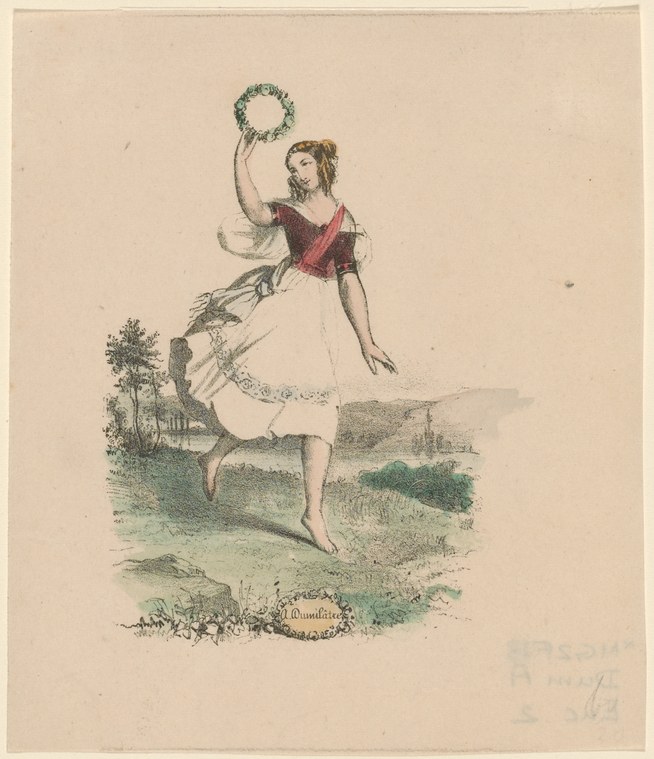
A young woman in a lightly colored dress stands alone in a pastoral landscape, one arm raised high above her head holding what appears to be a wreath or garland of greenery. Her body is in a graceful, airborne pose suggesting a leap or bound, with her torso lifted and one leg extended behind her. She wears a dark corseted bodice over a pale skirt, and her hair is styled in long ringlets typical of the mid-nineteenth century. The setting is rural and simplified—trees and shrubs frame the scene at left, with distant landscape visible at right, all rendered in soft greens and browns. At the base of the composition, a cartouche bears the name "Eucharis" in script. The overall mood is one of lightness and grace, with the figure suspended in a moment of joyful movement.
The dancing
The dancer stands in a single lifted pose, weight appearing to rest on one leg while the other extends behind or to the side. Both arms are active: the upper arm raises the wreath overhead while the lower arm remains relaxed at the side or extended downward. The torso is erect and energetic, the head held high and turned slightly, and the whole silhouette conveys upward spring and buoyancy. The pose reads as a moment caught mid-leap or mid-turn, with the lightness and airiness characteristic of early Romantic ballet.
The dance depicted
This appears to depict a moment from Romantic-era ballet, likely from the mid-nineteenth century. The figure of Eucharis (a nymph from classical myth, transformed into a myrtle tree in Ovid's account) was the subject of ballets performed in this period. The raised wreath and pastoral setting align with the sylph-like characters of Romantic ballet, and the suspended, weightless quality of the pose matches contemporary accounts of dancing technique. The image captures a solo moment of a mythological character, rendered in the ethereal vocabulary of the Romantic stage.
How it was made
This is a hand-colored engraving or possibly a hand-tinted lithograph from the nineteenth century, employing stipple, line engraving, and light tonal blocking to suggest form and depth. The medium allowed for wide circulation of dance imagery among theater audiences and collectors. The soft hand-coloring in greens and flesh tones, applied over a tonal base, was typical of theatrical prints of the 1840s–1860s. This technique was economical enough to be mass-produced and accessible to people outside the theater.
About this work
This hand-colored engraving depicts a solitary female dancer or nymph named Eucharis in a moment of suspended, balletic grace. The figure, rendered in the lightweight, ethereal style of Romantic ballet, holds aloft a wreath of greenery while captured in an airborne pose in a pastoral landscape. The work is a theatrical print of the type widely circulated to preserve and popularize the ephemeral art of ballet for audiences beyond the opera house.
How to look at it
Observe the moment the artist chose to freeze: not a standing pose, but a leap captured at its apex, where the dancer appears to float weightlessly despite gravity. Notice how the artist conveyed airborne suspension through the extension of limbs, the upright carriage of the spine, and the strategic placement of the raised arm and wreath. The pastoral background and the gentle treatment of drapery reinforce the ethereal quality. The composition emphasizes the illusion of effortlessness that was the hallmark of Romantic ballet technique.
The period
This work dates to the era of Romantic ballet (roughly 1830s–1870s), when the ballet d'action—a narrative form set to music—dominated European stages. Ballets drew heavily on classical mythology, fairy tales, and orientalist fantasies, populated by sylphs, naïads, and supernatural beings. Women dancers, en pointe and in diaphanous skirts, came to embody the otherworldly and the unattainable. Prints and engravings of celebrated dancers and characters proliferated as a form of souvenir and celebrity culture, allowing middle-class audiences to own images of performances they attended or longed to see.
Where it lives
This hand-colored engraving is held in the New York Public Library's collection of prints depicting dance. It belongs to a substantial body of theatrical ephemera documenting nineteenth-century ballet performance and celebrity.
Dance in this work
Questions about this work
Who was Eucharis and why does she appear in ballet?
Eucharis is a figure from classical mythology—in Ovid's account, a nymph transformed into a myrtle tree. In nineteenth-century Romantic ballet, classical and mythological characters were stock subjects because they allowed dancers to portray supernatural, otherworldly beings. Ballet librettos often drew loosely on myth to justify the fantastical action and the otherworldly grace dancers were meant to embody.
What is the wreath she holds and why?
The wreath is likely a garland of myrtle, referring to Eucharis's transformation into a myrtle tree in classical myth. In Romantic ballet, such attributes—flowers, crowns, garlands—were used as symbols and visual markers of a character's identity and story, and to add motion and visual interest to the dancer's silhouette.
What does this print tell us about how Romantic ballet was actually danced?
The suspended, weightless pose, the extended legs and arms, and the upright carriage all reflect the technical ideals and achievements of Romantic ballet. The artist has captured the illusion of effortless floating that was central to the aesthetic—the dancer appears to defy gravity, which was precisely the goal of Romantic technique and training.
How did images like this circulate and who saw them?
Hand-colored theatrical prints were sold in printshops and by theaters themselves, making them accessible to middle-class audiences as souvenirs of performances. They were collected, pasted into albums, and gifted, allowing people to own images of celebrated dancers and moments even if they could not attend the theater frequently.
More dance artwork





