49 works in this view — arrow keys or swipe to move between them.
Dance in Art
Die Reunion im Wasser und Feuerreich
Unknown artist
- Collection:
- Prints depicting dance
- Source:
- New York Public Library
- Rights:
- Public domain — free to use, share and adapt.
- Recorded as:
- Public Domain
This work is a rare documentary record of how Baroque court society actually organized space, movement, and social interaction in the 17th and 18th centuries. It captures the lived environment of ballroom dance before the professionalization and codification of technique that characterized later ballroom practice, showing dance as embedded in courtship, display, and social ritual rather than as a distinct performative art.
What you are looking at
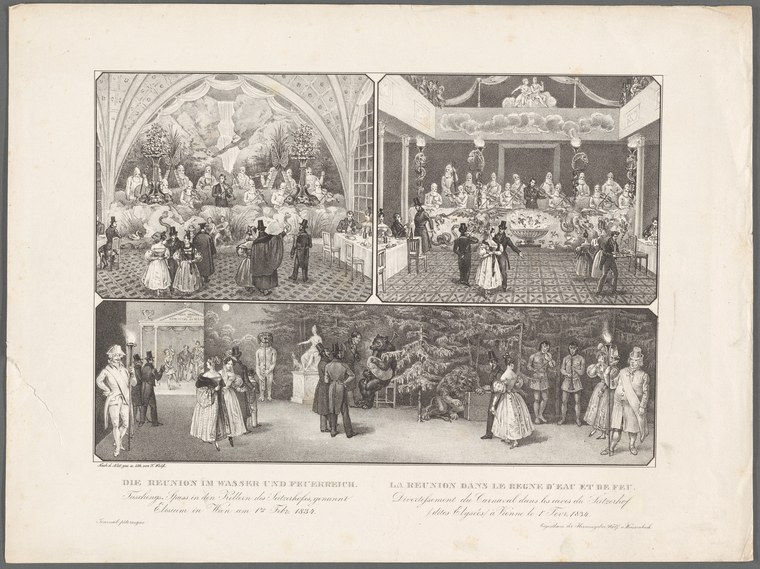
This engraving depicts three separate aristocratic gatherings, each labeled in German, showing formal social dance and dining scenes in palatial interiors. The top left shows a large indoor celebration in a vaulted hall with figures arranged around a central space; musicians play from a gallery above. The top right depicts a formal banquet or ball in an ornate reception room with high ceilings and elaborate drapery, where figures stand and move among tables laden with refreshments. The bottom panel, the largest, shows an outdoor garden or parkland setting where couples and groups scatter across a vast terrace or lawn bordered by trees and architectural features. Throughout all three scenes, the figures are dressed in elaborate 17th- or 18th-century court costume—women in full skirts and fitted bodices, men in breeches, stockings, and formal coats. The perspective and composition emphasize the scale and grandeur of the spaces as much as the people within them.
The dancing
The figures are distributed across space in small clusters rather than unified group formations. In the ballroom and garden scenes, pairs stand close together in what appears to be conversation or courtship posture—upright, formal, often with one figure turned toward another. Arms are held at the sides or gesturing gently; no couples appear locked in closed ballroom position. The outdoor scene shows more dispersal and varied activity: some figures stand in twos or threes, others appear to be walking or promenading. The overall impression is of social mingling, courtship, and display rather than synchronized group dancing. A few figures in the background may be actively dancing, but the focal compositions emphasize the formal greeting and conversation.
The dance depicted
This work documents the fashionable courtly social gatherings of the 17th or early 18th century—the "Reunion" (gathering) of the German title suggests a formal assembly. The scenes likely depict the ritualized dancing, promenading, and social interaction that accompanied court life: minuets, contradances, or the formal walking and positioning characteristic of Baroque courtship and display. No specific dance technique is identifiable from footwork or positioning, as the print emphasizes the social occasion and architectural setting over kinetic detail. The work is more interested in documenting the occasion, the dress, and the social geography than in capturing a moment of active dancing.
How it was made
This is an engraving on paper, recognizable by the fine parallel hatching, crisp line work, and absence of color. The technique allowed for precise detail in architectural elements, costume, and facial features, and the print's existence in a collection indicates it was created for circulation and collecting—likely a commercial print documenting fashionable court life for an educated audience interested in social customs and courtly etiquette. The three-panel composition suggests this was designed as a single sheet showing multiple related scenes, a format common in 17th- and 18th-century didactic and documentary prints.
About this work
This engraving documents formal aristocratic social gatherings, most likely from the German-speaking territories of the 17th or 18th century, showing three linked scenes of court life: an indoor celebration, a formal banquet-ball, and an outdoor garden assembly. The work is as much architectural and sartorial documentation as it is a dance image—the enormous vaulted halls and gardens are the true subjects, with human figures distributed through them as evidence of fashionable use and social hierarchy. The print records not a performance or a unified dance event but rather the ambient social dancing, courtship, and display that constituted court life: the minuets, promenades, and formal interactions through which aristocratic society maintained itself.
How to look at it
Study the distribution of figures across each space and notice that no unified dance formation emerges: this is a record of social mingling and courtship, not synchronized group dance. Look at the architecture first—the vaulted ceilings, the gardens, the proportions of the halls—as these define how the figures move and position themselves. The three scenes together form a typology of courtly occasions: the formal indoor celebration, the dining and refreshment room, and the outdoor promenade. The print is documenting the total social occasion, not isolating a dance moment.
The artist
The artist is not recorded in the catalogue. The engraving's style, technique, and subject matter are consistent with 17th- or 18th-century German or Central European courtly documentary prints, which were often produced anonymously or by workshop hands. Such prints were commercial enterprises, created for collectors and courtly audiences interested in recording and circulating images of fashionable life.
The period
This work dates to the height of the Baroque court system, when elaborate formal gatherings—balls, banquets, and garden festivals—were central to aristocratic life and political display. Minuets and contradances were the fashionable social dances of this era, performed in exactly these settings. The architectural grandeur and careful composition of the scenes reflect the importance of court spectacle to the maintenance of aristocratic power and prestige. Prints documenting courtly life circulated widely among the educated elite and served as records of fashionable practice.
Where it lives
The work is held in the New York Public Library's Prints collection, catalogued as a documentary engraving depicting social customs. It is one of many such didactic prints created for circulation among educated collectors interested in courtly etiquette and fashionable life.
Dance in this work
Questions about this work
What is being danced in these scenes?
The specific dances are not identifiable from the print's imagery alone. Based on the period and setting, the figures likely engaged in minuets, contradances, or formal promenading typical of Baroque court life. The print emphasizes the social occasion and setting rather than technical detail.
Why are the scenes divided into three panels?
The three panels likely depict the sequence of a formal courtly gathering: the opening celebration in the grand hall, the refreshment and social period in the ballroom, and the final promenade in the gardens. Together they document the total arc of a fashionable event.
Who would have owned or viewed this print?
Such prints were created for educated aristocratic and merchant-class collectors interested in documenting and imitating fashionable courtly customs. They circulated among courts and wealthy households as records of contemporary etiquette and social practice.
More dance artwork





