49 works in this view — arrow keys or swipe to move between them.
Dance in Art
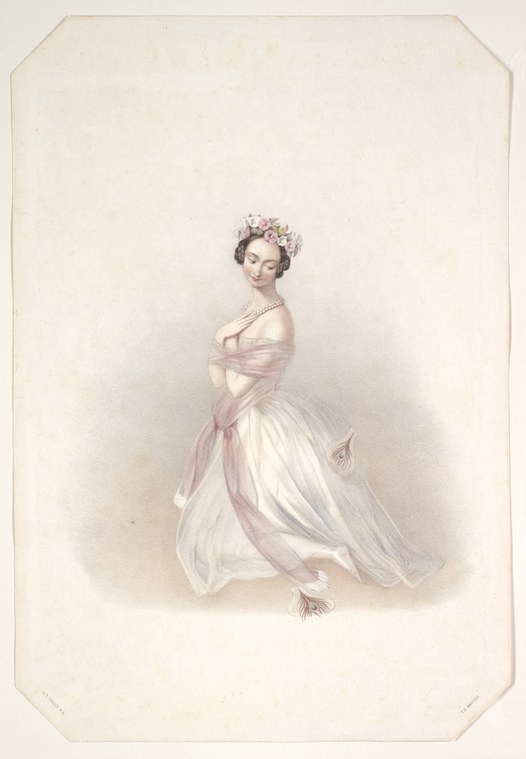
Souvenir d'adieu de Marie Taglioni
Unknown artist
- Collection:
- Prints depicting dance
- Source:
- New York Public Library
- Rights:
- Public domain — free to use, share and adapt.
- Recorded as:
- Public Domain
This print documents the visual conventions and star power of Romantic ballet at its peak, showing how the most celebrated dancers of the era were idealised and distributed to the public. It is also evidence of the flower imagery—particularly the garland or wreath—that became a signature attribute of sylph roles and that persists in ballet portraiture to the present day. For students of 19th-century theatrical culture, it exemplifies the mass production of dance memory through the lithographic print.
What you are looking at
A single female dancer is portrayed in three-quarter view against a plain, luminous background. She wears a white Romantic-era tutu with a fitted bodice and off-shoulder drapery in pale pink, her dark hair crowned with a wreath of flowers. Her pose is captured mid-movement: she stands on her left leg in a lifted, elegant stance, her right leg extended behind or to the side, her arms held in a graceful frame. The figure is rendered with soft shading that gives dimensionality to the fabric and body; the tutu is rendered with particular delicacy, its layers suggested through graduated tone rather than detail. The composition is intimate and formal—a portrait of a dancer rather than a narrative scene—and the pale, almost ethereal quality of the rendering gives the work the character of a commemorative or devotional image.
The dancing
The dancer's weight rests on a strongly pointed left leg, with the supporting hip lifted and rotated. The right leg is extended behind in what appears to be an attitude or arabesque position, with a pointed foot. Her arms are held in a classical frame characteristic of Romantic ballet—one arm extended forward and upward in an elegant line, the other positioned to the side. The head is inclined slightly, the gaze directed downward in a pose of serene introspection typical of Romantic period portraiture. The overall frame suggests trained classical technique and the balletic vocabulary of the mid-19th century.
The dance depicted
This is a portrait of Romantic-era ballet, almost certainly depicting a scene from the repertory of the 1840s–1850s. The title references Marie Taglioni, the Swedish-Italian ballerina who was the defining figure of the Romantic ballet movement and creator of the role in *La Sylphide* (1832). The pose, costume, and floral crown are consistent with the aesthetic of sylph roles—ethereal, otherworldly characters that defined Taglioni's performance style and that of her contemporaries. The inscription 'Souvenir d'adieu' (farewell keepsake) suggests this was made in connection with a farewell performance or retirement, a common occasion for commemorative dance prints.
How it was made
This is a hand-coloured lithograph or engraving, rendered with fine linear detail and subtle tonal gradations. The technique allows for soft modelling of the figure while maintaining crisp definition of the costume and pose. The colouration—pale pinks, whites, and flesh tones against a cream ground—is characteristic of mid-19th-century theatrical portraiture intended for a middle-class market. The size and presentation suggest this was a popular print, likely produced for circulation among ballet enthusiasts and collectors of theatrical memorials.
About this work
This work is a commemorative portrait of one of the 19th century's most celebrated dancers, rendered in a medium that brought theatrical imagery to a mass audience. It documents both a specific performer and the aesthetic ideal of Romantic ballet—the ethereal, pointe-dancing sylph—at the moment of that aesthetic's dominance. The image serves as evidence of how Romantic dancers were marketed, remembered, and idealised in prints made for public consumption.
For a dance historian, this work is valuable as both iconography and cultural document. It shows the standardisation of the Romantic silhouette and pose, the importance of the floral attribute (particularly the flower crown), and the role of lithographic reproduction in creating and sustaining the star system of 19th-century ballet. The title's reference to farewell also points to the ritualised way in which major dancers' retirements were commemorated in popular culture.
How to look at it
Attend to the dancer's pose and how it represents effort disguised as effortlessness—the strongly pointed foot and lifted hip that suggest muscular control, held within a frame of apparent weightlessness. Notice how the artist uses the flower crown not as decoration but as an attribute that identifies the dancer with the sylph or fairy characters of Romantic ballet. The soft modelling of the tutu, which emphasises its material delicacy, was a technical priority in theatrical portraiture of this era; the tutu itself was becoming an iconic symbol of the ballet dancer. Observe too the downturned gaze and the pose's overall quietness—a moment of stillness rather than of spectacular motion—which was the preferred way of depicting Romantic dancers in prints.
The artist
The artist is not recorded in the catalogue. The style and execution are consistent with the commercial theatrical print workshops of Paris and London in the 1840s–1850s, particularly those producing coloured lithographic portraits of opera and ballet stars. The work bears no visible signature and may have been produced anonymously or pseudonymously, as was common for commercial theatrical prints of the period.
The period
This work dates from the height of the Romantic ballet era, when Marie Taglioni and her peers (Fanny Elssler, Carlotta Grisi) dominated European stages. The Romantic movement in ballet—characterised by the dominance of the female dancer, the preference for ethereal and supernatural characters, the development of pointe work, and the aesthetic of weightlessness—was at its artistic and commercial peak in the 1840s. Lithographic reproduction was the primary technology for distributing images of performers to a paying public, and theatrical portraits were a staple of popular print culture. This was also the period of the first great wave of international touring by ballet stars, which created demand for their images across Europe and North America.
Where it lives
This work is held in the New York Public Library's collection of prints depicting dance. It is catalogued under the title 'Souvenir d'adieu de Marie Taglioni,' though the artist and date remain unrecorded. It is a single-sheet theatrical print, likely one of many produced by a commercial workshop.
Dance in this work
Questions about this work
Is this actually a portrait of Marie Taglioni, or just inspired by her?
The title claims it as a 'souvenir' of Taglioni, suggesting it commemorates a specific performance or farewell. However, without a signature or further documentation, we cannot confirm whether the image is a likeness of Taglioni herself or a more generalised representation of the Taglioni style and aesthetic. It is certainly in the tradition of star portraiture associated with her name.
What is the flower crown for?
The floral wreath or garland was both a practical costume element in Romantic ballet roles (particularly for fairy and sylph characters) and a symbolic attribute associating the dancer with nature and the supernatural. It became an iconic identifier of Romantic ballet heroines and persists in ballet imagery today.
Why is she on pointe if this is Romantic ballet?
Pointe work emerged gradually in the 1820s–1830s and became standard in Romantic ballet roles by the 1840s. By the time this print was made, pointe dancing was the signature technique of the Romantic ballerina, even though it was still relatively new and not universal across all roles.
What does 'Souvenir d'adieu' mean?
'Farewell keepsake' or 'memento of departure.' This title suggests the print was made to commemorate a farewell performance, a retirement, or a major parting—a common occasion for releasing special commemorative editions of star performers' portraits.
More dance artwork





