49 works in this view — arrow keys or swipe to move between them.
Dance in Art
Fanny Elssler
Unknown artist
- Collection:
- Prints depicting dance
- Source:
- New York Public Library
- Rights:
- Public domain — free to use, share and adapt.
- Recorded as:
- Public Domain
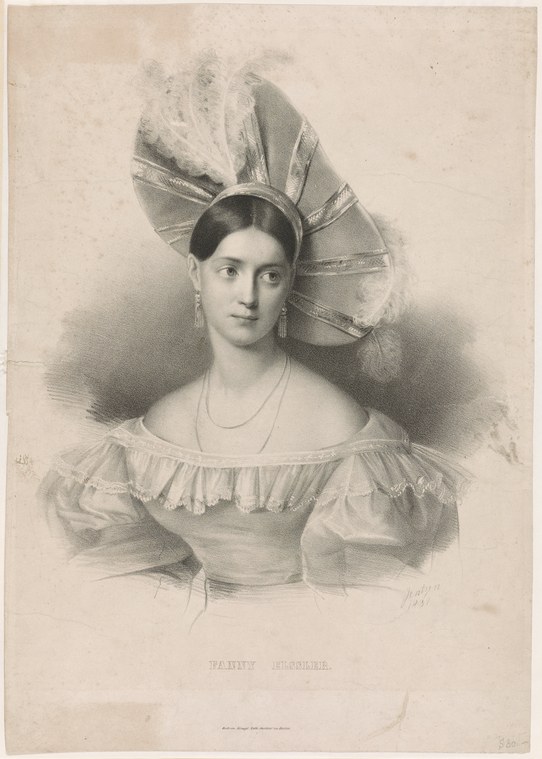
Fanny Elssler was the first female dancer to achieve truly international celebrity, touring Europe and the Americas in the 1830s–40s at a moment when a dancer could become a public figure known beyond the opera house. This portrait was produced as commercial publicity, circulating her image in the thousands; it is therefore evidence of how 19th-century dance was packaged, marketed, and consumed by the public.
What you are looking at
A bust-length portrait of a woman set against a neutral ground, rendered in graphite or lithographic crayon with careful tonal modulation. She faces the viewer directly, her dark hair parted in the center and smoothed close to the head in the style of the 1830s–40s. The most striking feature is an enormous circular headdress—a wide, stiffened collar or frame of sheer fabric, pleated and radiating outward like a halo or cartwheel. It frames her face and rises well above her head. She wears a low, off-shoulder dress with a deep ruched or gathered neckline that exposes her shoulders and upper chest. A simple chain or cord runs across her collarbone. The fabric of her dress appears to be silk or muslin, rendered with fine cross-hatching to suggest volume and drape. The portrait carries the refined, theatrical quality of early-19th-century dance publicity—this is a performer presented as herself rather than in character, yet the costume itself is the statement.
The dancing
The figure is shown in repose, facing frontally with a composed, neutral expression. The shoulders are relaxed and square; the neck is long and gracefully extended. There is no movement frozen here—no turn, leap, or gesture. Instead, the artist has chosen a moment of stillness, perhaps as if between movements or in presentation. The body and gaze are direct and dignified, inviting the viewer to regard the costume as an object of interest and the wearer as a professional object of attention.
The dance depicted
This is a portrait of Fanny Elssler, one of the most celebrated European ballet dancers of the Romantic era, known for her technical prowess and her performance in character dances—particularly the Cachucha, a Spanish dance that became her signature role. The headdress and off-shoulder dress are consistent with early 19th-century Romantic ballet costume, though this portrait appears to show her in formal dress rather than in character. Elssler was famous both as a classical ballerina and as an exponent of national dances. The image captures her as a public figure and star rather than in a narrative or character dance moment.
How it was made
This is a lithographic print or crayon study, created by hand without a named artist in the surviving record. The medium allows for fine tonal gradation and the soft modeling of form visible in the face and neck; the artist has used parallel hatching and stumping to create volume in the dress and shadow across the background. This technique of portraiture was the standard for theatrical publicity of the period—reproducible in quantity for distribution to patrons and the public, yet capable of capturing individual likeness. The quality of execution suggests a skilled commercial portraitist working for a publisher or theatre.
About this work
This is a portrait of the Romantic-era ballerina Fanny Elssler, one of the first international dance celebrities. It is not a record of a dance itself, but rather a theatrical portrait of the dancer as a public figure, displaying the costume and styling that made her an icon. The work belongs in a dance history gallery because it documents how a major dancer of the era was represented, marketed, and seen. Elssler's fame rested on her technical innovation and her performance of character dances outside the classical European tradition—this portrait, with its striking costume, signals that innovation and theatricality.
How to look at it
Study the headdress: it is not a prop or an ornament, but a deliberate assertion of spectacle and foreign/exotic identity—a visual marker of the character dances for which Elssler was known. The off-shoulder pose, unusual in formal portraiture outside the theatre, signals the décolleté required of a stage dancer and distances this from a civil or family portrait. The composure and direct gaze establish her as a professional performing her public self, not a character in a narrative. The artist has chosen not to show her dancing, but to display her as a theatrical object.
The period
This portrait dates to the height of the Romantic ballet era (1830s–1840s), a period defined by the rise of the ballerina as the central figure of the stage and the fashion for exotic and national character dances. Elssler was part of this shift; while her contemporary Marie Taglioni epitomized the ethereal, plotless classical style, Elssler built her reputation on the Cachucha and other Spanish and Italian dances, as well as on legendary technical facility. Lithographic portraiture was the dominant medium for theatrical publicity in this period, cheaper and faster to produce than engraving and capable of wide distribution. Images like this one were sold at the theatre, in galleries, and through print shops, making famous dancers visible to a mass audience for the first time.
Where it lives
This is a lithographic print from the New York Public Library collection of prints depicting dance. It is a mass-produced item of theatrical publicity, likely created in the 1830s or 1840s during or shortly after Elssler's peak fame.
Dance in this work
Questions about this work
Who was Fanny Elssler?
Fanny Elssler (1810–1884) was an Austrian ballet dancer and the first female dancer to achieve international celebrity. She was famous for her technical virtuosity and for her performances of character dances, particularly the Cachucha, a Spanish dance that became her signature role. She toured Europe and the Americas and was a major cultural figure of the 1830s–40s Romantic era.
What is the headdress?
The headdress is a large, stiffened circular collar or frame of pleated sheer fabric, radiating outward from the head. It was characteristic of some Romantic-era dance costumes and served to signal exoticism and theatricality. It may be related to the costume of the Cachucha or other character dances in Elssler's repertoire.
Is this a picture of Elssler dancing?
No. This is a formal portrait of Elssler as a public figure, posed in costume between performances. The artist has chosen stillness and direct presentation rather than capturing a moment of movement. It is documentary of how a star dancer was marketed and represented to the public.
Why was this portrait made and distributed?
This is theatrical publicity—a lithographic print made and sold to capitalize on Elssler's fame. Thousands of such prints were sold at theatres, in galleries, and through print shops, allowing her face and image to circulate widely among the public. It is evidence of the birth of modern celebrity culture and the role of printed reproduction in making famous performers visible beyond the theatre.
More dance artwork





