49 works in this view — arrow keys or swipe to move between them.
Dance in Art
Marie Taglioni
Unknown artist
- Collection:
- Prints depicting dance
- Source:
- New York Public Library
- Rights:
- Public domain — free to use, share and adapt.
- Recorded as:
- Public Domain
Taglioni defined Romantic ballet, and this image captures her in the very pose and costume that made her famous—the simple dress and the lifted, seemingly weightless body that broke with Classical rigidity. For historians of ballet, this print is documentary evidence of how Romantic technique was understood and marketed to contemporary audiences. For dancers, it shows the foundation of modern ballet vocabulary: the emphasis on verticality without stiffness, on naturalism, and on the dancer as a figure of beauty in repose as well as in motion.
What you are looking at
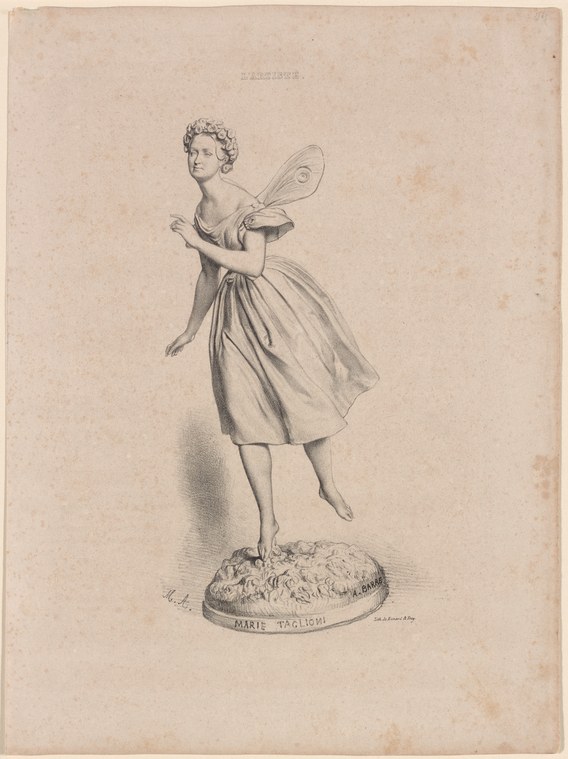
A young woman in Romantic-era dress stands in a graceful, weightless pose against a plain background. She wears a simple, high-waisted muslin dress with short puffed sleeves and a full skirt that falls to just below the knee—the silhouette of the 1830s-40s. Her curled hair is arranged loosely on her head. She holds a small hand mirror in her right hand, tilted forward as if admiring her reflection, while her left arm extends softly at her side. Her body is captured in a characteristic pose of early Romantic ballet: one leg appears to support her weight while the other is subtly lifted, and her torso leans slightly forward with the ease of a dancer at rest between movements. She stands on a rocky or textured base inscribed with her name. The composition is frontal and centered, rendered in fine black ink on cream paper with delicate shading that creates form and dimension.
The dancing
A single female figure in a relaxed but poised stance characteristic of Romantic ballet vocabulary. Her weight is carried on one leg while the other leg is slightly lifted and bent, creating the soft, effortless line valued in this period. Her arms are held away from her body with a gentle curve—the right raised to hold the mirror, the left extended—and her upper back is slightly rounded in a posture of introspection. The pose suggests a moment of pause rather than active step-work; there is no indication of turnout or the rigid verticality of Classical technique, but rather the naturalism and apparent ease that defined Romantic aesthetics.
The dance depicted
This is a portrait of Marie Taglioni, the Swedish-Italian dancer who became the defining figure of Romantic ballet in the 1830s and 1840s. She revolutionized ballet by introducing the pointe shoe, ethereal costuming, and an emphasis on weightlessness and naturalism that transformed the art form. The pose and costume depicted here—particularly the simple muslin dress, modest height, and the gentle, unforced quality of the body—evoke Taglioni's signature style and her famous role in *La Sylphide* (1832), where she danced a supernatural sylph. The image captures her not in mid-performance but in a moment of reflection, holding a mirror that may allude to vanity or self-regard, a common theme in prints and sculptures of celebrated dancers of this era.
How it was made
This is a finely executed line engraving or lithograph, executed in black ink on paper. The artist has used delicate cross-hatching and fine parallel lines to build form and shadow, particularly in the drapery of the dress and the definition of the base. The technique suggests a mid-19th-century commercial print, likely produced for circulation among the ballet-going public and collectors of theatrical imagery. The inscription with Taglioni's name indicates this was a marketed portrait, not a private sketch, and the refinement of the technique speaks to the cultural status of both the subject and the medium of celebrity portraiture in this period.
About this work
This is a celebrity portrait engraving of Marie Taglioni, the Romantic era's most celebrated dancer, captured in a pose that embodies the ethereal, weightless aesthetic she pioneered. The work dates from the height of her fame, when she was reshaping ballet technique and taste across Europe. It combines portraiture with dance documentation: it preserves not her likeness alone but a record of her physical presence and the movement vocabulary she made famous—the soft, natural line and apparent effortlessness that were revolutionary in the 1830s. As a mass-produced print, it speaks to Taglioni's celebrity status and to the appetite among bourgeois audiences for images of the stars who graced the ballet stage.
How to look at it
Notice the pose: the dancer appears to be in a moment of perfect balance and ease, not caught in the middle of a step but suspended in an instant of quiet grace. This was the Romantic ideal—beauty should appear natural and effortless, even though Taglioni's technique was revolutionary. The hand mirror is a key detail: it transforms the image from a simple portrait into an allegory of vanity or self-contemplation, a common theme in prints of female performers. The artist has captured not movement but the illusion of movement—the potential for flight suggested by the lifted leg and the buoyant posture of the upper body.
The artist
The artist is not recorded in the catalogue. The work is signed with initials only, a common practice in commercial printmaking of the 1830s-40s. The engraving technique and the style of the portrait are consistent with the work of theatrical print workshops that flourished in Paris, London, and other major European cities during this period, where demand for images of celebrated dancers was high. Many such prints were anonymous or credited only to the publisher rather than the engraver.
The period
This print was made during the height of the Romantic movement in dance and the visual arts, when the ideal of feminine grace, otherworldliness, and apparent effortlessness came to dominate aesthetic values. The 1830s-40s saw the apotheosis of ballet as a medium for expressing Romantic ideals: dancers increasingly performed in ethereal costumes inspired by sylphs and spirits, and the introduction of the pointe shoe (which Taglioni championed) allowed for new qualities of line and weightlessness. In the visual arts, the Romantic period prized the sketch, the fragment, and the portrait that captured the essence of the subject in a single pose. Celebrity culture was in its infancy, but theatrical stars like Taglioni were among the first to be documented in mass-produced prints for a growing middle-class audience.
Where it lives
The work is held in the New York Public Library's Prints collection, which documents performing arts and celebrity culture across several centuries. Such prints were typically published and distributed by theatrical print shops and music sellers, and many were bound into albums or portfolios for collectors.
Dance in this work
Questions about this work
Who was Marie Taglioni?
Marie Taglioni (1804–1884) was a Swedish-Italian ballet dancer and the most celebrated dancer of the Romantic era. She is credited with pioneering the use of pointe shoes in ballet and with defining the ethereal, weightless aesthetic that became the hallmark of Romantic ballet. Her most famous role was the Sylph in *La Sylphide* (1832), a ballet created specifically for her. She was one of the first dancers to achieve international celebrity status and commanded enormous fees for her performances across Europe and America.
What does the mirror in her hand signify?
The mirror is both a literal attribute of a well-dressed woman of the era and a symbolic one. In allegorical prints of the period, a mirror often suggested vanity or self-regard, themes that were applied to celebrated actresses and dancers with complex irony—celebrating them for their beauty while also implying the transience of that beauty and the moral ambiguity of theatrical fame. The mirror may also simply anchor the image as a portrait of a particular person at a particular moment.
Why is she en pointe if she is standing still?
She is not clearly en pointe in this image; her feet are on the ground. However, the lifted, elongated leg line and the graceful, vertical posture are characteristic of the pointe technique that Taglioni popularized. The overall pose—relaxed but refined—is designed to evoke her signature style and the transformed aesthetics of Romantic ballet, even in a static portrait moment.
What is the purpose of this print?
This is a celebrity portrait, made and sold to the ballet-going public as a souvenir and collectible. Such prints were often published after a famous dancer's successful season and circulated through print shops, music stores, and artistic societies. They served multiple functions: as marketing for the performer, as objects of aesthetic appreciation, and as evidence of the theatrical event for those who had or had not seen the dancer in person. They were also status symbols for middle-class collectors.
More dance artwork





