49 works in this view — arrow keys or swipe to move between them.
Dance in Art
La sylphide
Unknown artist
- Collection:
- Prints depicting dance
- Source:
- New York Public Library
- Rights:
- Public domain — free to use, share and adapt.
- Recorded as:
- Public Domain
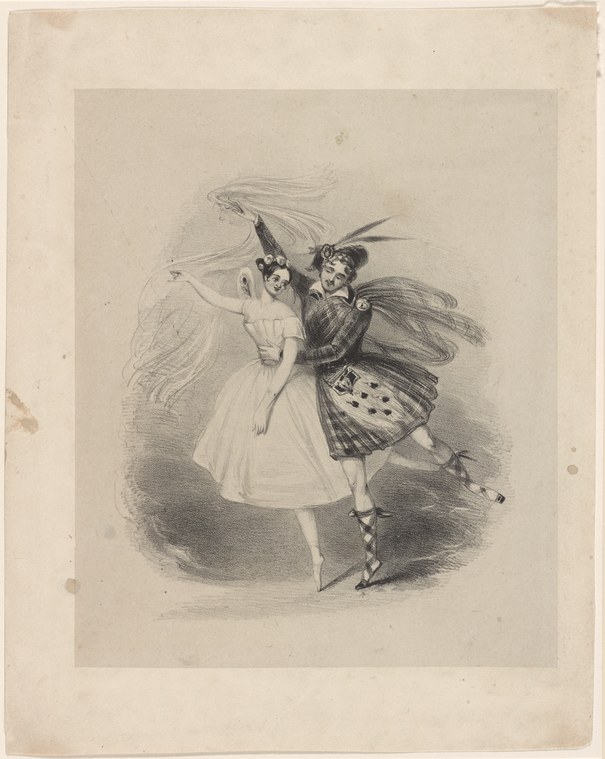
*La Sylphide* was the founding work of romantic ballet, and this engraving is a primary document of how that revolution was visually represented and circulated. For dancers and choreographers, the image shows the physical ideals and partnering vocabulary of the romantic era—the sylph's vertical extension, the male dancer's role as earthbound supporter, and the emotional asymmetry encoded in their pairing. For historians, the print itself is evidence of the theatrical economy of the period: a way of commodifying and reproducing the ephemeral labor of famous dancers.
What you are looking at
Two ethereal female figures in an elegant pas de deux, rendered in black and white engraving. The dancer on the left wears a classical white ballet dress with a fitted bodice and full skirt, poised on the balls of her feet. Her partner, positioned behind and to the right, wears a darker, ornately patterned costume—possibly a male role or supernatural character—with wings or flowing drapery suggested by sweeping lines. Both figures are captured mid-leap or suspension, their bodies angled gracefully across the composition. The lighter figure appears to be lifted or supported by the darker-costumed dancer, their limbs arranged in an idealized, weightless configuration. The background is soft and undefined, rendered in gray tones that dissolve into white, emphasizing the dancers against empty space rather than any theatrical setting. The linear quality of the engraving technique gives the figures an almost ink-sketch immediacy, as though the artist captured the precise instant of an impossible, extended jump.
The dancing
The composition shows two figures in close spatial relationship but asymmetrical in dress and apparent role. The lighter-clad figure maintains an upright, elongated carriage with arms extended in a classical frame, her weight distributed through her feet though lifted from the stage. The darker figure arches behind her, one arm extended to steady or lift the other dancer, creating a supporting gesture rather than a closed ballroom hold. Both bodies are extended vertically and curve slightly; the silhouette suggests that classical ballet port de bras and épaulement (shoulder carriage) valued in the romantic era. The figures do not form a symmetrical pair—the contrast in their costume and the protective/supporting geometry of their embrace suggests a narrative or character differentiation rather than mutual social dancing.
The dance depicted
This is almost certainly *La Sylphide*, the most celebrated romantic ballet of the 19th century, first choreographed in 1832. The pairing of a mortal male dancer (in darker, earthly dress) with a supernatural sylph in white tulle identifies the narrative moment: the moment of romantic desire and the impossible union between human and spirit. The composition captures the essence of romantic ballet's central conflict: the sylph is weightless, ethereal, otherworldly—captured here in the elongated line and the sense of suspension—while the male dancer is earthbound and protective, unable to truly possess her. The engraving shows how the role was performed in the romantic era: pointe work suggested by the dancer's elevated carriage, the sylph portrayed as literally above or outside ordinary space, the partnership as one of pursuit rather than social exchange.
How it was made
This is a steel or copper engraving, likely executed in the 1830s–1840s, created from the image by incising fine lines into metal plate and printing the result. The technique allows for precise linear detail and a range of tones achieved through closely spaced parallel lines (hatching and cross-hatching). The gray tones in the background and the dancers' bodies are built up through this tonal hatching, while the white of the sylph's dress is left largely unworked, creating visual contrast. The medium was ideal for theatrical prints of this period: engraved reproductions of celebrated dance moments could be mass-produced and distributed to audiences and collectors, making famous dancers and roles visible across Europe. The style suggests either a direct illustration from a contemporary dance scene or a reproduction of a larger painting.
About this work
This engraving depicts one of the most iconic moments in romantic ballet: the encounter between the earthly and the supernatural in *La Sylphide*. The work captures the aesthetic ideals of 1830s ballet—weightlessness, ethereality, the impossible romance between human and spirit—through the careful composition of two figures in dance contact. The contrast between the classical white costume of the sylph and the darker dress of her mortal suitor encodes the narrative and emotional stakes of the ballet within the image itself. As a widely circulated print, it served to memorialize celebrated performances and disseminate the visual language of romantic ballet to audiences who may not have witnessed the ballet itself. The engraving thus documents not only a specific choreographic moment but also the apparatus by which romantic ballet was made culturally visible and reproducible in the 19th century.
How to look at it
Notice the asymmetry between the two dancers: the sylph appears almost suspended, her feet barely touching the ground, while the male dancer is more grounded and active in his support. The white dress of the sylph is rendered by the absence of line—the whiteness is the paper itself—which makes her appear to float above the darker tones of the background and her partner's clothing. Look at the arm positions: they follow the classical vocabulary of ballet, with the sylph's arms opened and extended, suggesting lightness and freedom, while her partner's arms frame and contain her. The moment frozen here is not a stable pose but a transient instant of lift and yearning—the technique of the engraving, with its fine hatching and precise line, is paradoxically used to suggest weightlessness and impossible grace.
The period
*La Sylphide* premiered at the Paris Opéra in 1832 and inaugurated romantic ballet as a European phenomenon. The ballet emerged at a moment of intense interest in the supernatural, the medieval, and the irrational—themes that animated romantic literature, visual art, and music across the 1820s–1840s. The role of the sylph, danced in the premiere by Marie Taglioni, became the emblem of romantic femininity in ballet: weightless, passive, elusive, defined by her distance from human desire. The engraved print was one of the primary technologies for circulating and commemorating this new aesthetic. Dance historians recognize such prints as crucial evidence of how 19th-century ballet actually looked and was understood by its contemporary audience.
Where it lives
This engraving is held in the New York Public Library's collection of prints depicting dance. Such prints were produced throughout the 19th century as commercial illustrations of celebrated ballet roles and performances, distributed to theater audiences, collectors, and the broader public. The work is an artifact of the theatrical print trade that made famous dancers and roles visible beyond the opera house.
Dance in this work
Questions about this work
Is this definitely La Sylphide?
The title on the catalogue record identifies it as such. The visual content strongly supports this: the pairing of a mortal male dancer in darker costume with a weightless female figure in white classical dress is the signature image of the ballet, repeated across hundreds of 19th-century prints and paintings. No other ballet of the era carries this visual signature so distinctly. However, without access to signatures, inscriptions, or publication information, complete certainty is not possible from the image alone.
Who danced this role?
The ballet was created for Marie Taglioni at the Paris Opéra in 1832, and she remained the most celebrated sylph of the era. Many other dancers performed the role in the decades that followed. Without additional information (artist attribution, publication date, performance venue), we cannot determine which dancer or production this engraving documents.
What is the darker-costumed figure?
In *La Sylphide*, the mortal male dancer is typically a Scottish peasant or nobleman (James). The darker, ornate costume and the protective gesture he makes toward the sylph indicate his earthly nature and his role as the human subject of the sylph's unattainable desire. Some romantic-era productions gave the male role supernatural or allegorical dimensions; the exact character depends on the production.
Why is she in white and why is he in darker clothes?
The white tulle dress became the emblem of the romantic ballet heroine—weightless, pure, ethereal, supernatural. The darker costume distinguishes the male figure as earthbound and mortal. This visual encoding of narrative and theme through costume color is central to romantic ballet aesthetics. The contrast also serves the engraver: white and dark create maximum graphic impact in a black-and-white print.
More dance artwork





