49 works in this view — arrow keys or swipe to move between them.
Dance in Art
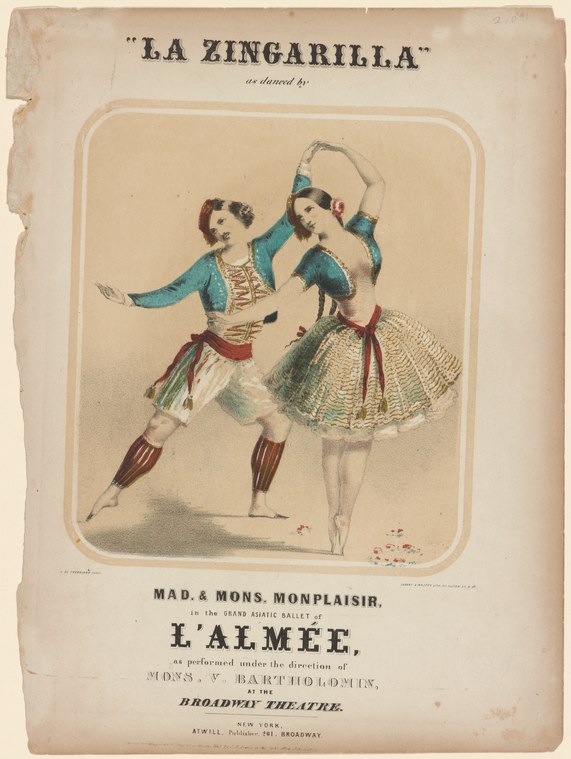
La zingarilla,: as danced by Mad. & Mons. Monplaisir, in the grand Asiatic ballet of L'almée, as performed under the direction of Mons. V. Bartholomin, at the Broadway Theatre.
Unknown artist
- Collection:
- Prints depicting dance
- Source:
- New York Public Library
- Rights:
- Public domain — free to use, share and adapt.
- Recorded as:
- Public Domain
This image is a rare visual record of how Romantic-era ballet was actually danced and costumed, captured by someone with enough choreographic understanding to render anatomically credible positions. For historians and dancers, it bridges the gap between written descriptions of nineteenth-century ballet and the living practice—showing us the silhouette, the line, the apparent speed and control of performers like the Monplaisirs, who were among the most celebrated dancers of their era. It also documents the reach of European ballet to America and the commerce of theatrical stardom in the 1850s.
What you are looking at
This is a hand-colored lithographic print of a pas de deux from the 1850s, likely a promotional image for a theatrical production. Two dancers in full theatrical dress occupy a shallow, neutral stage space. On the left, a male dancer in a deep teal jacket with ornate frogging, a beaded or embroidered waistcoat, and dark burgundy stockings extends one leg in an attitude devant, his arm lifted gracefully. His partner, on the right, wears a voluminous tulle skirt with a decorative ribbon waistband and a fitted teal bodice, posed en relevé with one arm raised overhead in a classical position. Both dancers are rendered with careful attention to anatomical precision and the fashionable silhouettes of mid-nineteenth-century stage costume. The print employs soft, naturalistic lighting that models the figures without harsh shadows, typical of the lithographic process. The composition is framed by a simple rounded-corner border, centering the dancers as the sole focus.
The dancing
Both dancers are captured in what appears to be a moment of sustained, elevated partnered work. The male dancer's weight appears to be on his supporting leg, with the raised leg in a high, clean extension—a position requiring significant strength and control. His partner balances en relevé (on the balls of her feet), her spine extended and her raised arm following the classical épaulement (shoulder line) of the period. The two dancers are separated in space but clearly related, suggesting a structured duet rather than close contact; the geometry of their poses—his horizontal line, her vertical lift—creates a visual symmetry. Their bodies communicate technical competence and the balletic vocabulary of the era, though the exact relationship between them is ambiguous: this could be a moment between phrases, or a lifted presentation of the two dancers as separate soloists within a shared space.
The dance depicted
This depicts an excerpt from *L'Almée*, a grand ballet performed at the Broadway Theatre in New York under the direction of Mons. V. Bartholomin, featuring the celebrated partnership of Mademoiselle and Monsieur Monplaisir. The title 'La Zingarilla' (The Little Gypsy) indicates this was one of the acts within the larger work—a common structure in mid-century ballet, where a full evening consisted of a series of national or character dances within a dramatic frame. The Monplaisirs were a prominent French-Italian dancing family known for virtuosity in both classical and character work, and the style evident here—the high extensions, the pointe work, the romantic-era costume vocabulary—confirms this as theatrical ballet of the mid-nineteenth century. The 'Asiatic' designation in the full title may refer to the setting or narrative context of the larger ballet, a common theatrical conceit of the period.
How it was made
This is a hand-colored lithograph, a technique that allowed rapid, economical reproduction of theatrical imagery for promotional and commercial purposes. The design has been printed in black or dark gray, and color has been applied by hand in a limited palette—teal, burgundy, cream, and pale pink—with watercolor or similar pigment. Lithography allowed for softer, more naturalistic rendering than wood engraving, and the medium's characteristic slight graininess is visible in the background and drapery. As a printed promotional image produced for Broadway audiences, it would have been distributed as a souvenir, advertisement, or theatrical memorabilia, making it a primary document of how dance was marketed and understood in mid-nineteenth-century New York. The publisher's mark—Awell, 791 Broadway, New York—confirms Broadway distribution.
About this work
This is a mid-nineteenth-century lithographic print documenting a moment from *L'Almée*, a grand ballet mounted at New York's Broadway Theatre and performed by the celebrated dancers Mademoiselle and Monsieur Monplaisir. It captures 'La Zingarilla,' a character act within the larger work, and preserves visual evidence of Romantic-era stage practice: the costumes, the technical vocabulary, the partnering conventions, and the aesthetic of the era. Such prints were the primary means by which American audiences encountered detailed images of European ballet stars and repertory, and this example is both a document of theatrical history and a beautiful artifact of nineteenth-century theatrical commerce.
How to look at it
Attend to the precision of the extended leg and the clarity of the supporting structure—the artist has rendered the male dancer's weight distribution with anatomical accuracy, showing the alignment of his supporting side from foot to shoulder. Notice the female dancer's relevé position; she is not simply 'up on her toes' but appears to have the controlled, sustained lift characteristic of trained classical technique. The print freezes a moment of presentation rather than maximum action—a common choice in ballet portraiture, which often showed dancers in poses that demonstrated technical mastery rather than the moment of greatest spectacle. The symmetry of the composition, with the two dancers balancing each other across the frame, reflects the nineteenth-century convention of presenting the star pair as equal partners in display.
The artist
The artist is not recorded. The print was published by Awell at 791 Broadway, a commercial print distributor, and was likely created by a theatrical lithographer or designer working in New York in the 1850s. Such promotional prints were often unsigned or credited only to the publisher; the lithographer may have worked from a sketch, a photograph (if available), memory of a performance, or a commission from the theater itself. The quality of the anatomical rendering suggests someone with either dance training or close familiarity with the stage.
The period
This print dates from the height of the Romantic ballet era in America, when European stars regularly toured and American theaters competed to present them. The Monplaisirs were prominent among these touring artists. The theatrical practice evident here—the structure of a full evening built from a series of character and national dances, the dominance of the pointe vocabulary, the romantic-era tutu and costuming—was the dominant mode of ballet in the 1850s. This was also a period of rapid growth in American theater and theatrical commerce; Broadway was becoming the center of theatrical life, and lithographic prints like this were mass-produced souvenirs and advertisements that shaped audience expectations and memory. The image captures ballet at a moment between the early Romantic period (1830s–1840s) and the later classical consolidation of the Petipa era.
Where it lives
This print is held in the New York Public Library's collection of prints depicting dance. It was published by Awell, a Broadway-area print distributor, and was likely sold as a souvenir or theatrical memorabilia in the 1850s.
Dance in this work
Questions about this work
Who were the Monplaisirs?
Mademoiselle and Monsieur Monplaisir (also Monplaisir) were members of a prominent French-Italian dancing family who were among the most celebrated performers of the mid-nineteenth century. They were known for virtuosity in both classical ballet and character dance, and toured extensively in Europe and America. The Monplaisirs performed extensively at major theaters including the Broadway Theatre in New York.
What does 'L'Almée' mean, and what kind of ballet was it?
L'Almée (The Almehs, or Dancing Girls) was a 'grand ballet' with an Orientalist or Eastern setting, typical of mid-nineteenth-century theatrical practice. Such works were structured as a series of acts, each featuring national or character dances within a narrative frame. The 'Asiatic' designation indicates the work's exotic setting. 'Zingarilla' (Little Gypsy) was one act or scene within the larger work, likely a character dance in Gypsy style.
How can you tell this is ballet and not another form of dance?
The evidence is visual and technical: the high extensions, the pointe work visible in the female dancer's elevated position, the romantic-era tutu (the voluminous tulle skirt with fitted bodice), the classical arm positions and épaulement, and the upright carriage all indicate classical theatrical ballet of the Romantic period. The theatrical context—Broadway Theater, a named work with a narrative title—confirms this is ballet rather than social, folk, or vernacular dance.
Is this a photograph or a drawing?
This is a lithograph—a print made from a stone or metal plate, hand-colored after printing. You can see the characteristic slight grain and softness of the medium. It is not a photograph (which would have different visual properties) and not a drawing in the fine-art sense, but a commercial print made for distribution and sale as theatrical memorabilia.
More dance artwork





