49 works in this view — arrow keys or swipe to move between them.
Dance in Art
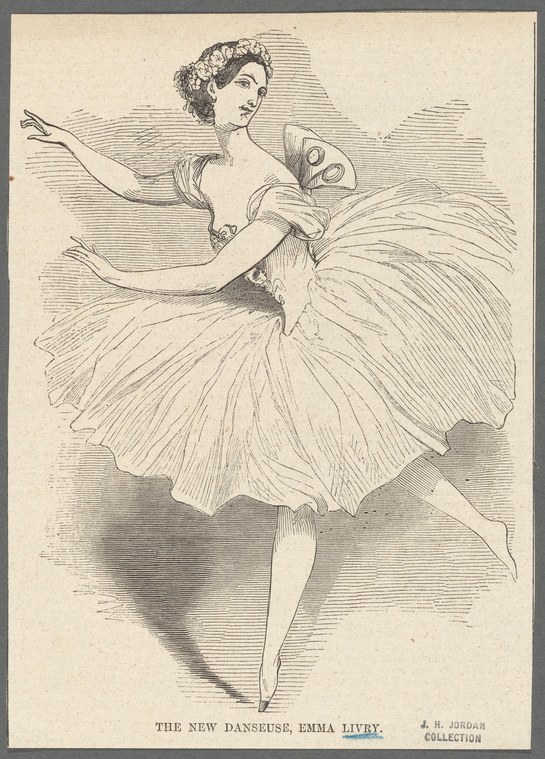
The new danseuse, Emma Livry
Unknown artist
- Collection:
- Prints depicting dance
- Source:
- New York Public Library
- Rights:
- Public domain — free to use, share and adapt.
- Recorded as:
- Public Domain
Emma Livry was historically important as one of the last great dancers of the Romantic ballet era in Paris, and her career was cut short by a horrific accident in 1862 when her costume caught fire on stage—a tragedy that exposed the extreme danger of the flammable fabrics used in ballet at the time and led to reforms in theatrical safety. This engraving documents her at her height, in the costume and vocabulary that made her famous, and serves as a visual record of how Romantic ballet technique and aesthetics were embodied and celebrated.
What you are looking at
A young woman in Romantic-era ballet costume dominates the composition, shown mid-leap or sustained in an impossibly weightless moment. She wears a fitted bodice with off-shoulder drapery and the characteristic bell-shaped tutu of the 1850s–60s, its layers rendered with delicate parallel lines that suggest the volume and translucency of tulle. Her left leg extends high and pointed behind her, her right bent beneath, her torso upright and graceful. Her arms are raised in a soft frame, left arm extended sideways, right arm curved upward, the gesture both elegant and controlled. Her hair is pulled back in the fashion of the period. She wears what appears to be wings—small, ornamental appendages at her back, identifying her as a supernatural or sylph-like creature. The background is rendered in soft cross-hatching that creates atmosphere without distraction, allowing the figure to float free in the composition. The print technique is wood engraving or fine line engraving, giving the image a crisp, jewel-like quality.
The dancing
A single figure captured in what appears to be an elevated position—either en relevé, in a jump, or in the sustained illusion of weightlessness that Romantic ballet demanded. The torso is held in perfect vertical alignment; the supporting leg (right) is turned out and bent; the working leg extends in a high arabesque or attitude derrière, fully pointed. The arms frame the body in the soft, rounded positions characteristic of Romantic choreography, with no tension or angularity. The overall carriage suggests balletic training at the highest level: the dancer has complete control over a technically demanding line.
The dance depicted
This is Romantic ballet, almost certainly a representation of Emma Livry, who was a celebrated Paris Opera dancer in the 1850s and early 1860s. The wings, the ethereal costume, and the impossible lightness of the pose are all hallmarks of the Romantic ballet repertoire, in which human dancers took on supernatural or sylph-like roles. The title explicitly names Livry as "the new danseuse," suggesting this is a promotional or commemorative print circulated during her performing years. The technical vocabulary visible here—the sustained height, the turnout, the pointed foot, the refined arm position—documents the classical ballet vocabulary as it was being codified in the mid-nineteenth century.
How it was made
This is a wood engraving or fine steel engraving, a reproductive print technique that allowed detailed work and was suited to wide distribution. The medium's capacity for fine parallel lines (visible in the tutu, wings, and background) creates a luminous, atmospheric effect, with the figure rendered in high contrast against the softer background. Engraving was the standard medium for theatrical and celebrity portraiture in the mid-nineteenth century, making this the kind of image that would have been sold as a souvenir to theatre-goers and dance enthusiasts. The NYPL attribution to the "A. H. Jocelyn Collection" suggests this was part of a curated series of dance and theatrical prints.
About this work
This is a mid-nineteenth-century wood or steel engraving depicting Emma Livry, a celebrated Romantic ballet dancer, in a moment of weightless grace. She is captured mid-leap or in sustained elevation, dressed in the tutu and off-shoulder bodice of the Romantic era, with ornamental wings that mark her as a supernatural being. The print documents both the physical technique and the aesthetic ideology of Romantic ballet: the emphasis on ethereal lightness, the turned-out legs and pointed feet, the soft arm positions, and the illusion of defying gravity. It is a artifact of mid-nineteenth-century theatrical celebrity and a record of how Romantic ballet dancers were marketed and remembered.
How to look at it
Look at the articulation of the feet and legs: the working leg is fully pointed and extended high, the supporting leg is turned out and bent—this is the classical ballet vocabulary at mid-nineteenth-century pitch. Notice the arm position: soft, rounded, never rigid, creating a frame around the body rather than a dramatic gesture. The upward gaze and the slight tilt of the head contribute to the sense of otherworldly composure. The wings and the floating quality of the pose are the engraver's attempt to render the stage illusion of supernatural being—to show the dancer not as a human woman performing, but as the character she embodied. The technique of fine parallel lines gives the tutu an airy, translucent quality that mimics the actual material and adds to the weightless effect.
The artist
The artist is not recorded in the catalogue. However, the print's high technical quality and the inscription identifying it as from the A. H. Jocelyn Collection suggest it was produced by a professional engraver working for the Parisian theatrical press in the mid-nineteenth century. Jocelyn may have been a collector or publisher; the collection itself documents the visual culture of nineteenth-century French dance.
The period
This engraving was made during the height of the Romantic ballet era (roughly 1830–1870), when European ballet was dominated by ethereal, supernatural themes and by the idealization of weightlessness and grace. The 1850s and 1860s were the final decades of this aesthetic; by the 1870s, ballet technique would begin to shift toward the more athletic, virtuosic vocabulary associated with the Russian Imperial Ballet and later modern revivals. Emma Livry danced during this twilight moment, performing in works like La Sylphide and Giselle, which defined the Romantic repertory. The engraving is contemporary with or shortly after her performances, making it a document of live performance practice at a time when photography of theatre was still rare and expensive.
Where it lives
This is a print from the NYPL's collection of prints depicting dance, catalogued as coming from the A. H. Jocelyn Collection. No other provenance information is recorded. It is a circulating promotional or commemorative print, the kind that would have been sold to audiences at the Paris Opera or through theatrical print sellers during Livry's performing years.
Dance in this work
Questions about this work
Who was Emma Livry?
Emma Livry (1842–1863) was a French ballet dancer at the Paris Opera, celebrated for her roles in Romantic ballets including La Sylphide and Giselle. She was known for her technical refinement and ethereal quality. Her career ended tragically in 1862 when her costume caught fire during a performance at the Opéra-Comique in Paris; she died from her injuries a year later. Her death became a catalyst for safety reforms in theatrical costume design.
What does 'the new danseuse' mean?
The title suggests this engraving was made early in Livry's career as a celebrated dancer, when she would have been introduced to the public as a rising star or a new principal dancer. It was common for theatrical prints to label performers this way to mark a debut or a new season.
Why does she have wings?
The wings identify her character as supernatural—a sylph, fairy, or spirit rather than a mortal woman. In Romantic ballet, such wings were part of the costume and were essential to the visual narrative. The most famous role requiring wings was the Sylph in La Sylphide, one of Livry's signature roles.
How was this print made?
This is a wood engraving or steel engraving, a technique that allowed fine detail and was used to reproduce theatrical portraits for mass circulation. The engraver worked from a drawing or painting, cutting lines into a hard surface (wood or steel) so that ink could be applied and the image printed. This medium was standard for theatre publicity and souvenir prints in the nineteenth century.
More dance artwork





