49 works in this view — arrow keys or swipe to move between them.
Dance in Art
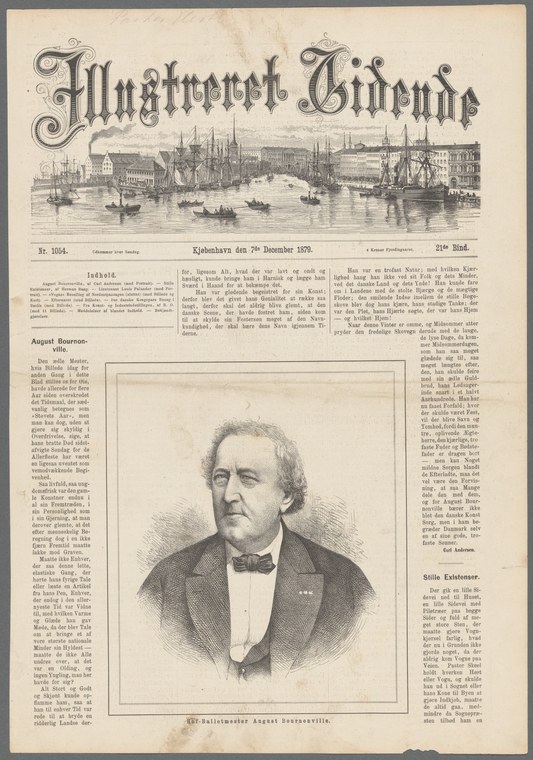
Hof-Balletmester August Bournonville
Unknown artist
- Collection:
- Prints depicting dance
- Source:
- New York Public Library
- Rights:
- Public domain — free to use, share and adapt.
- Recorded as:
- Public Domain
Bournonville's codification of ballet technique—emphasizing controlled épaulement, flowing port de bras, and a particular musicality—became a competing standard to the Italian Cecchetti method and continues to be taught in conservatories worldwide. This image marks the moment of his death and the cultural recognition of his legacy; it is evidence that the ballet world and the broader European reading public recognized his work as historically significant.
What you are looking at
This is a portrait engraving of a distinguished gentleman in formal 19th-century dress, presented as the frontispiece to an illustrated periodical. The subject wears a dark coat with a white shirt front and bow tie, his gaze direct and his expression grave. The engraving is surrounded by text in German, indicating this is from *Illustreret Tidende* (Illustrated Times), a Danish publication dated 19 December 1879. Above the portrait runs a panoramic engraving of Copenhagen's harbor and cityscape, showing multiple sailing vessels and steamships on the water, the spires and rooflines of the city rising beyond. The layout is typical of 19th-century periodical design: the portrait occupies the center of the page, flanked by columns of dense text.
The dancing
The subject is shown from the chest up in a three-quarter view, his posture upright and dignified. There is no dance gesture or movement implied; the figure is stationary and composed for formal portraiture. His hands are not visible. The presentation is that of official commemoration rather than the capture of motion.
The dance depicted
The caption beneath the portrait reads 'Hof-Balletmester August Bournonville,' identifying the subject as August Bournonville, the celebrated Danish Royal Ballet master and choreographer. Bournonville (1805–1879) was one of the most influential figures in 19th-century ballet, responsible for creating and codifying the Bournonville Method, a distinctive approach to classical ballet technique emphasizing fluidity, épaulement, and a particular aesthetic of port de bras. This image does not depict dance itself but rather commemorates a historical figure central to ballet's development. It appears to be a memorial portrait, as Bournonville died in 1879 and this periodical date (19 December 1879) falls shortly after his death.
How it was made
This is a wood engraving or steel engraving, a reproductive printmaking technique that allowed mass circulation of portraits and images through the periodical press. The fine line work and tonal modeling visible in the face and clothing are characteristic of 19th-century engraved portraiture. The panoramic cityscape above is executed in the same technique. The presence of dense German-language text surrounding the image indicates this was a European publication with wide readership. The engraving technique made it possible to reproduce this portrait accurately and affordably in thousands of copies, serving the commemorative and journalistic function of the periodical.
About this work
This is a commemorative portrait engraving of August Bournonville, the Royal Danish Ballet master, published in the illustrated periodical *Illustreret Tidende* in December 1879, shortly after his death. Though the image itself is a formal portrait rather than a representation of dance, it documents one of the most consequential figures in ballet history. Bournonville's method and aesthetic shaped classical ballet technique and practice across the 19th century and beyond. The periodical publication indicates that his death was a significant cultural event warranting immediate public commemoration in the illustrated press.
How to look at it
This is a portrait of a person, not a dance image, so approach it as historical documentation and commemoration rather than as a representation of movement or technique. What is worth noting is that Bournonville is presented here not as a dancer or performer but as an authority figure—formally dressed, grave in expression, and identified by his title 'Hof-Balletmester' (Court Ballet Master). This reflects the status of ballet masters in the 19th century as figures of institutional power and artistic authority. The context of the periodical and the cityscape above situate him within a specific place and moment in European cultural history.
The period
August Bournonville lived through the height of Romantic ballet (1830s–1850s) and into the transitional period when ballet was professionalizing and systematizing its technique. He was working during an era when multiple competing methods of ballet training were being codified—Cecchetti in Italy, Vaganova in Russia, and Bournonville's approach in Denmark. By 1879, when this portrait was published, ballet had already begun to shift away from the narrative and emotional focus of Romanticism toward greater technical display and athletic virtuosity. Bournonville's death marked the end of an era of ballet practice tied to a specific royal court (Copenhagen's) and a particular aesthetic sensibility.
Where it lives
This engraving comes from the *Illustreret Tidende* (Illustrated Times), a Danish periodical from 1879, and is held in the New York Public Library's collection of prints depicting dance. The New York Public Library's Dance Division collected images related to dance history, meaning this portrait was acquired because of Bournonville's significance to ballet history, not as a general periodical artifact.
Dance in this work
Questions about this work
Was August Bournonville a dancer as well as a ballet master?
Yes. Bournonville was trained as a dancer and performed in Copenhagen's Royal Theatre before becoming ballet master. He danced throughout much of his career while also creating new ballets and teaching. His method emerged from his own practice as a performer and his observations of other ballet traditions across Europe.
Why is this in a dance gallery if it is just a portrait?
Because Bournonville's contributions to ballet technique and aesthetics were so significant that his image has documentary and historical value to dancers and dance historians. The portrait marks a pivotal moment—his death—in the history of ballet practice. His method remains actively taught and performed today.
What is the Bournonville Method?
The Bournonville Method is a codified approach to classical ballet technique that emphasizes smooth épaulement (coordination of the arms and upper body with the legs), fluid port de bras (carriage of the arms), and an integration of technique with musical phrasing. It represents a distinctive aesthetic that developed in the Danish Royal Ballet and continues to influence ballet training worldwide.
When did Bournonville die?
Bournonville died on 6 August 1879. This portrait was published in December 1879, four months after his death, as part of the European press's commemoration of his life and legacy.
More dance artwork





