49 works in this view — arrow keys or swipe to move between them.
Dance in Art
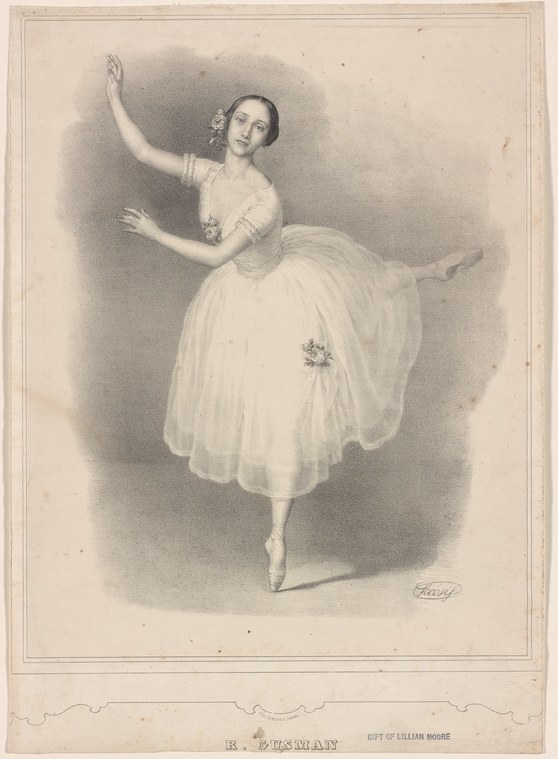
R. Gusman
Unknown artist
- Collection:
- Prints depicting dance
- Source:
- New York Public Library
- Rights:
- Public domain — free to use, share and adapt.
- Recorded as:
- Public Domain
This is documentary evidence of Romantic ballet in its defining moment—a single, unstaged image that captures the whole aesthetic: weightlessness, ethereality, refined feminine line, and the dancer as a floating rather than earthbound creature. For dancers and choreographers studying the period, it is a visual record of how the body was held, extended, and displayed. For historians of dance portraiture, it exemplifies the shift from the heavier, more grounded dancing of the early nineteenth century to the aerial, weightless style that dominated Romantic ballet.
What you are looking at
A single female dancer in a white tulle skirt occupies the center of a gray-toned composition. She is captured mid-leap or suspension, her body weightless against a soft, atmospheric background. Her left arm is raised and slightly curved; her right arm extends to the side in a graceful line. Her legs are in a scissor or split position, one bent and drawn beneath her, the other extended behind. She wears a pale, short-sleeved bodice with a corseted waist, and her dark hair is parted in the center and pulled back simply. A small floral corsage or brooch sits at her hip. The figure is rendered in fine grayscale—engraved or lithographed—with delicate shading that gives her muslin skirt volume and movement. There is no scenery, no other dancers, no floor indicated: she floats in an abstract space, the entire image dedicated to the isolated moment of her elevation.
The dancing
The dancer's frame is open and extended, with an elongated, upward-reaching quality. Her center of gravity is lifted; she appears weightless, suspended at the apex of a jump or leap. Both arms are held away from the body in gentle curves—the classic épaulement of early nineteenth-century dance. Her legs read as a vertical scissor, with the lower leg folded and the upper leg stretched. Her posture is erect and controlled despite the apparent ease of the flight. The raised arm and extended leg create a diagonal line that gives the composition its sense of ascension and refinement.
The dance depicted
This is Romantic-era ballet, almost certainly depicting the kind of elevation and lightness that defined the style in the 1830s and 1840s. The signature white tulle skirt, the pale satin slippers (just visible), the simplified bodice, and above all the effortless floating quality are the visual grammar of Romantic ballet. The title 'R. Gusman' most likely refers to the dancer—possibly Rosita Gusman or a performer known by that name—and this is a portrait of a celebrated dancer in her signature role or in the ethereal idiom her audience knew her by. The image prioritizes the dancer's ability to appear weightless and ethereal, the central aesthetic of the period.
How it was made
This is a lithograph or fine engraving, rendered in grayscale with skilled manipulation of tone and line. The soft atmospheric background and the delicate modeling of the figure suggest lithography, which allowed for subtle gradations of shading and an intimate, almost painterly effect. The technique was ideal for dance portraiture of the era: it could capture both the precision of the dancer's line and the romantic softness her admirers valued. The print's circulation as a theater souvenir or fashionable print meant it reached a broad audience of dance-goers and society.
About this work
This is a Romantic-era ballet portrait, capturing a celebrated female dancer in the emblematic pose of her generation—suspended, ethereal, weightless. The dancer (likely Rosita Gusman or another performer of that name) is shown in the white tulle and pale satin that defined Romantic ballet aesthetics. The image is a lithograph or fine engraving, a medium perfectly suited to capturing the dancer's celebrated line and the dreamy, atmospheric quality her audiences associated with the dance form. It belongs in a dance history collection as a primary record of how dancers of the 1830s–1840s moved, how they were perceived, and what their bodies were expected to do: appear to defy gravity.
How to look at it
Look at the dancer's feet: they are pointed and barely skimming an invisible ground, emphasizing weightlessness. Notice the arms and how they frame the body without strain—this was the Romantic ideal of effortless grace. The absent background is deliberate; it isolates the dancer and denies her any earthly context. The artist chose to freeze the moment of greatest elevation, not the preparation or landing, to maximize the impression of ethereal flight. The soft tonal modeling (rather than hard line) reinforces the dreamlike quality Romantic ballet audiences craved.
The artist
The catalogue record identifies the print only as 'R. Gusman,' likely the dancer's name rather than the artist's. The engraver or lithographer is unknown. This is typical of theater prints and dance portraits of the period, which often credited the dancer rather than the printmaker. The technique and style suggest a professional theatrical print shop, probably Parisian or London-based, working in the 1830s–1840s.
The period
The Romantic era in dance (c. 1830–1850) was marked by a radical shift in aesthetic values. The pointe shoe and the ethereal white tulle skirt emerged as symbols of an otherworldly, supernatural ideal—dancers were expected to appear to float, to embody sylphs and spirits rather than human beings grounded in gravity. Lithography and fine engraving boomed as a medium for distributing portraits of celebrated dancers to an enthusiastic public. Dance prints were collected, pasted into albums, and exchanged as tokens of admiration. This portrait sits within a flourishing culture of theatrical celebrity and the visual commodification of the dancing body.
Where it lives
This print is held in the New York Public Library's collection of prints depicting dance. It is a theater souvenir or fashionable dance portrait, one of thousands produced for sale and distribution to admirers in the mid-nineteenth century.
Dance in this work
Questions about this work
Who was Rosita Gusman?
The catalogue record does not identify her beyond the name on the print. She was likely a celebrated dancer of the Romantic era, active in the 1830s–1840s, whose name was recognizable enough to print and sell. Many dancers of the period are now known only through such prints.
Why is she wearing white?
White tulle became the uniform of Romantic ballet in the 1830s. It signified the dancer's otherworldliness and elegance, and it was practical for movement—light, flowing, and visible from a distance. By the time this print was made, a white tulle skirt was instantly legible as 'Romantic ballet dancer.'
What is the dance?
We do not know the specific ballet. This is likely a portrait of the dancer in a celebrated role or in the ethereal style she was known for, rather than a record of a particular narrative ballet. The pose—a vertical leap with extended arms—was the signature moment of Romantic ballet and would have been recognizable to any contemporary viewer.
Why is the background empty?
To focus attention entirely on the dancer's body and line. This was a convention of dance portraiture: the dancer was isolated against a neutral or atmospheric ground so that the viewer's eye stayed on the figure and its geometry. It also emphasizes the dancer's ethereality and independence from earthly context.
More dance artwork





