49 works in this view — arrow keys or swipe to move between them.
Dance in Art
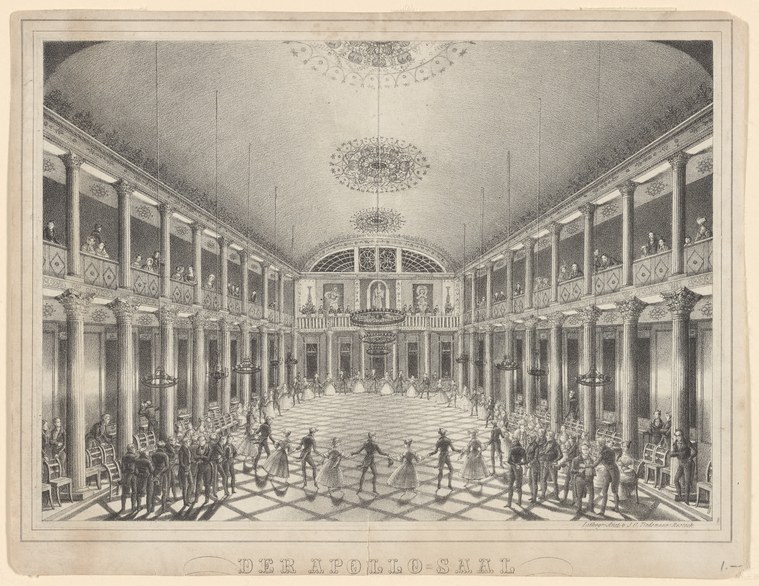
Der Apollo-Saal
Unknown artist
- Collection:
- Prints depicting dance
- Source:
- New York Public Library
- Rights:
- Public domain — free to use, share and adapt.
- Recorded as:
- Public Domain
This engraving is valuable as a historical document of the relationship between architectural design and courtly dance practice. It shows how the geometric spaces of the baroque saal—with their symmetrical colonnades and formal floor patterns—literally shaped and enabled the geometric, processional dances that occurred within them. For dance historians, it is a rare record of the actual dancing spaces of the 18th-century court, rendered with enough precision to allow study of proportions, sight lines, and the capacity for large ensemble dances.
What you are looking at
A grand ceremonial ballroom or saal is depicted in architectural perspective, stretching from foreground to a distant apse with a semicircular window. The space is defined by a colonnade of paired columns on both sides, creating a formal arcade. The ceiling is coffered and decorated with ornamental rosettes. A geometric floor pattern—likely a checkerboard or diamond design—extends the length of the hall. Dozens of figures in formal 18th-century dress are distributed throughout: some clustered in groups along the sides, others scattered across the floor in pairs or small formations. The lighting suggests interior illumination, with particular brightness on the floor and architectural elements. The composition emphasizes the monumental proportions of the space and the formal, ritualized nature of the gathering. This is clearly a space designed for courtly or aristocratic social assembly.
The dancing
The figures are rendered in miniature relative to the architecture, emphasizing the grandeur of the saal. Most dancers visible are arranged in pairs or small groups, many appearing to be in upright, formal postures consistent with 18th-century courtly bearing. Some figures appear to be stationary, while others seem to be moving through the space; without closer detail, their exact holds and frames are not fully legible. The scale of the engraving and the distance enforced by perspective make individual footwork invisible, but the overall composition suggests ordered, processional movement rather than free improvisation.
The dance depicted
This is almost certainly a formal court dance in an 18th-century German or Central European aristocratic setting. The title 'Der Apollo-Saal' (The Apollo Hall) suggests a specific, named venue. The formal dress, the geometric floor pattern, the architectural severity, and the choreographed distribution of figures all point to a minuet or another baroque courtly danse d'école. The emphasis on processional order and geometric floor design is consistent with the choreographed group structures of quadrilles or contredanses, though the formal seriousness and the single-sex groupings visible in parts of the image suggest the more ceremonial, less recreational dancing of the court.
How it was made
This is an engraving, rendered in fine linear hatching to suggest light and shade, with careful attention to architectural perspective and the diminution of figures toward the distance. The technique allows for precise delineation of architectural detail while the scale of the saal permits the inclusion of numerous figures without loss of clarity in the foreground. Engravings of this type—formal, large-format, architectural in emphasis—were produced for court documentation and circulation among the nobility, serving as records of ceremonial spaces and events.
About this work
Der Apollo-Saal is a formal record of an 18th-century German or Austrian aristocratic ballroom rendered as an architectural engraving. The work documents not the choreography itself but the ceremonial space and courtly gathering that housed formal dance—likely minuets, quadrilles, or contredanses. It belongs in a dance archive as evidence of the material and social context of court dancing: the monumental spaces built to contain it, the formal dress prescribed for it, and the ordered, processional character of the event itself. The saal as depicted is architecture in service of a carefully choreographed social ritual.
How to look at it
Attend first to the perspective: the engraver has used extreme linear perspective to dramatize the depth and grandeur of the saal, making the ballroom itself, not the dancers, the true subject. Notice the geometric floor pattern and its continuation toward the vanishing point—these grid structures were not decoration but the literal framework within which minuets and contredanses were choreographed. Look at how the figures are distributed: they occupy precise positions in the space, suggesting choreographed placement rather than free movement. The formal dress, the posture of the figures, and their distance from the viewer all reinforce that this is a serious, documented, ceremonial event.
The period
The Apollo-Saal belongs to the 18th century, when formal court dancing in Germany and Austria was at its height. The minuet and contredanse dominated aristocratic social life; the quadrille emerged mid-century. Such ballrooms were built as expressions of princely power and cultivated taste. The engraving form itself—formal, expensive, produced for distribution to court circles—reflects the serious, documented status of these dances in aristocratic culture. The image testifies to a period when dance was inseparable from architecture, music, costume, and courtly ceremony.
Where it lives
The work is held in the NYPL prints collection as part of a broader series documenting dance imagery. It is catalogued as a historical print and is part of the institution's collection of European engravings.
Dance in this work
Questions about this work
What is the Apollo-Saal?
The Apollo-Saal was a real ballroom in 18th-century German or Austrian aristocratic architecture, named in honor of Apollo, the classical god of music and dance. Specific documentation of which court housed it requires further research, but such named saals were significant venues for formal court ceremonies. The engraving is a record of the space itself and the kind of formal social gathering it was built to contain.
What dances would have been performed here?
Based on the period and formal architecture, primarily minuets, contredanses, and quadrilles. The geometric floor and the orderly positioning of figures are consistent with the choreographed group structures of these dances. The minuet, in particular, was the centerpiece of 18th-century court life and would have been the primary dance in such a formal setting.
Why is the architecture so prominent?
In 18th-century court culture, the ballroom itself was a statement of power and taste. The architect and the dance master worked together to ensure the space could accommodate the geometric patterns and processional movements of formal dances. This engraving prioritizes the saal because the space was inseparable from the dances it contained—it was not merely a container but a partner in the choreography.
Can we see what the dancers are actually doing?
The scale and distance enforced by the perspective make footwork impossible to discern, and most figures are too small to read their exact holds or frames. What we can see is the formal posture, the paired and grouped arrangement, and the geometric distribution across the floor—all of which is consistent with 18th-century courtly dance practice. The engraving prioritizes record over movement detail.
More dance artwork





