49 works in this view — arrow keys or swipe to move between them.
Dance in Art
Danse cosaque...Mademoiselle Fanny Elssler
Unknown artist
- Collection:
- Prints depicting dance
- Source:
- New York Public Library
- Rights:
- Public domain — free to use, share and adapt.
- Recorded as:
- Public Domain
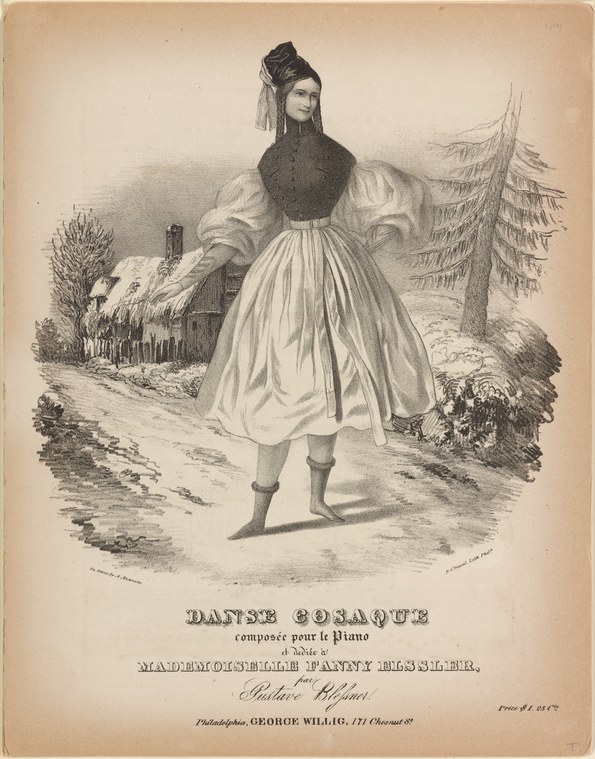
Elssler's character dances were as central to 1830s Romantic dance as Taglioni's pointe work, yet they are far less visible in ballet history. This image shows why: character dance leaves no technical legacy in the form of codified technique, and prints like this are among our best evidence of what audiences actually saw and valued. The stance, the costume, the solo format, and the landscape framing all belong to Romantic theater, not classical ballet.
What you are looking at
A young woman in theatrical costume stands alone in a mountainous landscape, posed in a moment of arrested motion. She wears a dark corseted bodice with voluminous white skirts that billow around her legs, paired with dark stockings and shoes. Her head is crowned with an elaborate tall headdress adorned with what appears to be feathers or fabric, and a gossamer veil trails from it. The setting is romantic and exotic: behind her rise snow-capped evergreen trees and rocky peaks rendered in soft etching lines. The composition places her as the solitary focal point, her weight shifted onto one leg, her posture suggesting a pause mid-performance rather than a static pose. The print is titled "Danse cosaque" (Cossack Dance) and credits Mademoiselle Fanny Elssler, the great Romantic-era dancer.
The dancing
The dancer stands in profile-frontal position with her weight clearly on her right leg; her left leg is bent and lifted slightly, suggesting the moment just before or after a springing motion characteristic of folk steps. Her arms are not prominently featured—the voluminous sleeves and skirts dominate the silhouette. Her torso is upright and her gaze directed forward, conferring dignity and focus. The pose is singular: one dancer alone, not part of a corps or couple, making this a solo portrait-performance.
The dance depicted
The work depicts what was marketed as a "Cossack Dance" (Danse cosaque) in the Romantic ballet tradition. Elssler was celebrated for character dances and national types during the 1830s–40s, and this costume—the tall headdress, the full skirt, the folk styling—aligns with the exotic and ethnographic fascination of Romantic dance. The lifted, bouncing leg and the springing readiness of her stance suggest the energetic allegro steps typical of character dance. This is not classical ballet, though Elssler was trained in both; it is the "character" or national-character genre that allowed her fame to rival that of the pointe-dancing Taglioni.
How it was made
This is a hand-colored engraving, likely produced in Philadelphia by George Willis (whose name and address appear at the lower left) for a commercial print market. The medium allowed rapid reproduction and wide circulation—such prints were souvenirs of celebrated performances and were sold to a middle-class public. The soft modeling achieved by fine cross-hatching renders the dancer's form and the atmospheric landscape; the hand-coloring (in sepia and grays) adds subtlety. The technique was standard for theatrical portraiture of the 1830s–40s, and the quality suggests a professional theater print house rather than a fine-art publisher.
About this work
This engraving documents Fanny Elssler performing a character dance styled as a Cossack number, a vehicle for the technical and dramatic prowess of one of the Romantic era's greatest dancers. Elssler was celebrated for character and national dances—Spanish, Italian, Scottish—and rivaled Marie Taglioni in popularity during the 1830s–40s. The image preserves not a classical ballet moment but a performance type that has largely vanished: the solo character dance as a showcase of virtuosity and exoticism. It shows us Elssler at the height of her powers, mid-career, and documents the theatrical world that celebrated both ethereal romance (Taglioni's domain) and fiery, earthbound character dancing (Elssler's triumph). The print reached audiences who would never see her perform on stage, making it a key artifact of how Romantic dance was consumed and remembered.
How to look at it
Observe the precise moment the artist has chosen: a dancer in repose between steps, her weight shifted, her body tensed as if to spring. The solitude of the figure in the vast landscape is deliberate—it echoes Romantic painting's fascination with the isolated figure in nature, while emphasizing the dancer as the sole focus of spectacle. Note the contradiction between the ethereal, weightless tutu and the earthbound, muscular stance and lifted leg; this tension between ethereality and earthiness is the heart of Elssler's art. The tall headdress and the veil are markers of exotic origin and theatrical fantasy, not realism. The engraver has rendered fabric and atmosphere with fine gradations of line, making this a technically sophisticated print.
The artist
The engraving is credited to George Willis of Philadelphia. Willis was a commercial theatrical print publisher active in the mid-19th century, producing hand-colored engravings of celebrated performers, dancers, and theatrical scenes for a popular market. These prints were sold at theaters and print shops and were collected by theatergoers and dance enthusiasts. Willis did not typically sign work as a fine artist; he was a reproductive print maker serving the entertainment industry.
The period
The 1830s and 1840s were the height of Romantic ballet, a period in which dance celebrated otherworldly femininity (Taglioni, La Sylphide) but also embraced exotic national types and character dances as vehicles for technical display. Fanny Elssler's success was built on this dual appeal: she was a virtuoso technician who excelled in the character dance roles—the Cachucha, the Sylphide, the Polish mazurka. She toured Europe and America extensively (visiting the U.S. in 1840–42), and her performances generated enormous quantities of prints, lithographs, and engravings. The hand-colored engraving was the standard medium for theatrical publicity and souvenir prints in this era, before photography displaced the form. The Romantic period also saw a surge of ethnographic and orientalizing subjects in dance and visual art: artists and choreographers mined European folk traditions and (often imaginatively) non-European cultures for color and authenticity.
Where it lives
The print is held in the New York Public Library's collection of prints depicting dance. It is a commercial theatrical print, one of many produced by George Willis in Philadelphia during the mid-19th century. Such prints were ephemeral objects, created for immediate consumption and sale, yet many survive in public collections.
Dance in this work
Questions about this work
Who was Fanny Elssler?
Fanny Elssler (1810–1884) was an Austrian dancer who became one of the two greatest ballerinas of the Romantic era, rivaling Marie Taglioni. While Taglioni embodied ethereal, otherworldly grace, Elssler excelled in character dances—technically brilliant, earthy, and exuberant. She was celebrated for dances like the Cachucha (a Spanish dance) and the Sylphide. She performed throughout Europe and made a triumphant tour of the United States in 1840–42.
What is a Cossack Dance?
The "Cossack Dance" was a stage character dance, not an ethnographically accurate folk dance. Romantic-era choreographers created such pieces to showcase national character and exotic appeal. They drew loosely on European and non-European folk traditions but were designed as vehicles for technical display and theatrical effect. The costume, the lifted leg, and the rhythmic energy all belong to the stage version.
How was this print made and sold?
This is a hand-colored engraving, a commercial print made by a theater print publisher. The engraver cut an image into a copper plate, inked it, and printed it on paper; a colorist then hand-applied watercolor or ink. Such prints were sold at theaters, print shops, and through the mail, making them affordable souvenirs for theatergoers and dance enthusiasts. They were mass-produced but individually finished, and they were the primary means of circulating theatrical images before photography.
What dance style is this?
This is character dance (or national-character dance), a category within Romantic ballet that celebrated national and exotic types. It was distinct from classical ballet's ethereal, plotless forms and required both technical virtuosity and dramatic personality. Character dances often drew on folk sources but were stylized for the stage. Elssler dominated this genre in a way that Taglioni, her great rival, did not.
More dance artwork





