49 works in this view — arrow keys or swipe to move between them.
Dance in Art
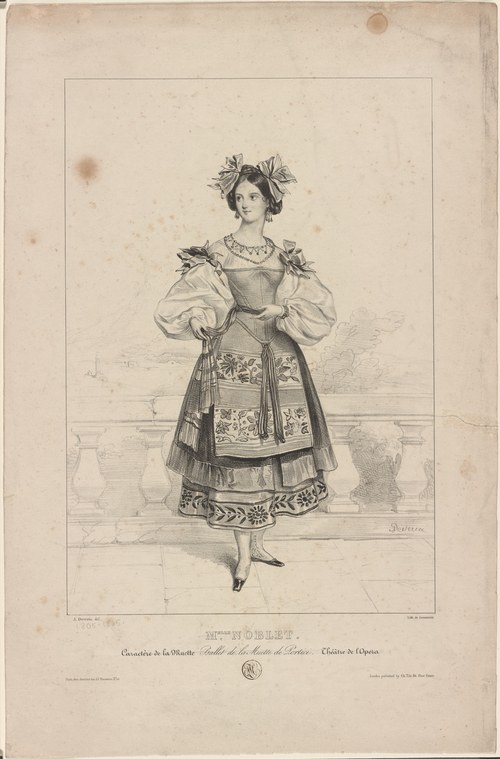
Melle. Noblet, caractère de la muette, ballet de La muette de Portici, Théâtre de l'Opéra
Unknown artist
- Collection:
- Prints depicting dance
- Source:
- New York Public Library
- Rights:
- Public domain — free to use, share and adapt.
- Recorded as:
- Public Domain
For dancers and historians, this print documents the emergence of character dance as a substantial theatrical genre in early Romantic ballet, and shows how a leading Parisian dancer was publicized and remembered. It also provides concrete visual evidence of early 19th-century theatrical costume, performance presentation, and the aesthetics of character dance before it was systematized into the national dances (Czardas, Tarantella, etc.) of later ballet vocabulary.
What you are looking at
A full-length portrait of a female dancer in elaborate early 19th-century theatrical costume, standing center stage against a minimal backdrop of classical architecture—a portico with urns visible in soft perspective behind her. She wears a richly decorated dress combining the Romantic ballet silhouette with what appears to be character dance elements: a fitted corset bodice in darker fabric with short puffed sleeves, topped by an ornamental headdress with feathers or plumes, and a voluminous skirt that falls to mid-calf with deep decorative borders featuring patterned embroidery or brocade. The skirt itself shows a contrast between lighter upper panels and darker lower bands of embellishment, suggesting the kind of elaborate national or regional costume associated with dramatic ballet. The figure is posed in a dignified, frontal stance with arms at rest in a position of repose, one hand slightly forward, the other at her side. The engraving is finely detailed, with careful attention to the texture and patterns of the fabrics and the delicacy of the dancer's features and posture.
The dancing
The dancer stands in an upright, presentational pose characteristic of theatrical portraiture of the period—not captured mid-movement but rather in a dignified formal stance. Her carriage is erect and proud; the weight appears evenly distributed with both feet planted, suggesting stability and authority rather than the suspended, weightless quality of pure ballet. Her arms are relaxed and positioned asymmetrically, the left slightly extended as if acknowledging an audience. The pose conveys both the technical control of a trained dancer and the character-dance persona she embodies in costume.
The dance depicted
This is a portrait of Mlle. Noblet performing a character role (likely a Polish or Hungarian maiden, based on the costume detail) in *La Muette de Portici* (The Deaf Girl of Portici), a major vehicle for dramatic dance at the Paris Opéra in the 1820s-30s. The work itself was an opéra comique that became famous as a ballet spectacle. Rather than capturing a moment of choreographic movement, the engraving preserves the costume and theatrical identity of a celebrated dancer in a specific role—a form of dance documentation common in 19th-century theatrical prints. This is evidence of how principal dancers were celebrated and circulated as public figures, and how the character dance (as opposed to pure classical ballet) was presented in costume albums and prints.
How it was made
This is a fine engraving, likely a steel or copper engraving on paper, executed with precise line-work to capture both the delicate modeling of the face and the complex pattern and texture of the theatrical costume. The technique allows for sharp detail and wide circulation—this was a commercial theatrical print, part of a documented series of Opéra performers and roles, intended for sale to audiences and collectors. The inscription below the image in French names the performer and the role, confirming it as part of a systematic documentation of celebrated dancers and their signature roles. Engraving was the dominant technology for reproducing images of performers in this period, before photography.
About this work
This is a theatrical portrait engraving documenting Mlle. Noblet in a character dance role from *La Muette de Portici*, a major 19th-century French opéra comique that featured elaborate dance spectacle. The work sits at the intersection of three practices: the documentation of celebrated performers, the representation of character and national dances within the Romantic ballet era, and the commercial circulation of theatrical imagery through prints. It belongs in a gallery of dance imagery because it preserves both the visual identity of a principal dancer and the costume and movement aesthetic of character dance as it was understood and performed in 1830s Paris.
How to look at it
Look first at the costume: the hybrid aesthetic of character dress (the ornamental headdress, the patterned skirts, the decorated bodice) combined with the silhouette of Romantic ballet (the fitted waist, the calf-length skirt). Notice the artist's attention to the texture and pattern of the fabrics—this was a work meant to preserve the richness of the role for people who could not see it on stage. Observe the dancer's pose: the upright, self-possessed carriage and the asymmetrical arm placement convey both classical training and theatrical presentation. This is a portrait of a performer in role, not a captured moment of choreography—a different kind of dance documentation than later theatrical photography.
The artist
The engraver is not identified in the catalogue record. The print was issued by a commercial Parisian theatrical print publisher and is part of a documented series, suggesting it was produced by a workshop or publishing house specializing in theatrical portraiture rather than a single named artist. Such prints were typically based on sketches or paintings of celebrated performers and were produced in series as commercial products for the theatre-going public.
The period
This print dates to the period of Romantic ballet's emergence in Paris (approximately 1820s-1830s), when the Opéra was the center of European dance innovation and when dancers were beginning to be celebrated as international celebrities through the circulation of prints and engravings. *La Muette de Portici* itself was a landmark work that demonstrated how opera and ballet could be combined to create spectacular theatrical entertainment. Character dance—dances in regional or national costume and idiom—was becoming a standard element of romantic ballet plots, offering contrast to the ethereal classical vocabulary. The engraving reflects the commercial and cultural infrastructure that celebrated and disseminated images of famous dancers.
Where it lives
The print is held in the Prints collection of the New York Public Library and is part of NYPL's extensive archives of 19th-century theatrical imagery. It is one of a series of character dance and operatic roles performed by celebrated dancers of the period, issued as commercial prints for sale to theatre-goers and collectors.
Dance in this work
Questions about this work
Who was Mlle. Noblet?
Mlle. Noblet was a principal dancer at the Opéra in Paris during the 1820s-30s, celebrated for roles in the major spectacle productions of the day. She was known for character and dramatic dance as well as classical technique. Like other leading dancers of her era, she was commemorated in theatrical prints that preserved her image in her signature roles.
What is La Muette de Portici?
*La Muette de Portici* (The Deaf Girl of Portici) was an opéra comique first performed in 1828, based on a historical story of a deaf girl during a rebellion in Naples. It became famous as a vehicle for spectacular dance and pantomime, combining operatic and balletic elements. The work was revolutionary in bringing historical spectacle and social themes to the Opéra.
What does 'character dance' mean in this context?
Character dance refers to dances performed in national, regional, or folk costume and style, in contrast to the ethereal, technique-focused classical ballet vocabulary. In Romantic ballet, character dances provided local color and dramatic specificity to narrative plots. They used turned-out positions and balletic technique but with different carriage, footwork, and aesthetic effect—heavier, earthier, more rooted.
Why is this an engraving and not a photograph?
This print predates the widespread use of photography for theatrical documentation. Engraving was the primary technology for reproducing and circulating images in the 1820s-30s. It allowed for wide distribution and commercial sale, making it possible for theatre-goers to own images of celebrated performers they had seen on stage.
More dance artwork





