49 works in this view — arrow keys or swipe to move between them.
Dance in Art
La jolie fille de Gand
Unknown artist
- Collection:
- Prints depicting dance
- Source:
- New York Public Library
- Rights:
- Public domain — free to use, share and adapt.
- Recorded as:
- Public Domain
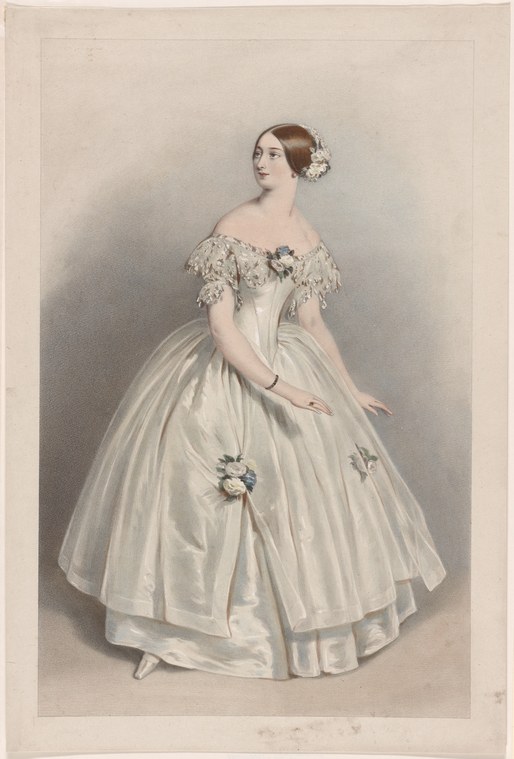
This print preserves the silhouette, construction, and styling of mid-19th-century ballet costume in vivid detail, showing how the Romantic ideal was actually executed and presented to audiences. It also documents the role of commercial printmaking in the theatrical economy: these were mass-produced objects that made famous dancers accessible to people who could not afford theatre tickets, shaping how dance was understood and desired.
What you are looking at
A young woman in an elaborate white ball gown stands in three-quarter view against a neutral background, her body angled slightly to the left. She wears a off-shoulder dress with short puffed sleeves trimmed in lace or embroidered detail, the neckline low and curved. The skirt is voluminous and constructed in multiple layers of sheer white fabric—likely tulle or muslin—creating a sculptural silhouette that falls to the ankles; the hem is gathered or pleated to increase fullness. She holds a small bouquet of flowers in her right hand, positioned at waist level. Her left arm hangs naturally at her side. Her hair is pulled back smoothly and adorned with a decorative comb or ornament on one side. The lithograph employs subtle tonal gradation to model the figure, with gentle shading to suggest the volume of the skirt and the contours of the bodice. The background is featureless, directing attention entirely to the figure and her costume.
The dancing
The dancer is depicted in a standing pose with weight evenly distributed and posture upright and dignified. There is no active stepping or turning in progress—this is a presentational stance, the kind a performer would hold while acknowledging applause or being introduced to an audience. Her arms are not in a dance frame; the right arm is raised slightly to display the flowers, while the left simply hangs. The pose suggests poise and composure rather than the momentum or extension characteristic of an active dance sequence.
The dance depicted
This is not a depiction of dance in action, but rather a theatrical portrait of a dancer or ballet performer in costume and repose. The date and dancer are unknown, but the dress and presentation conventions point to mid-19th-century Romantic-era ballet. The flowers and the formal presentation suggest this may be a portrait distributed after a performance, a common practice in theatre. The title *La jolie fille de Gand* (The Pretty Girl of Ghent) is likely the name of a ballet or theatrical piece, and the print may have served as a souvenir or promotional item celebrating a specific dancer in a particular role.
How it was made
This is a hand-colored lithograph, identifiable by the soft tonal transitions and the characteristic crayon marks visible in the background shading. The delicate coloring—primarily pale blues, greys, and flesh tones—is applied over a lithographic stone print. The technique allowed for relatively inexpensive mass production, making theatrical portraits of this kind widely available to audiences and collectors. The quality of the work and the careful attention to fabric texture suggest this was a professional commercial product, likely sold in theatre lobbies or through print dealers to commemorate popular performers and roles.
About this work
This is a mid-19th-century lithographic portrait of a Romantic-era ballet dancer in performance costume. The image documents both the aesthetic ideal of the period—the ethereal, voluminous white gown that became synonymous with Romantic ballet—and the commercial circulation of dance imagery in the 19th century. Such prints served as both souvenirs and promotional tools, celebrating celebrated performers and roles to audiences who could not attend every performance. The work belongs in a dance archive as evidence of how ballet was visualized, marketed, and consumed in popular culture.
How to look at it
Look at the construction of the skirt: the layers of fabric, the careful pleating at the hem, the way the tulle catches light. This is not artistic invention but documentation of actual stage costume. Notice the pose: the dancer is standing still, composed, facing the viewer. This is a formal portrait convention borrowed from fine art, not a moment of dance in progress. The flowers are a deliberate detail—they reference both the floral adornment worn in performances and the tradition of gifting flowers to celebrated performers after shows. This is a document of how a dancer was presented and remembered.
The artist
The artist is not recorded. The quality of draftsmanship and production suggests a professional theatrical print workshop, likely based in Paris or another major European theatre center. Such prints were typically produced by collaborative studios rather than individual named artists, with responsibility split between the lithographer, colorist, and publisher.
The period
The 1840s-1860s were the height of Romantic ballet in Europe, when Giselle, La Sylphide, and La Peri dominated the stage. The cult of the ballerina—the celebration of individual dancers as celebrities—was at its peak, and lithographic portraits were a primary means of circulating their images. Audiences bought these prints as souvenirs, gifts, and collectibles, much as they would purchase photographs or lobby cards later. The white tulle skirt had become the uniform of Romantic ballet, codifying an ideal of weightlessness and otherworldliness that persisted for decades.
Where it lives
This work is held in the New York Public Library's collection of prints depicting dance. It appears to be a commercial theatrical souvenir from the mid-19th-century European stage, likely collected as part of a larger archive documenting dance history and costume.
Dance in this work
Questions about this work
Is this a real performance or a posed portrait?
It is a posed portrait. The standing, frontal position and the formal presentation are studio or promotional conventions, not a captured moment of dancing. However, the costume is authentic theatrical dress from an actual ballet or theatrical role, and the print likely commemorated a real performer in a specific role.
What does the title mean?
La jolie fille de Gand translates to 'The Pretty Girl of Ghent.' This is likely the name of a ballet, theatrical piece, or role. The print was probably sold to audiences after performances as a keepsake.
Why are there so many layers in the skirt?
The layered tulle construction was the defining silhouette of Romantic-era ballet. Multiple layers created volume and lightness, supporting the visual metaphor of weightlessness and otherworldliness central to Romantic ballet. The layers also allowed the skirt to move and settle in ways that silk alone could not.
How was this printed?
This is a hand-colored lithograph. An image was drawn on a limestone plate, which was then inked and printed onto paper. The color was applied by hand afterward, layer by layer, by specialist colorists. This allowed prints to be produced in quantity at moderate cost, making them affordable souvenirs.
More dance artwork





