49 works in this view — arrow keys or swipe to move between them.
Dance in Art
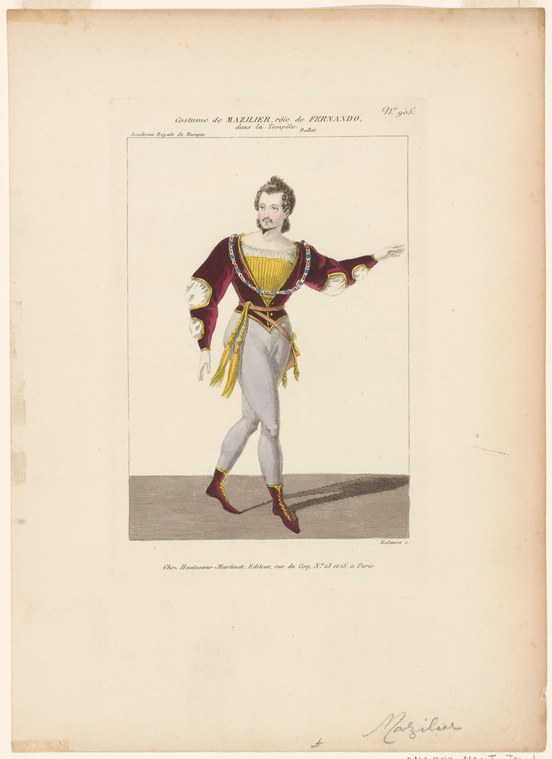
Costume de Mazilier, rôle de Fernando, dans La tempête, ballet, Académie royale de musique
Unknown artist
- Collection:
- Prints depicting dance
- Source:
- New York Public Library
- Rights:
- Public domain — free to use, share and adapt.
- Recorded as:
- Public Domain
Costume studies like this one are among the few surviving visual records of how Romantic ballet was actually performed—the body carriage, the turnout, the arm positions, and the relationship between dramatic action and academic technique. The specificity of the role attribution (Fernando in *La Tempête*) allows this image to be cross-referenced with librettos, cast lists, and music to situate it within the exact repertory of the Paris Opéra, making it invaluable for reconstructing a lost performance tradition.
What you are looking at
A male dancer in early 19th-century theatrical costume stands in a classical contrapposto pose against a neutral ground. He wears a deep maroon velvet jacket trimmed with gold braid and buttons, paired with a yellow-gold satin waistcoat and pale breeches. Red-heeled shoes with black stockings complete the ensemble. His right arm extends outward in an open gesture, while his left hangs at his side; his weight rests on his back leg, creating an elegant S-curve through his torso. His posture and positioning suggest a moment of dramatic address or flourish—the frozen instant of a theatrical gesture rather than active locomotion. The economy of the composition—a single figure against white paper—emphasizes the precision of his stance and the formality of his presentation.
The dancing
One male dancer shown at full length in a classical theatrical pose. His weight is shifted onto his back leg, the front leg extended and turned out, creating the foundation for a formal balletic or demi-caractère stance. His torso leans slightly forward; his head is held upright and turned three-quarter toward the viewer. The right arm frames the body in an open, expressive gesture; the left arm curves gently. The posture and arm carriage are consistent with early Romantic ballet technique, suggesting training in the academic tradition.
The dance depicted
This is a costume study for a named role in a specific theatrical ballet: Fernando in *La Tempête* (Ballets at the Paris Opéra, mid-19th century). The figure shows the demi-caractère style typical of male roles in Romantic-era ballets, particularly roles for male dancers who were not primary danseurs but character or secondary male performers. The costume—an aristocratic or courtly coat and breeches in jewel tones—points to a noble or courtly role within the narrative. Fernando in Shakespeare's *The Tempest* would typically be a young nobleman, and the costume aligns with that character type. The formal pose suggests the dancer was trained in classical ballet technique but performed a role that blended classical vocabulary with character elements.
How it was made
This is a hand-colored engraving or lithograph, a standard medium for theatrical costume documentation in the 19th century. The composition employs fine line work to define the figure and garments, with watercolor or gouache applied by hand to render the vivid jewel tones of the velvet and satin, the flesh tones, and the red heels. The technique allowed rapid circulation of costume designs and role information through the theater world and to the balletgoing public; such prints were sold independently and collected in portfolios. The precision and clarity of execution indicate a professional atelier, likely associated with the Paris Opéra or a major Parisian print publisher.
About this work
This is a documentary record of a performer and role at a major European opera house during the Romantic era. It functions simultaneously as a costume plate—a design reference for dressmakers and theater wardrobe departments—and as a portrait of a named dancer in a named role. The work belongs to a rich archival tradition of theatrical prints that documented not only stage appearance but also the repertory and casting practices of European ballet companies. Such prints are crucial evidence for understanding what Romantic ballet looked like in performance, since they preserve both the costumes and the codified poses and comportment of trained dancers.
How to look at it
Attend to the pose: this is not a moment of movement but a held gesture, the kind of classical station a dancer would strike to open an act or to punctuate a dramatic moment. The open right arm and the turned-out legs reveal both academic training and the theatrical decorum of the period. The costume—its color, its fit, its jewelry—tells the viewer that this is a nobleman or courtier, establishing rank and character before a word is spoken. The formal, frontal presentation and the neutral ground strip away narrative context entirely, asking the viewer to focus entirely on the dancer's body and the elegance of his bearing.
The period
This print was created during the height of Romantic ballet in Europe, when the Paris Opéra was the arbiter of taste and the primary innovator in ballet choreography and design. The Romantic movement in theater and visual art celebrated emotion, narrative, and the supernatural, and ballet reflected these values through story ballets, exotic settings, and the technical innovation of pointe work. Costume plates became a standard medium for disseminating knowledge of stage fashion and for advertising the reputation and repertory of theaters and dancers. The role of Fernando in *La Tempête* places this work within the operatic and ballet adaptation tradition—Shakespeare's plays were frequently adapted for the Paris stage in the 1830s-1850s.
Where it lives
The print is held by the New York Public Library's collection of prints depicting dance, a major institutional archive of theatrical and dance imagery from across Europe and America. This collection specializes in costume plates, performance documentation, and artistic prints related to theater and dance from the 16th century onward.
Dance in this work
Questions about this work
What is *La Tempête* and when was it performed?
La Tempête was a ballet adaptation of Shakespeare's *The Tempest*, produced at the Paris Opéra in the mid-19th century. The exact premiere date and choreographer are not specified in the current catalogue record, but the style and costume design place it firmly in the Romantic era (1830s-1860s). The ballet would have told a dramatic story through dance, pantomime, and spectacle rather than through the Shakespearean text.
Who was Fernando, and what kind of role did he dance?
Fernando is a young nobleman in Shakespeare's *The Tempest*, and in this ballet adaptation he would have been a secondary male role—not the leading male (usually a prince or hero) but a supporting character. The term 'demi-caractère' suggests he was a role that blended classical ballet vocabulary with character acting, making it suitable for a skilled dancer who was not a principal male soloist.
How does this costume compare to other Romantic ballet costumes?
The jewel-toned velvet, the fitted cut, and the formal coat-and-breeches silhouette are typical of male aristocratic or courtly roles in Romantic ballets. Compared to female dancers' costumes (tulle skirts, pale tights, pointe shoes, flower crowns), male costumes maintained more realistic period dress, often representing nobility or high social station. The elaborate embroidery and trim indicate a costly production at a major theater.
How were these prints made and used?
Costume plates were hand-colored engravings or lithographs, produced by professional print studios, often in consultation with theater wardrobe departments. They were sold to the public as souvenirs, collected in portfolios, and used by dressmakers and costume designers as references. They served as both artistic documents and theatrical publicity, allowing people who had never seen the ballet to know what it looked like.
More dance artwork





