49 works in this view — arrow keys or swipe to move between them.
Dance in Art
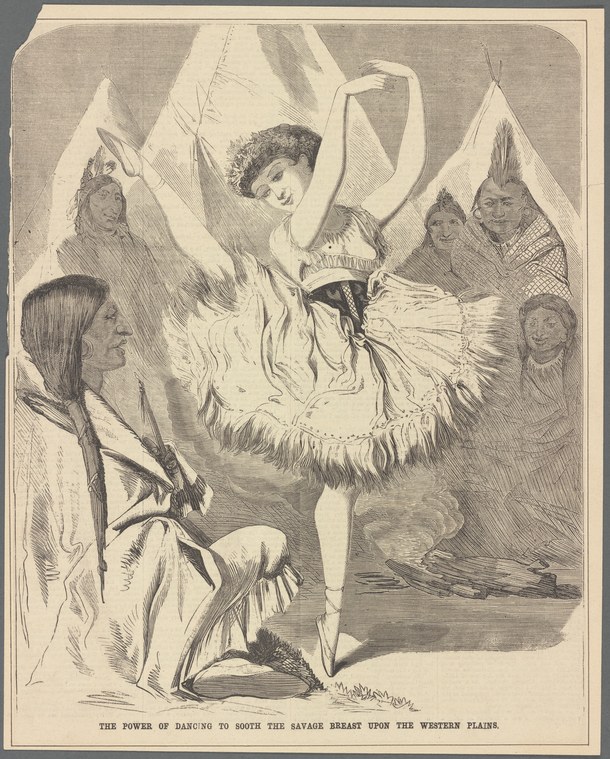
The power of dancing to sooth the savage breast upon the western plains
Unknown artist
- Collection:
- Prints depicting dance
- Source:
- New York Public Library
- Rights:
- Public domain — free to use, share and adapt.
- Recorded as:
- Public Domain
This image documents a particular colonial fantasy and its deployment of dance: the idea that a woman's unrestrained body in motion could 'civilize' or dominate an indigenous or 'savage' audience. For historians of dance, gender, and empire, it is a primary source for understanding how dance was conscripted into narratives of cultural superiority in the 19th century. The work also reveals what was considered visually and theatrically compelling to a print audience of that era—spectacle, exoticism, and narrative rather than technical or aesthetic achievement.
What you are looking at
A female dancer in a billowing white dress and elaborate headdress dominates the center of this engraving, her body arched backward in an exuberant pose with one arm raised overhead and the other extended outward. The dress—high-waisted, corseted, and trimmed with dark fur at the hem—billows around her in motion, suggesting rapid spinning or a dramatic lift. She wears what appears to be a decorative headpiece or crown. To the left, a figure in draped fabric watches from a lower position; to the right and behind, several other figures in period dress observe the scene, their faces rendered in shadow. The setting is ambiguous but suggests an interior theatrical or domestic space, rendered in soft tonal work typical of 19th-century engraving. The composition emphasizes the dancer's elevation and freedom of movement against the watching crowd.
The dancing
The central dancer's body forms an extreme backward arch with the head tilted back, knees slightly bent, suggesting either a moment of spinning momentum or a theatrical lift. Her arms are positioned asymmetrically—one raised high, one extended—which reads as neither ballroom closed position nor classical ballet frame. The watching figures have minimal articulation; they appear as witnesses rather than participants. The engraver has emphasized the dancer's isolation and spectacle rather than the technical precision of her footwork or the mechanics of partnership.
The dance depicted
The title's reference to 'the power of dancing to soothe the savage breast upon the western plains' suggests this depicts a narrative moment—likely from a theatrical piece or popular entertainment involving frontier or colonial themes. The dancer's exuberant, unrestrained posture, the fur-trimmed costume, and the watching audience suggest staged performance rather than social ballroom dance. The work appears to reference the late 19th-century theatrical convention of 'civilization' being demonstrated or imposed through the spectacle of a European woman's dance before indigenous or 'savage' observers. This is not a record of an actual dance style but rather a visual argument about power, gender, and colonial encounter rendered through theatrical gesture.
How it was made
This is an engraving, recognizable from the fine parallel lines (hatching) used to build tone and the crisp linear quality of the contours. The technique allowed for mass reproduction and wide circulation in print collections and periodicals. The engraver has used varying densities of line to create atmospheric depth—the central figure is crisply rendered while the background figures dissolve into shadow. The medium was ideal for narrative illustration with satirical or moralistic intent, and the work's subject matter and technique suggest it was intended for a educated print-collecting audience in the late 19th century.
About this work
This engraving depicts a theatrical dance scene with a European female performer at its center, watched by a group of figures rendered as observers or audience. The title invokes a colonial narrative—dance as a civilizing force or demonstration of superiority on the American frontier. The work is significant as material evidence of how dance was imagined and represented in 19th-century popular culture and print discourse. The engraver has chosen to emphasize the dancer's emotional and physical abandon—the arch of her body, the sweep of fabric—rather than technical accomplishment, suggesting that the work's interest lay in narrative spectacle and the visual drama of the moment rather than in dance itself as a disciplined practice.
How to look at it
Notice the engraver's choice to freeze the dancer at a moment of maximum physical abandon—the extreme backward arch, the raised arm, the billowing fabric. This is not a position held in stillness but rather a moment of motion captured mid-gesture. The composition places her body at the apex of the image, elevated above the watching figures below, literally embodying the title's claim about 'power.' The careful rendering of the fabric's movement and the deliberate contrast between the dancer's crisp articulation and the shadowed, passive observers creates a visual hierarchy that reinforces the narrative.
The period
This engraving belongs to the late 19th century, an era when theatrical dance in America was deeply enmeshed with narratives of the frontier, colonialism, and the imagined 'West.' Buffalo Bill's Wild West shows and similar spectacles were circulating in this period, alongside a broader cultural anxiety about 'civilization' and 'savagery.' In the visual arts, narrative engravings and lithographs were a dominant medium for distributing popular theatrical images to middle-class audiences. The subject matter—a woman's body as an instrument of cultural power—reflects both the period's fetishization of the female dancer and its imperialist ideology.
Where it lives
This engraving is held in the New York Public Library's collection of prints depicting dance, a collection built around the visual documentation of dance practice and performance across media and centuries.
Dance in this work
Questions about this work
What dance is this supposed to be?
The title and image do not depict any recognizable historical dance form. Instead, this is a theatrical narrative scene—likely from a 19th-century play or popular entertainment—that uses dance as a visual symbol of cultural power rather than as a technical practice. The dancer's posture and costume suggest staged performance designed for dramatic effect rather than adherence to a specific dance style.
Is this image satirical or serious?
The work's earnestness is difficult to establish from the image alone. The exaggerated posture and the explicit title could support either a sincere endorsement of the colonial narrative or a critique of it. What is clear is that the image was circulating in a print culture that trafficked in such frontier fantasies, and the engraver has composed it to be visually compelling rather than absurd.
Who were the 'savage' observers supposed to be?
The title's reference to 'the western plains' suggests indigenous peoples, though the engraving does not render them with ethnographic specificity. The figures in the background are generic 'observers'—their faces obscured, their bodies passive. The work is less interested in representing the watchers accurately than in using them as a narrative device to justify the spectacle of the central dancer.
More dance artwork





