49 works in this view — arrow keys or swipe to move between them.
Dance in Art
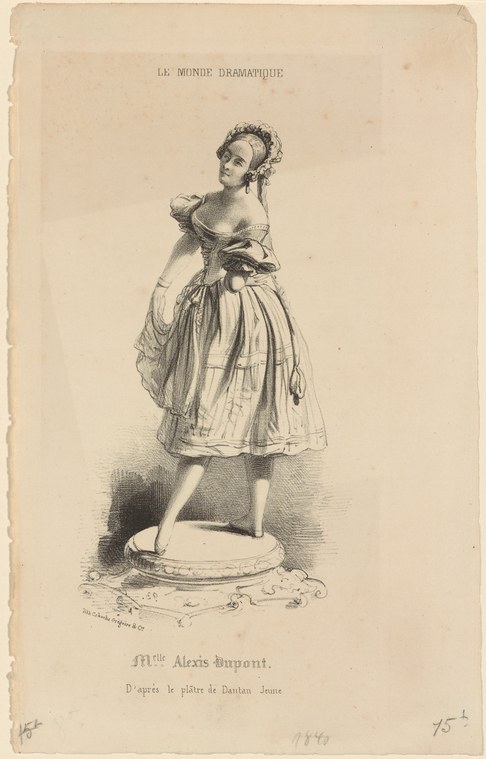
Melle Alexis Dupont, d'après le plâtre de Dantan jeune
Unknown artist
- Collection:
- Prints depicting dance
- Source:
- New York Public Library
- Rights:
- Public domain — free to use, share and adapt.
- Recorded as:
- Public Domain
Alexis Dupont was a celebrated ballerina of the Romantic era, and Dantan's statuette was one of the primary ways her image circulated beyond the theatre. For dance historians, the engraving preserves costume detail, body type, and the emotional register of mid-19th-century ballet performance in a form that reached a wide public. The work also demonstrates how sculpture and reproductive printmaking functioned as technologies for immortalizing dancers whose performances existed only in the moment.
What you are looking at
A single female figure stands in contrapposto against a plain background, her body weight shifted onto one leg in a pose of studied elegance. She wears a white or cream-coloured dress with a fitted bodice and full skirt that falls to mid-calf, with the skirt pulled slightly to one side to reveal her legs and feet. Her hair is bound up in a decorative net or snood, and she gazes upward and to the side with an expression of dreamy reverie. The figure stands on a simple circular platform or base. The composition is a formal portrait of the figure in theatrical costume, rendered in a fine engraving technique with careful attention to the play of light and shade across the fabrics and the body.
The dancing
The dancer's weight rests primarily on her right leg, with the left leg bent and slightly advanced, creating a classic contrapposto pose. Her arms hang loosely at her sides, one slightly more forward than the other, in an attitude of repose rather than active movement. The upward gaze and graceful neck line suggest a moment of romantic yearning or reverie—the body is still but emotionally animated. Her feet are visible beneath the skirt, planted firmly on the base, showing no active movement vocabulary.
The dance depicted
This is a portrait of a Romantic-era ballet dancer in theatrical costume, likely representing a moment from a narrative ballet rather than depicting active dancing. The pose and costume align with the Romantic ballet aesthetic of the mid-19th century, when female dancers in white muslin skirts and pointe shoes became the norm. The title credits this as a sculpture by "Dantan jeune" (Jean-Pierre Dantan, 1800–1869), a celebrated French sculptor of caricature and portrait statuettes, suggesting this engraving reproduces or documents Dantan's sculptural work of the dancer Alexis Dupont. The emotional register—dreamy, ethereal, melancholic—is characteristic of the Romantic ballet aesthetic, though without witnessing active movement the specific style cannot be pinpointed.
How it was made
This is a steel engraving, a fine-line reproductive technique that allowed wide circulation of images of celebrated performers and artworks in the 19th century. The delicate cross-hatching and careful modulation of tone show the skill required to translate three-dimensional sculpture into two-dimensional print. The engraving technique permitted high-quality reproduction for publication in journals and albums, making it a vehicle for promoting both the sculptor Dantan and the celebrated dancer. The signature or mark at bottom left indicates the engraver's hand.
About this work
This is a reproductive engraving of a portrait statuette by the sculptor Jean-Pierre Dantan depicting the dancer Alexis Dupont in Romantic ballet costume. It documents both the aesthetic ideals of mid-19th-century ballet and Dantan's celebrated practice of creating portrait sculptures of contemporary performers. The work sits at the intersection of dance history and art history, preserving the image of a dancer whose live performances have otherwise vanished, and exemplifying how 19th-century audiences consumed images of theatrical celebrities. As a document of Romantic ballet iconography—the ethereal femininity, the pointe work implied by costume, the emotional inwardness—it is historically significant for understanding how the era visualized and celebrated its dancers.
How to look at it
The engraver has captured the dancer not in active movement but in a moment of repose—a pause between phrases, or a tableau vivant moment. Note the careful delineation of the pointe shoe (implied by the toe position and the way the skirt drapes), the fineness of the muslin skirt rendered through delicate parallel lines, and the emotional lift in the upward gaze. The circular base suggests the viewer is encountering this figure as a sculpture viewed in the round—a reminder that this is a document of a three-dimensional artwork, not a direct representation of a live performance. The blank background and frontal pose follow the convention of portrait sculpture, emphasizing the figure's presence rather than narrative or setting.
The artist
Jean-Pierre Dantan (1800–1869), known as Dantan jeune, was one of the most celebrated portrait sculptors of 19th-century France, famous for his witty, caricatural statuettes of contemporary celebrities—writers, musicians, actors, and dancers. He was patronized by royalty and the Paris Salon, and his works were widely reproduced in engravings and lithographs, making them accessible to a broad public. His practice merged fine art sculpture with the appetite for theatrical celebrity portraiture, creating a large body of work documenting the stars of the July Monarchy and Second Empire.
The period
This work dates to the height of the Romantic ballet era (roughly 1830–1850s), when the ethereal, otherworldly female dancer became the dominant image in European ballet aesthetics. Marie Taglioni's debut in *La Sylphide* (1832) had established the aesthetic that defined the era: weightlessness, emotional interiority, pointe work, and the white muslin dress. In visual culture, portrait statuettes and engravings of celebrated dancers became a major form of artistic production and celebrity consumption. The practice of reproducing sculpture as fine engravings allowed images of dancers to circulate in homes and collections across Europe, creating a mass market for dance imagery that had not existed before.
Where it lives
This engraving is held in the New York Public Library's Prints collection under the subject heading "Prints depicting dance." It is a reproductive print—a secondary artwork documenting Dantan's original sculpture—and one of what must have been a large edition, given its circulation as a celebrity image in the 19th century.
Dance in this work
Questions about this work
Who was Alexis Dupont?
Alexis Dupont was a celebrated French ballerina of the Romantic era, active in the mid-19th century. She was a principal dancer at the Opéra de Paris and known for her elegance and technical refinement. Her performances in the major ballets of the era would have made her a celebrity in Parisian theatrical circles. Little else survives about her individual career beyond the historical record and images like this one.
Why did sculptors make statuettes of dancers?
In the 19th century, portrait statuettes of celebrated performers—actors, singers, and dancers—were a major genre. They served multiple purposes: they honored the performer, they fed the public appetite for celebrity imagery, and they were sold or given as high-status artworks. Dantan specialized in this market, and his works were reproduced as engravings and lithographs that could reach a much wider audience than the sculptures themselves.
Is this image from a live performance?
No. This is a statuette pose, not a moment from actual dancing. It represents how a sculptor chose to commemorate the dancer—in a moment of repose, embodying the aesthetic ideals of the era (ethereality, grace, emotional interiority) rather than depicting an active movement from a specific performance. The pose is theatrical but static.
What does the costume tell us about ballet in this era?
The white muslin skirt, the upswept hair, and the implied pointe shoes are all signatures of Romantic ballet. The skirt length (mid-calf, not ankle-length) and the fitted bodice show the evolution toward the ballet silhouette that dominated from the 1830s onward. The ethereal, otherworldly quality the costume creates was central to how Romantic ballet aestheticized the female dancer.
More dance artwork





