49 works in this view — arrow keys or swipe to move between them.
Dance in Art
Rousset family
Unknown artist
- Collection:
- Prints depicting dance
- Source:
- New York Public Library
- Rights:
- Public domain — free to use, share and adapt.
- Recorded as:
- Public Domain
This print is direct evidence of how professional dancers were marketed and celebrated in the 19th century, and of the physical ideals that ballet training was meant to achieve. For historians of ballet pedagogy and of the professionalization of dance in the Victorian era, it is a primary visual document showing pose, costume, and the corporate identity of a working ensemble.
What you are looking at
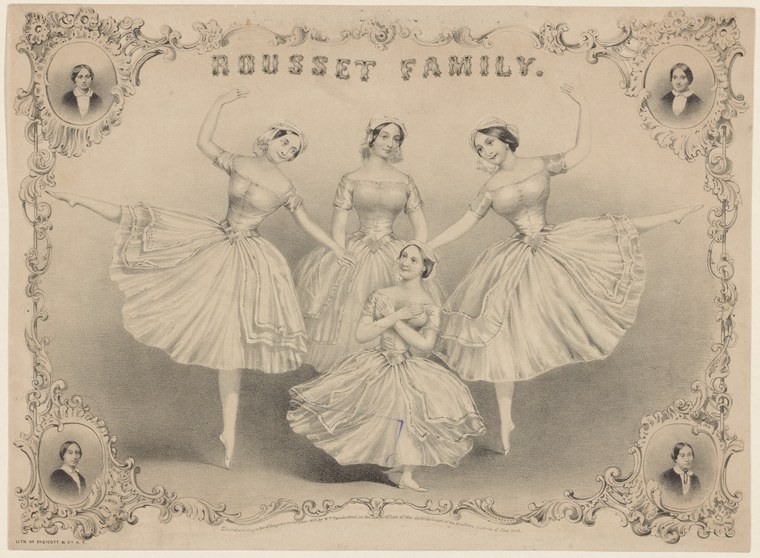
A formal allegorical composition centered on four female figures in classical dress, arranged in a graceful pyramidal composition. Three women stand in attitudes of elegant extension, their bodies curved and weightless, while a fourth reclines or sits below them in a supporting role. All wear diaphanous, high-waisted Empire silhouette gowns with full skirts that billow and sweep across the ground, rendered with delicate linear shading to suggest movement and fabric. The scene is framed by an ornate decorative border of scrollwork, foliate designs, and cherub heads in four corners—a neoclassical ornamental scheme typical of 19th-century commercial prints. The background is plain and neutral, focusing all attention on the bodies and their relationship to one another. The title "ROUSSET FAMILY" appears centered at the top in decorative lettering.
The dancing
Three of the four figures maintain open, extended positions with arms raised or outstretched in balletic attitudes—the classical first and fifth positions are suggested by the placement of the feet and the formal carriage of the torso. The standing figures display the lifted ribcage, turned-out legs, and pointed feet characteristic of early 19th-century theatrical dance training. Their arms are positioned in graceful ports de bras, with hands delicately articulated. The seated or reclining figure provides a visual anchor and compositional balance. The overall arrangement suggests a ensemble of trained dancers rather than social figures; the bodies are idealized and virtuosic rather than naturalistic.
The dance depicted
This print depicts theatrical ballet, most likely in the Romantic era style of the 1830s–1850s, when the Rousset family were known performers in Paris and London. The composition resembles a tableau or formal group portrait of professional dancers rather than a narrative scene from a specific ballet. The classical-mythological dress, the emphasis on extension and verticality, and the absence of dramatic action all point to a display of training and physical accomplishment rather than storytelling. The Rousset family were celebrated for their technical skill and for performing in corps de ballet formations, and this image commemorates them as a professional ensemble.
How it was made
This is a steel or copper engraving, executed with the fine linear hatching and tonal modulation typical of mid-19th-century commercial theatrical prints. The clarity of line, the refined modeling of the drapery through parallel striations, and the precision of the decorative border all indicate a professional engraving house. The technique allowed for mass reproduction and wide distribution; such prints were standard promotional materials for theatrical companies and were sold to the public as souvenirs and collectibles. The scale, finish, and presentation suggest this was a deluxe commercial product aimed at an educated audience with disposable income.
About this work
This is a formal group portrait in print of the Rousset family, a celebrated ensemble of professional dancers active in the mid-19th century. It captures them in classical balletic attitudes, rendered in the neoclassical allegorical style favored for theatrical commemoration. The print is a document of training, rank, and professional achievement—the dancers are presented as trained bodies achieving difficult formal positions, not as characters in narrative. It belongs in a gallery of dance imagery because it records the aesthetic ideal of the Romantic era: vertical extension, weightlessness, formal composition, and the dancer as a virtuosic technician rather than an actor.
How to look at it
Attend to the precision and formality of each body position: these are not natural or accidental poses but trained, repeated, standardized positions. Notice how each figure maintains a lifted posture and how the arms and legs are positioned to show off extension and rotation—the physical vocabulary of ballet. The ornate frame and the formal symmetry of the composition elevate the dancers to the status of classical sculpture or allegory. The print asks you to see the body as an instrument of art, shaped by discipline and training.
The artist
The artist is not recorded. The print bears no signature or attribution visible in the image. It was produced as a commercial theatrical print, likely by a Paris-based engraving house, and distributed as a promotional item by or for the company in which the Rousset family performed.
The period
This print dates to the Romantic era of ballet, when the art form had become a major commercial entertainment in European cities. The 1830s–1850s saw the rise of the ballerina as a star performer and the codification of ballet technique into a standardized system of training. Group portraits of dancers and ensemble prints were common promotional materials, sold at theaters and through print dealers. The neoclassical allegorical framing—the decorative borders, the mythological dress, the formal poses—was the standard visual language used to elevate theatrical entertainment to the status of high art.
Where it lives
This print is held in the New York Public Library's collection of prints depicting dance. It was identified as part of NYPL's Theater Collection or Dance Collection and is part of the broader category of 19th-century theatrical promotional prints.
Dance in this work
Questions about this work
Who were the Rousset family?
The Rousset family were professional ballet dancers active in mid-19th-century Europe, known particularly for their performances in Paris and London. They were celebrated members of the corps de ballet and were marketable enough to warrant a formal group portrait print. Little else is known about them from this image alone.
Why are they posed this way?
The poses are classical ballet positions—first position, attitudes, arabesques—chosen to display technical training and physical achievement. These are not costumes or characters from a specific ballet, but a formal demonstration of the dancer's skill. The arrangement mimics allegorical group portraits of classical figures.
What does the ornate border mean?
The decorative neoclassical border elevates the dancers to the status of fine art, mimicking the presentation of engravings after paintings or sculptures. It signals that this is a serious, collectible object, not a cheap theatrical bill. It also dates the print stylistically to the mid-19th century.
Is this a scene from a ballet?
No—this is a formal group portrait, not a narrative scene. There is no plot, no setting, no dramatic action. It is a commemoration of the dancers as professionals and a display of their trained bodies.
More dance artwork





