49 works in this view — arrow keys or swipe to move between them.
Dance in Art
Folk and ethnic dancing in wood engravings
Unknown artist
- Collection:
- Prints depicting dance
- Source:
- New York Public Library
- Rights:
- Public domain — free to use, share and adapt.
- Recorded as:
- Public Domain
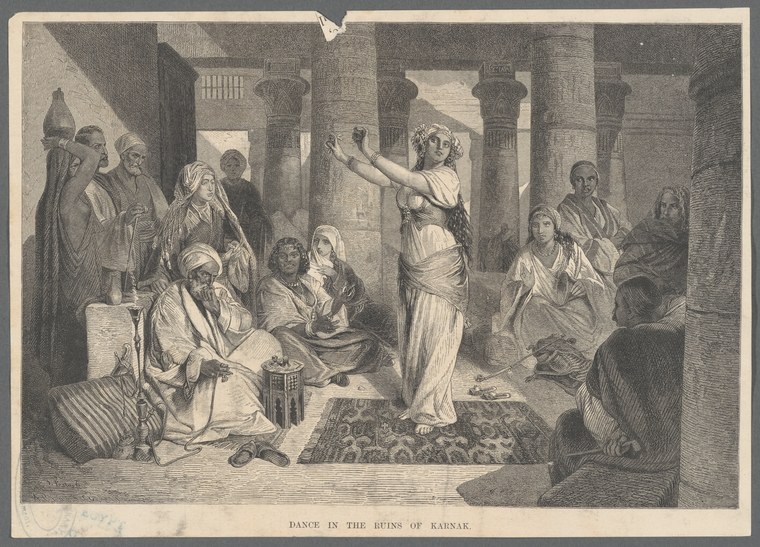
This work exemplifies orientalism in visual culture and the entanglement of nineteenth-century theatrical aesthetics with imperial fantasy. For dance historians, it demonstrates how European Romantic ballet vocabulary was projected onto imagined "Oriental" bodies and spaces, erasing actual regional dance traditions while claiming to document them. The image reveals the circulation and authority lent to such fantasies through reproductive media aimed at mass audiences.
What you are looking at
A wood engraving depicting a dance scene in ruins, likely from an orientalist or historical narrative context. A central female figure in classical drapery performs with raised arms in a dynamic pose, her body angled and weight shifted, suggesting mid-movement. She is surrounded by seated and standing onlookers in Middle Eastern and North African dress—turbans, long robes, and wraps—arranged in loose groups around columned classical architecture. The setting suggests an ancient or ruined temple interior, with large fluted columns receding into shadow and a small window or opening admitting light. The composition emphasizes the dancer's isolation and spectacle: she occupies the lit center ground while viewers cluster in shadow, some seated on the floor, others standing or leaning, creating a hierarchy of attention. The engraving's fine crosshatching renders texture and shadow with precision, giving the scene archaeological weight and romantic atmosphere typical of nineteenth-century orientalist illustration.
The dancing
The principal dancer stands in a contrapposto stance with weight on one leg, the other bent or extended, arms raised high and spread in an attitude suggesting Classical or Romantic-era theatrical dance. Her torso twists away from her hips in a marked arc, creating elongation through the spine—a pose more consistent with European theatrical training than with regional Middle Eastern movement vocabulary. She wears a classical chiton or similar flowing single garment. Around her, spectators display varied postures: some sit cross-legged on carpets, others recline, one man stands in animated conversation or reaction. The figures are precisely articulated despite the small scale, with clear indication of weight, drapery, and spatial depth.
The dance depicted
This appears to be a nineteenth-century European artist's interpretation of a solo dance performance in a Levantine or North African setting, possibly connected to historical or literary sources (the title references Karnak, the ancient Egyptian temple complex). The pose and training evident in the dancer's body—the lifted, extended arms, the turned-out positioning, the theatrical contrapposto—reflect European Romantic ballet vocabulary rather than authentic regional dance practice. The scene stages an encounter between a European dance aesthetic (imported through colonialism and orientalism) and an imagined ancient or exotic setting. The engraving does not document a living tradition but rather visualizes a fantasy constructed for a European audience, conflating classical antiquity, orientalist desire, and theatrical spectacle.
How it was made
This is a wood engraving, a technique in which an image is cut into the end-grain surface of a hardwood block, allowing very fine line-work and tonal variation through density of parallel lines. Wood engraving was the dominant reproductive technology for book and periodical illustration in the nineteenth century, enabling wide circulation and multiple impressions. The fineness of the crosshatching here—particularly visible in the rendering of architectural shadow and fabric texture—is characteristic of skilled wood-engraving work. The technique permitted the circulation of orientalist narratives and visual fantasies to a mass audience, shaping nineteenth-century ideas about non-European dance and performance.
About this work
This wood engraving depicts a performance scene set among the ruins of Karnak, likely created for a European audience in the nineteenth century. A soloist in classical drapery dances for an assembly of spectators in Middle Eastern dress arranged within an ancient Egyptian architectural setting. The image conflates multiple orientalist fantasies—ancient civilization, exotic performance, theatrical spectacle—and uses the precision of wood-engraving technique to give authority to an invented scene. It belongs to a large corpus of nineteenth-century visual material that exoticized non-European dance and movement, often importing European theatrical conventions and aesthetics while claiming to depict authentic regional traditions. The image is valuable less as documentation of actual dance practice than as evidence of how European artists and audiences imagined, consumed, and romanticized the bodies and cultures of colonized and orientalized peoples.
How to look at it
Note the hierarchy of light and attention: the dancer occupies the brightest, most clearly rendered space while spectators recede into shadow, emphasizing the European viewer's imagined vantage point. Observe the dancer's pose carefully—it is recognizably European Romantic ballet, not a regional dance tradition—and consider what that tells you about the engraver's sources and assumptions. Look at the rendering of the Karnak columns in the background: they ground the scene in archaeological authority, lending credibility to what is actually a fantasy. The precision of the engraving technique itself was part of the appeal, making the invented scene seem empirical and trustworthy.
The period
This engraving belongs to the nineteenth-century vogue for orientalism in European art, literature, and popular illustration. The period saw intense visual and literary production around Egypt, the Levant, and North Africa following military campaigns, archaeological expeditions, and colonial expansion. Simultaneously, Romantic ballet was at its height in Europe, with sylphs, odalisques, and exotic maidens becoming stock characters in theatrical works like *La Bayadère* and *Le Corsaire*. Wood engraving was the primary means of disseminating such imagery to middle-class readers through travel narratives, periodicals, and literary illustrations. The fusion of archaeological interest, theatrical spectacle, and colonial gaze visible in this print was typical of the period.
Where it lives
The print is held by the New York Public Library as part of a collection of prints depicting dance. It is catalogued only as a wood engraving of unrecorded artist and unknown date, though stylistic and iconographic evidence suggests a nineteenth-century date and European origin.
Dance in this work
Questions about this work
Is this depicting a real dance tradition from Egypt or the Middle East?
No. While the setting (Karnak) and dress reference real places and cultures, the dancer's body vocabulary and pose are European Romantic ballet. This is a European artist's fantasy projection of what an exotic or ancient dance might look like, not documentation of a living tradition. It is valuable as evidence of how nineteenth-century Europeans imagined non-European bodies, not as evidence of what was actually danced.
Why is the dancer posed that way?
The raised, extended arms and contrapposto stance reflect European Romantic ballet training and aesthetics of the nineteenth century. The artist was trained in European artistic conventions and applied them to the imagined Oriental body. This tells us more about European theatrical values than about actual dance in Egypt or the Levant.
Who would have seen this print?
As a wood engraving, this would have been reproduced and circulated in books, periodicals, and illustrated narratives aimed at middle- and upper-class European readers. It likely appeared in a travel narrative, literary work, or magazine, shaping educated Europeans' visual fantasies about the colonized and orientalized world.
More dance artwork





