49 works in this view — arrow keys or swipe to move between them.
Dance in Art
Valse de l'inconstance du ballet La vivandière
Unknown artist
- Collection:
- Prints depicting dance
- Source:
- New York Public Library
- Rights:
- Public domain — free to use, share and adapt.
- Recorded as:
- Public Domain
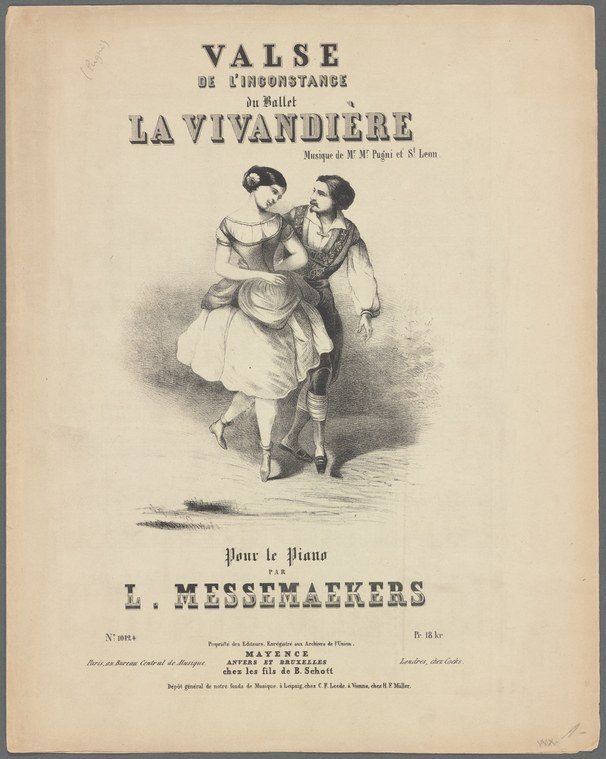
This print is evidence of the waltz as a dominant theatrical and social form in the nineteenth century, and of the commercial circulation of dance imagery in the period. For dancers and historians, it documents the posture, frame, and costume conventions of the era, and shows how movement was frozen and marketed to a broad audience.
What you are looking at
A lithographic cover sheet for sheet music depicting a waltz scene from the ballet *La Vivandière*. Two figures occupy the center of the composition: a woman in a pale, full-skirted dress with fitted bodice, her dark hair styled in the fashion of the mid-nineteenth century, and a man in military costume—dark coat with light-colored collar and trim, suggesting the uniform of a soldier or officer. The man supports the woman with one arm at her waist while she leans back in the supported position characteristic of ballroom dance, her skirts billowing with the implied motion of the turn. The composition is set against an plain cream background with minimal setting detail, focusing attention entirely on the dancers and their interaction. The image is rendered in fine lithographic line work with careful stippled shading to suggest volume and movement, particularly in the treatment of the woman's skirt and the folds of the man's coat.
The dancing
The couple is shown in a closed ballroom position with the man facing forward and slightly to the left, his right arm supporting the woman's back. The woman is tilted away from her partner in a backbend or counter-balance typical of waltzing, with her left arm extended toward the man's shoulder. Both figures are upright and formal, with the woman's weight appearing to be supported primarily by the man's frame. The posture and position suggest the downbeat or a moment of suspension within a turning phrase rather than a lunge or extreme extension.
The dance depicted
This is a waltz from the ballet *La Vivandière*, a mid-nineteenth-century work. The image shows the couple in the standard closed ballroom waltz position—the three-quarter-time rotational dance that dominated European ballrooms and theatrical dance spectacle from the 1830s onward. The waltz depicted here is titled *Valse de l'inconstance* (Waltz of Inconstancy), suggesting a dramatic or romantic narrative moment within the ballet. The theatrical context is clear from the lavish costume and the professional quality of the rendering, which would have been used to advertise the ballet and sell sheet music to amateur pianists.
How it was made
This is a lithograph, a process evident from the fine, even line work and the characteristic way ink has been applied to create tone through stippling and cross-hatching rather than continuous shading. Lithography allowed rapid, economical production of multiple copies, making it the standard medium for theatrical sheet-music covers and promotional images of the period. The technique also enabled the detailed rendering of costume and movement that would appeal to middle-class music buyers, who often performed dances at home based on published arrangements.
About this work
This is a French theatrical print from the mid-nineteenth century, a lithographic cover for the sheet-music arrangement of a waltz from the ballet *La Vivandière*. The work documents both the choreographic conventions of Romantic-era ballet and the commercial apparatus that brought operatic and ballet spectacles into domestic drawing rooms. The image is one of thousands of such prints produced in France and elsewhere to promote theatrical works and to supply the growing market for fashionable dance music. It captures a specific moment—a supported turn or lean in the waltz—and presents it as a scene of romantic narrative interest, which was the dominant mode of mid-century ballet. The work belongs in a gallery of dance in art as a primary source for understanding how nineteenth-century dancers and their audiences understood the waltz, and for appreciating the visual culture that surrounded theatrical dance.
How to look at it
Attend to the frame and position of the dancers' bodies: the closed hold, the woman's lean or counter-balance, and the formal upright carriage typical of ballroom dancing. The artist has chosen to freeze a moment of suspension or support, not a dynamic jump or dramatic extension, reflecting the waltz's essential character as a turning, supported, repetitive form. Notice the care taken with costume detail—the cut and drape of the woman's skirt, the military insignia and tailoring of the man's coat—which would have been recognizable to contemporaries and would have anchored the image in a specific narrative moment within the ballet. The lithographic technique allows for fine line work that conveys movement through the tilt of the body and the implied momentum of the turn.
The artist
The print is credited to L. Messemaeckers (or Messemaeckers), listed as the arranger for piano. The cover identifies the music as composed by M. M. Delges and S. Leon, with the lithograph itself likely produced by a commercial printshop in Paris or Brussels associated with the publisher. The names suggest Francophone or Flemish musicians and printers, consistent with the major centers of opera and ballet production in the 1840s–1860s. Individual attribution of lithographic images to named artists is rare; such prints were often collaborative efforts between composers, choreographers, arrangers, printmakers, and publishers.
The period
The waltz was the dominant ballroom and theatrical dance of the nineteenth century, transforming from a scandalous court dance in the 1780s–1790s to an emblem of respectability and romantic sentiment by the 1830s onward. *La Vivandière* (The Vivandière, or Laundress), choreographed by Jean Saint-Léon and premiered in Paris in 1844, was one of the most successful and frequently performed ballets of the Romantic era. It featured a heroine of humble social status in a narrative of love and military adventure, a formula that appealed to audiences across Europe. The ballet spawned numerous arrangements and adaptations, including popular waltz numbers sold as sheet music. The print's date is uncertain, but the styling, typography, and printing technique suggest the 1850s–1870s, when such promotional imagery was at its peak.
Where it lives
This is a lithographic sheet-music cover from the New York Public Library's collection of prints depicting dance. Such covers were distributed by music publishers to advertise theatrical works and to accompany published arrangements for home use.
Dance in this work
Questions about this work
What ballet is this from?
*La Vivandière* was choreographed by Jean Saint-Léon and premiered at the Paris Opéra in 1844. It tells the story of a vivandière (a woman who followed armies and sold provisions) who falls in love with an officer. The ballet was hugely successful and remained in the repertory throughout the nineteenth century.
What is a vivandière?
A vivandière was a woman who followed an army, selling food, drink, and supplies to soldiers. In the Romantic era, they became stock characters in operas and ballets, often portrayed as spirited and flirtatious. In *La Vivandière*, the heroine's position as a woman outside of conventional society adds dramatic tension to her romance with a soldier.
How do I know this is a waltz?
The title of this particular movement is given as *Valse de l'inconstance*—Waltz of Inconstancy. The closed ballroom position and the supported lean of the woman also conform to the standard waltz frame of the period.
Why would someone buy this sheet music?
Nineteenth-century ballrooms and drawing rooms relied on piano arrangements of operatic and ballet music. A middle-class household might purchase this waltz to play at home, allowing family members and guests to dance to fashionable music from a successful theatrical production. Owning such music was a mark of sophistication and current taste.
More dance artwork





