49 works in this view — arrow keys or swipe to move between them.
Dance in Art
Mademoiselle Parisot
Unknown artist
- Collection:
- Prints depicting dance
- Source:
- New York Public Library
- Rights:
- Public domain — free to use, share and adapt.
- Recorded as:
- Public Domain
For dancers and historians, this image documents the visual conventions of Romantic ballet at its height, showing precisely how the body was held, framed, and presented on stage. For art historians, it illustrates the role of theatrical prints in 19th-century visual culture and the ways that dance performance was mediated, celebrated, and made available to a broad public through mechanical reproduction. The engraving is evidence of a specific dancer's prominence and the market demand for images of celebrated performers.
What you are looking at
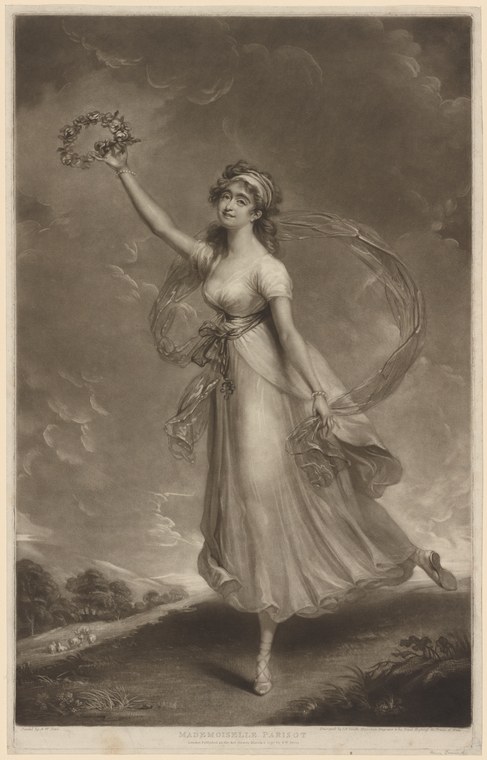
A young woman in classical drapery stands in a landscape, caught mid-leap or turn. She wears a high-waisted white muslin gown of early 19th-century cut, with her torso and shoulders nearly bare; a flowing shawl or scarf trails behind her in wind or motion. She holds a wreath of flowers aloft in her raised right arm, her head tilted upward in a pose of rapture or invocation. Her left leg is extended behind her or to the side, body arched in an attitude of weightless grace. The setting is a moody landscape with storm clouds gathering above and distant terrain below, lit by a diffuse glow that throws the figure into relief. The overall impression is of a nymph or allegorical spirit rather than a ballroom dancer—this is Romantic dance imagery, theatrical and fantastical rather than social.
The dancing
A single female figure dominates the composition, positioned off-center and slightly elevated. Her weight appears to rest on one leg with the other extended in a line suggesting the balletic attitudes of the period. Both arms are active: the right arm raised high to present the wreath, the left arm swept outward at shoulder height. Her torso is arched backward, creating the characteristic Romantic curve of the époque—an open chest and extended line rather than the upright carriage of ballroom dancing. The pose suggests a sustained moment rather than a step, and the body's elongation and the tilt of the head upward are hallmarks of theatrical ballet vocabulary of the 1820s–1840s.
The dance depicted
This is theatrical ballet imagery, almost certainly representing a moment from a Romantic-era ballet or a dancer performing in the Romantic style. The wreath—symbol of a sylph, nymph, or ethereal character—and the landscape setting point to the popular subject matter of Romantic ballet. The pose itself is an *attitude* or an *arabesque-like* extension, key positions in the classical vocabulary that had crystallized by the 1820s. The title *Mademoiselle Parisot* suggests this is a portrait of a specific dancer, likely a prominent Paris Opera performer of the 1820s–1840s, posed in her signature role—possibly as a sylph or spirit character. Without further documentation, the specific ballet cannot be named, but the visual language is unambiguously that of French Romantic theatrical dance.
How it was made
This is an engraving or aquatint, executed in the fine-print tradition of theatrical portraiture. The technique allowed for wide circulation as a print commodity—such engravings were sold to the public as souvenirs of celebrated performances and dancers, a practice standard in Paris during the Romantic period. The monochrome medium required the artist to convey movement, drapery, and atmosphere through line and tonal gradation alone. The soft modeling of the sky and the delicate rendering of the muslin fabric show skilled use of the medium to capture both the ethereal quality of Romantic ballet and the material specificity of the dancer's costume.
About this work
This is a theatrical portrait engraving of a Romantic-era ballet dancer, titled after the performer herself. It captures not a moment from a social dance but a pose from the concert stage—a single figure suspended in a pose of classical grace, dressed in the simple white muslin and high waist that became the uniform of Romantic ballet. The image is both a portrait (recording a specific performer's appearance and renown) and an idealization (presenting the dancer as a timeless, weightless creature of the stage). It belongs to the large body of theatrical prints that documented and promoted ballet in early 19th-century Paris, circulating as both art commodity and fan memorabilia.
The work exemplifies how Romantic-era ballet was visualized and consumed in its own time. By showing a single dancer in a static pose rather than in narrative action or partnered interaction, the print emphasizes the display of the body in space—the extended line, the arched spine, the lifted port de bras—as the primary meaning of the dance itself. This is theatre as visual spectacle, and the engraving as a means of circulating and immortalizing that spectacle.
How to look at it
Notice the pose itself: the extended leg, the arched back, the raised arm holding the wreath. This is not a step or a moment of locomotion but a sustained position of display. The artist has chosen to freeze the body at a moment of maximum extension and visual clarity, allowing the viewer to see the line of the dance. The upward tilt of the head and the ethereal landscape behind her situate this dancer not in a ballroom but in a theatrical world of dreams and spirits. Pay attention to how the muslin fabric clings to and flows from the body—the engraver has rendered the material properties of the costume with precision, as that fabric was as much a symbol of Romantic ballet as the dancer's own body.
The artist
The artist is not recorded in the catalogue. However, the print is professionally executed in the manner of Parisian theatrical engravers of the early 19th century—a skilled commercial practice rather than fine art printmaking. Many such portraits were unsigned or attributed only to the engraver's workshop. The tradition of theatrical portraiture through engraving was well-established by the 1820s–1830s, and prints of this quality and subject would have been produced by one of the major Paris print publishers or theatrical portrait specialists of the period.
The period
This print dates to the height of Romantic ballet in Europe, likely the 1820s–1840s. This was the era when ballet shifted decisively away from the 18th-century courtly tradition toward theatrical spectacle centered on the female dancer as an ethereal, often supernatural being. The Paris Opera became the center of this aesthetic, and dancers like Marie Taglioni and Fanny Elsler were celebrated as international stars. The rise of pointe work, the development of the tutu, the emphasis on weightlessness and otherworldliness in choreography—all coincided with a surge in demand for images of these performers. Theatrical prints were a major form of visual culture, as central to the dissemination of ballet as photography would become later in the century. The engraving technique allowed for affordable multiple copies, making images of famous dancers accessible to the paying public.
Where it lives
This print is held in the New York Public Library's collection of prints depicting dance. It is catalogued as a historical theatrical print but lacks detailed provenance information or artist attribution. It exemplifies the archival record of 19th-century dance: widely circulated at the time, but not always carefully documented by later collectors.
Dance in this work
Questions about this work
Who was Mademoiselle Parisot?
The print is titled after the dancer, suggesting she was a known performer in Paris during the Romantic ballet era (likely 1820s–1840s). Without further documentation, her identity cannot be confirmed from the image alone. She was evidently celebrated enough to warrant a published theatrical portrait, which indicates some prominence in the Paris Opera or similar venue.
What is the wreath she is holding?
The wreath of flowers is a symbol of ethereal or supernatural characters in Romantic ballet—sylphs, nymphs, spirits, and other otherworldly beings that populated the ballets of this era. It identifies the character role and the emotional tone: celestial, innocent, weightless. The wreath was as much a costume prop as the muslin dress.
Is this a portrait or a stage image?
It is both. It is a portrait of a specific dancer, documenting her appearance and renown, but it represents her performing in a theatrical role, posed in a balletic position. The distinction between the performer and the character is deliberately blurred—Mademoiselle Parisot *is* the sylph or nymph she portrays.
How do we know this is ballet and not another kind of dance?
The pose itself—the extended leg, the arched back, the port de bras—belongs to the vocabulary of classical ballet codified in the early 19th century. The costume, the theatrical setting, and the representation of a single female dancer in display rather than in narrative action are all conventions of Romantic ballet. The wreath and landscape situate her in a distinctly theatrical world.
More dance artwork





