49 works in this view — arrow keys or swipe to move between them.
Dance in Art
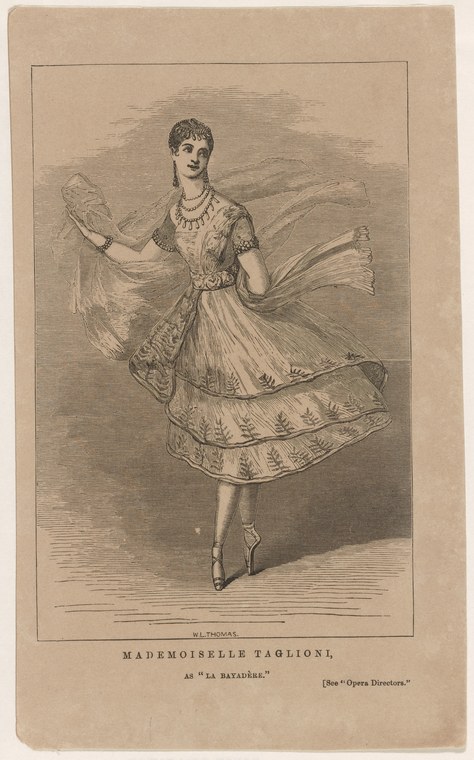
Mademoiselle Taglioni, as "La bayadère"
Unknown artist
- Collection:
- Prints depicting dance
- Source:
- New York Public Library
- Rights:
- Public domain — free to use, share and adapt.
- Recorded as:
- Public Domain
This image documents Romantic ballet at its height and captures the visual techniques by which 19th-century dancers created the illusion of weightlessness and otherworldliness that defined the era's aesthetic. The bayadère character and Taglioni's interpretation of it became foundational to how Western theatrical dance understood exoticism and femininity, influencing ballet practice for generations.
What you are looking at
A single female dancer poses in a moment of arrested motion against a plain background, her body oriented in three-quarter view and tilted in a lunging arabesque or attitude position. She wears a pale, heavily decorated tunic with embroidered or patterned borders at the hem and sleeves, draped with diaphanous fabric that floats from her raised arms and extended leg, creating dynamic diagonal lines across the composition. Her costume includes a necklace and earrings suggesting an exotic or Oriental character. The dancer rises on the ball of her supporting leg, her face turned toward the viewer with a composed expression. The engraving technique and the dramatic play of light and shadow across the floating drapery create an impression of ethereal motion despite the fixed pose.
The dancing
The dancer stands in a classical ballet attitude or arabesque, with one leg extended behind or in a raking diagonal, her body weight centered over a sharply pointed foot. Her arms are raised in a graceful port de bras, one extended forward and one back, framing her torso. The floating drapery creates the visual impression of movement, though the dancer's core alignment and the precision of her lines—turned-out leg, elongated neck, composed shoulders—are hallmarks of academic ballet training. Her posture and positioning suggest studied technique rather than spontaneous movement.
The dance depicted
This appears to be a depiction of Romantic ballet, most likely Marie Taglioni in the role of La Bayadère or a similar Orientalist ballet character. The costume, the elevated pose, and the ethereal floating drapery are signatures of mid-19th-century Romantic ballet, which favored sylph-like ethereality, exotic settings, and gravity-defying illusion. The bayadère (temple dancer) character became iconic through ballets of this period, particularly as performed by Taglioni, who revolutionized ballet technique and visual presentation. The engraving captures the moment of suspension and weightlessness central to Romantic ballet's aesthetic—the dancer appears to float rather than stand.
How it was made
This is an engraving, executed with fine parallel hatching lines to model light, shadow, and texture. The technique allows for precise linear definition of the dancer's silhouette and the elaborate ornament of her costume while creating atmospheric depth through tonal gradation. Engravings of this quality and subject matter were typically published as individual prints or in illustrated journals and annuals, making them relatively affordable and distributable to middle-class audiences interested in theatrical subjects. The careful rendering of anatomical detail and drapery suggests a skilled printmaker working from a drawn or painted source.
About this work
This is a formal portrait engraving of a named Romantic-era ballet dancer in an iconic character role, documenting the visual splendor and technical accomplishment of mid-19th-century theatrical dance. The print preserves both the costuming and the aesthetic values of Romantic ballet—its emphasis on ethereality, its flirtation with the exotic and supernatural, and its display of the dancer's training and artistry. As a commercial print from the theater world, it is evidence of how dance imagery circulated among theatergoers and of how a specific dancer and role became culturally legible through their repeated representation in popular media.
How to look at it
Attend to the precise moment captured: not a climactic jump but a poised, sustained pose—the heart of Romantic ballet aesthetics. Note how the engraver has rendered the floating drapery to suggest motion and weightlessness even in a static pose; the fabric catches light and creates visual rhythm around the dancer's body. The dancer's facial composure and the studied precision of her line convey technical mastery and aristocratic bearing. The minimal background and formal framing emphasize the dancer as the sole subject of attention, a convention that asserts her importance as both an artist and a celebrity.
The artist
The artist is recorded as 'M. THOMAS' on the plate, but their identity and biographical details are not established in the holding catalogue. The technical accomplishment of the engraving suggests a professional printmaker working within the theatrical print industry of the mid-19th century, likely in Paris or London, where such documentation of celebrated performers was a commercial and artistic practice.
The period
This print dates to the height of Romantic ballet, a movement that emerged in the 1830s and dominated European theatrical dance through the 1850s. Marie Taglioni was the defining figure of this era, celebrated across Europe for her technical innovations—particularly her mastery of pointe work—and her ability to embody the Romantic ideal of the ethereal, weightless female dancer. Taglioni's performances in ballets such as La Sylphide (1832) and her subsequent roles as exotic characters redefined what ballet could express and how audiences understood the dancing female body. Theater prints like this one were a primary medium through which audiences who had not seen a performance could engage with the visual spectacle and celebrity of the stage.
Where it lives
This print is held in the Prints depicting dance collection at the New York Public Library. It is a commercial theatrical print, the kind distributed to audiences and collectors as a souvenir and documentation of celebrated performances.
Dance in this work
Questions about this work
Who was Marie Taglioni?
Taglioni (1804–1884) was an Italian-Swedish ballet dancer who became the most celebrated performer of the Romantic era. She revolutionized ballet technique, particularly through her mastery of pointe work and her ability to create an illusion of effortless weightlessness. Her performances in Paris in the 1830s and 1840s made her an international celebrity and defined the visual and technical ideals of Romantic ballet.
What is a bayadère?
A bayadère is a Hindu temple dancer, a character type that became popular in European Romantic ballet as part of the era's fascination with exotic and Oriental subjects. The character allowed choreographers to explore different movement vocabularies and visual aesthetics while reflecting contemporary (and problematic) stereotypes about Asian and Indian culture.
Why do the dancer's legs and feet look that way?
The turned-out positioning and the sharp relevé (rising on the ball of the foot) visible here are fundamental to classical ballet technique. This outward rotation of the hip and the emphasis on pointing through the foot were developed and codified during this period and remain central to ballet training today.
How were theater prints like this circulated?
Prints were sold individually at theaters or through print dealers and were also reproduced in illustrated journals and annuals. They were affordable enough for middle-class audiences to collect and were a primary way that people who could not attend performances could visualize the spectacle of the stage and own a memento of a celebrated dancer.
More dance artwork





