49 works in this view — arrow keys or swipe to move between them.
Dance in Art
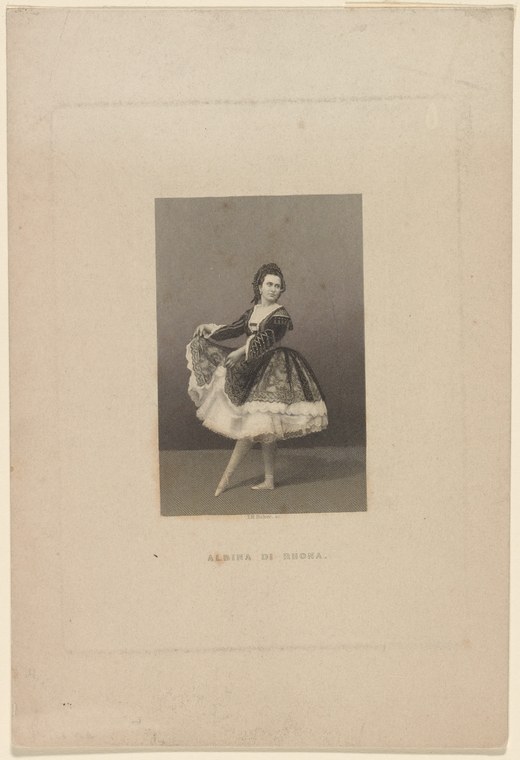
Albina di Rhona
Unknown artist
- Collection:
- Prints depicting dance
- Source:
- New York Public Library
- Rights:
- Public domain — free to use, share and adapt.
- Recorded as:
- Public Domain
This print is evidence of how Romantic ballet dancers were marketed and celebrated in the nineteenth century. It shows us not how the dancer moved, but how she was presented to the public—and prints like this shaped contemporary understanding of who these performers were and what ballet looked like. The work belongs to a genre of theatrical portraiture that has become a primary historical record of costume, fashion, and the visual culture of dance.
What you are looking at
A young woman in mid-nineteenth-century theatrical costume stands in a studio setting against a dark background. She wears a black laced bodice or corset over a white skirt with ruffled underskirts, typical of Romantic-era ballet costuming. Her posture is upright and formal, weight shifted slightly to one side. She holds a length of patterned fabric—possibly a shawl or decorative drapery—in her right hand, allowing it to billow or cascade. The lighting is theatrical: her figure is sharply modeled against the dark background, with particular attention paid to the texture of her costume and the play of light on the gathered skirt. The pose suggests she is a professional dancer and the work was likely made for theatrical publicity or promotion.
The dancing
The dancer stands in a static, formal pose rather than mid-motion. Her body is nearly frontal, with a slight turn at the hips and a gentle S-curve to the torso. Her right arm is raised and extended, holding and displaying the decorative fabric; her left arm hangs at her side. The pose reads as a studio portrait moment rather than a captured movement—a conventional way to present a ballerina to the public. Her stance appears to have weight evenly distributed or slightly favoring one leg, but the footwork is not clearly legible. The composition privileges presentation and costume visibility over the recording of active technique.
The dance depicted
This is almost certainly a Romantic ballet dancer from the 1840s–1860s. The costume—dark bodice, white skirt, hair arrangement—and the formal studio presentation are consistent with mid-nineteenth-century ballet practice, when dancers like Marie Taglioni and her contemporaries were celebrated across Europe. The title 'Albina di Rhona' suggests a character from a ballet narrative, though the work does not depict a specific moment of choreography but rather a promotional portrait of the dancer in character. The static pose and theatrical dress indicate she was a professional ballerina of some standing, but the image records her appearance rather than her movement.
How it was made
This is an engraving or lithographic print on paper, characteristic of mid-nineteenth-century theatrical publicity. The technique allowed for multiple copies to be distributed—to theaters, patrons, and the ballet-going public—making the dancer's image reproducible and portable. The soft modeling of form and the careful handling of light and shade suggest a skilled reproductive engraving, possibly after a photograph or painting. The medium was standard for ballet promotion of the period, when printed images of celebrated dancers were collected and traded much like modern celebrity photographs.
About this work
This print is a theatrical portrait of a Romantic-era ballet dancer presenting herself in character costume. 'Albina di Rhona' was likely a role in a narrative ballet popular during the 1840s–1860s. The work belongs to a vast tradition of ballet publicity prints that documented the appearance and costume of celebrated dancers without attempting to freeze them mid-movement. The image tells us how the dancer wished to be seen and remembered—in a glamorous, formal studio setting that emphasized costume, bearing, and professional status. It is a document of both ballet practice and the commercial apparatus that surrounded it.
How to look at it
Look first at the costume: the black laced bodice, white skirt with ruffles, and the careful arrangement of the drapery tell you this is a theatrical character, not a studio study. Notice how the artist has used light to model the figure and create depth—the dark background makes the dancer's form spring forward. The pose itself is not a moment of dance but a formal presentation: the dancer is showing herself to the viewer, not lost in performance. The elaborate printed texture of the shawl or fabric she holds is rendered with great care, suggesting the material worth and visual spectacle of theatrical dress. This is a print made for circulation and sale, and it aims at glamour and legibility in equal measure.
The period
The Romantic ballet era (c. 1830–1870) saw a dramatic expansion in the cult of the ballerina. Marie Taglioni's triumph as the sylph in La Sylphide (1832) established the ethereal, weightless female dancer as an ideal, and the white tutu and pointe shoes became standardized. Dancers became celebrities, and their images were mass-produced for a growing public of ballet enthusiasts. Lithography and engraving made such portraits economical and widely available. The theatrical print served as both advertisement and souvenir, and collecting images of celebrated dancers was a common practice among ballet patrons. By the 1850s and 1860s, when this print was likely made, such portraiture was a routine and highly professionalized art form.
Where it lives
The print is held in the New York Public Library's collection of prints depicting dance. It is a reproductive engraving or lithograph, likely printed in multiple copies for theatrical or commercial distribution in the nineteenth century.
Dance in this work
Questions about this work
Who was Albina di Rhona?
The catalogue record does not identify her. She was a professional ballet dancer of the Romantic era, likely active in the mid-nineteenth century, and 'Albina di Rhona' was the name of a character she performed—possibly from a narrative ballet now lost to the repertory. The print does not document her real name or biographical details, but rather how she was presented to the public in character.
How do we know this is a ballet dancer and not another kind of performer?
The costume is the primary evidence: the black bodice, white tulle skirt with multiple ruffled layers, and the upswept hairstyle are all standard to mid-nineteenth-century Romantic ballet. The formal studio setting and pose are also typical of ballet publicity prints from this period. The elegance and expense of the costume suggest a celebrated professional dancer.
Why does the pose look so static?
This is a publicity portrait, not a record of movement. Professional ballet dancers of the era were presented to the public in formal costume poses for prints like this. The aim was to show the dancer's beauty, bearing, and costume—not to document choreography or technique. The static pose was conventional and expected.
When was this print made?
The catalogue record gives no date. On stylistic grounds—the fashion, the style of engraving, and the conventions of ballet costume—it was almost certainly made between 1840 and 1870, during the height of Romantic ballet. It may date to the premiere or early performances of the ballet in which the character appeared.
More dance artwork





