49 works in this view — arrow keys or swipe to move between them.
Dance in Art
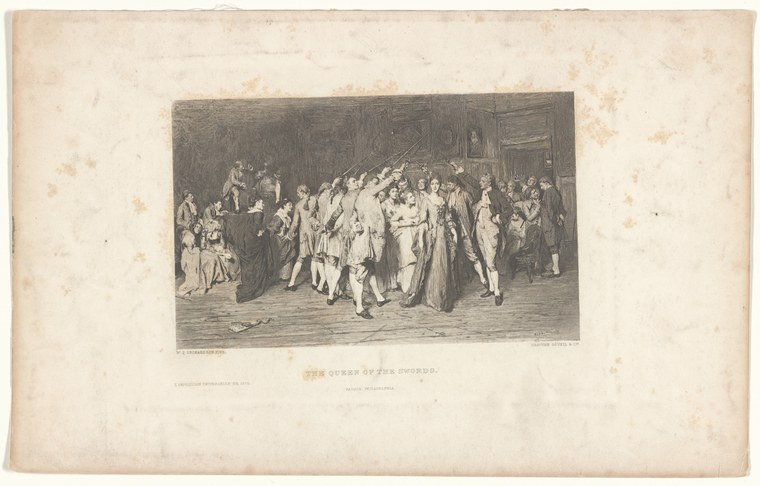
The queen of the swords
Unknown artist
- Collection:
- Prints depicting dance
- Source:
- New York Public Library
- Rights:
- Public domain — free to use, share and adapt.
- Recorded as:
- Public Domain
This image preserves evidence of a now-forgotten performance spectacle at a moment when dance and theatre were documented primarily through the engraver's eye rather than the camera. For historians of nineteenth-century performance, the engraving is a vital witness to staging practices, costuming, and the relationship between performer and audience—particularly the centrality of solo virtuosity and dramatic gesture in the theatrical dance of the period.
What you are looking at
A crowded indoor scene, rendered in grayscale engraving, depicts a formal theatrical or court performance. The composition is densely populated with spectators and performers arranged in depth across a large hall with architectural detailing—doorways and classical elements visible in the background. A central female figure in white drapery dominates the middle ground, posed dynamically with arms raised and body in an attitude of dramatic exertion or triumph. She is surrounded by a pressing crowd of figures in period dress—men in dark coats and breeches, women in gowns and bonnets—who create a ring of witnesses around her performance. The lighting is dramatic, with the white-draped central figure standing out sharply against the darker tones of the surrounding crowd and setting. The title 'The queen of the swords' suggests a narrative moment: this appears to be a performance piece, possibly a pantomime or dance-drama, with the woman as the focal point of attention and action.
The dancing
The central female performer stands with weight on one leg, body arched, with one or both arms raised in an expansive, dramatic gesture. Her posture suggests active movement—possibly mid-leap, mid-turn, or in an arrested moment of exertion. She wears flowing white drapery that enhances the sense of motion. The surrounding spectators are static, densely packed, creating a clear visual hierarchy between the dynamic performer and the watching crowd. No obvious partnered hold or formation is visible; this appears to be a solo performance or exhibition piece.
The dance depicted
The image likely documents a theatrical or balletic performance piece from the nineteenth century, possibly featuring dramatic or spectacular choreography rather than formal ballet technique. The title 'The queen of the swords' hints at a narrative or fantasy subject, common in Romantic-era theatre and dance spectacles. The performer's pose and the enrapt crowd suggest a moment of climactic display—a virtuosic turn, leap, or dramatic attitude designed to astonish. Without inscription or signature, the specific choreography and dancer cannot be identified, but the style of dress, staging, and printmaking suggests a performance witnessed and documented by a print audience, likely from the 1830s–1860s. This may record a historical performance or a theatrical moment that held popular interest.
How it was made
This is a line engraving, executed in the classical tradition of theatrical documentation. The technique—fine parallel lines and cross-hatching to build tone and form—was the standard method for disseminating images of celebrated performances before photography became widespread. Engravings like this had broad circulation as prints sold separately or bound into periodicals and books, making them a primary record of how nineteenth-century audiences experienced theatre and dance. The clarity and precision of the medium allowed for legible narrative detail despite the crowded composition, and the formal execution suggests a professional commission, likely based on an eyewitness sketch or a painted scene.
About this work
This engraving documents a moment from a theatrical performance titled 'The queen of the swords,' capturing a dramatic solo by a white-draped female performer witnessed by a dense crowd in a formal interior setting. The work exemplifies nineteenth-century theatrical printmaking, when engravings served as the primary visual record of celebrated performances and helped construct public memory of notable dancers and dramatic moments. The identity of the artist, the specific performance, and the date remain unrecorded, but the work belongs to the tradition of commercial theatrical prints that brought news of sensational performances to print-buying audiences.
How to look at it
Observe the compositional strategy: the artist has placed a single dynamic figure at the center and surrounded her with a ring of static witnesses, creating a visual narrative about spectatorship and performance. Note the contrast between the flowing white drapery of the performer and the dark formal dress of the crowd—a compositional choice that draws the eye and communicates hierarchy. The moment captured appears to be one of climax or display rather than narrative action, suggesting this records a virtuosic or spectacular instant designed to elicit astonishment. The engraver has worked densely to render the crowd convincingly, suggesting this was a celebrated public event worth documenting in fine detail.
The period
This work belongs to the era of Romantic ballet and theatrical spectacle (roughly 1820s–1870s), when narrative ballets and pantomimes combined dance, drama, and visual spectacle. The 'queen of the swords' motif suggests either a classical or oriental fantasy subject—both popular in the period. The engraving format indicates it was made to circulate widely among the theatre-going and print-buying public, documenting celebrated moments and performers for audiences who could not attend live performances. This was the last major era in which engravings were the primary visual record of dance before the advent of photography.
Where it lives
The work is held in the NYPL's collection of prints depicting dance. It appears in the catalogue as 'The queen of the swords,' with artist, date, and medium unrecorded, suggesting it was catalogued from the print itself without accompanying documentation.
Dance in this work
Questions about this work
What dance style is this?
The work does not depict a recognisable dance technique or style in the formal sense. It appears to record a theatrical or dramatic performance piece, likely from the nineteenth century, in which a solo female performer executes a dramatic or spectacular moment before a witnessing crowd. The title suggests a narrative or fantasy subject rather than formal ballet.
Who was the performer?
The performer is unidentified. The lack of artist signature, title attribution, or date makes it impossible to determine who danced this role or when the performance took place. It may represent a celebrated dancer of the mid-nineteenth century, but that information is lost.
Why was this printed?
In the nineteenth century, engraved prints of celebrated theatrical moments were sold to the public as souvenirs and mementos of performances. This print served as a visual record of a spectacular moment, allowing audiences who attended—or heard of—the performance to own an image of it, and allowing those who did not attend to learn of its sensational appeal.
What does the title tell us?
The title 'The queen of the swords' suggests a narrative or fantasy theme, possibly involving combat, oriental spectacle, or a mythological or fairy-tale subject. In nineteenth-century theatre and ballet, 'sword' dances and warrior-queen roles were popular, often combining dramatic gesture, exotic costuming, and spectacular display.
More dance artwork





