49 works in this view — arrow keys or swipe to move between them.
Dance in Art
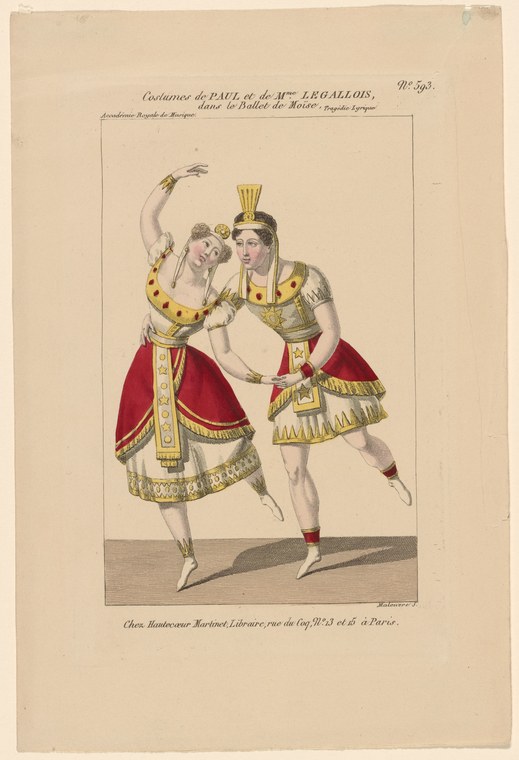
Costumes de Paul et de Mme Legallois, dans le ballet de Moïse: Tragédie lyrique. Academie Royale de Musique
Unknown artist
- Collection:
- Prints depicting dance
- Source:
- New York Public Library
- Rights:
- Public domain — free to use, share and adapt.
- Recorded as:
- Public Domain
For a dance historian or performer, this image is direct evidence of how the body was held and displayed in the highest theatrical form of early-18th-century France—not as reconstruction or written description, but as a formal image made from life or close observation. The costumes, the stance, the gesture, and the framing all convey what the choreography valued: vertical alignment, noble carriage, and the legible expression of emotion through pose. It documents a moment of performance history that would otherwise vanish.
What you are looking at
Two dancers in elaborate Egyptian-style costumes perform against a neutral ground, posed as if mid-movement in a dramatic scene. The figure on the left wears a short white pleated skirt with a deep red overskirt bordered in gold embroidery, a gold breastplate, a broad beaded collar, and an ornamental headdress; one arm is raised with a curved blade or ceremonial object. The figure on the right wears similar military dress—a gold corselet, short kilt with red panel, and tall headdress—and appears to gesture or gesture toward the other dancer. Both figures stand in contrapposto with one leg bearing weight and the other flexed, suggesting choreographed poses rather than neutral standing. The bodies are rendered in the style of 18th-century French theatrical engravings: carefully modeled, anatomically coherent, with attention to the play of fabric and the geometry of the pose. The setting is abstract; the dancers occupy the entire frame against plain ground with only a thin shadow beneath suggesting stage space.
The dancing
Both dancers stand in pronounced contrapposto: weight shifted to the back leg, the forward leg flexed and lifted slightly, creating the balletic line of early 18th-century theatrical dance. The left figure's raised arm and curved implement suggest a narrative gesture—perhaps a moment of surprise or confrontation—while the right figure's posture and hand position indicate response or engagement. The bodies are upright and formally articulated rather than bent or grounded; the impression is of courtly elevation and control, not folk or ritual movement. This is the body language of the aristocratic stage.
The dance depicted
This is a costume study for a dancer in the tragédie lyrique *Moïse* (Moses), a form that combined sung recitative and instrumental music with choreographed spectacle in the French court and public theaters of the 17th and 18th centuries. The record identifies the dancers as Paul and Mme Legallois, principal performers at the Académie Royale de Musique (the Paris Opéra). The theatrical Egyptian dress—exotic to European eyes—suggests a scene of dramatic action rather than social dancing, and the contrapposto pose and raised gesture indicate the kind of noble or heroic pantomime-in-motion that was integral to tragédie lyrique. The dance would have been a mix of balletic technique, geometric patterns, and mime.
How it was made
This is a hand-colored engraving on paper, typical of theatrical costume documentation in 18th-century France. The engraved line creates the figure and drapery; color is applied by hand afterward, which gives the print its characteristic clarity in outline and variation in pigment application. This format was standard for publicizing opera and ballet dancers and their roles: affordable to produce in multiples, easily distributed, and serving as both souvenir and advertisement. The presence of an engraved inscription and numbered plate suggests this was part of a numbered series documenting the dancers or roles of a specific production.
About this work
This is a costume plate documenting two principal dancers of the Paris Opéra in the early-to-mid 18th century, posed as characters in the tragédie lyrique *Moïse*. The work preserves not a performance but a formal record of how the dancers appeared in role: their costume, their carriage, and the theatrical moment their choreographer chose to immortalize. Such prints were essential documents in a world without photography, circulating among patrons, fellow performers, and devotees of the opera as evidence of the grandeur and spectacle of French courtly theater. The work sits at the intersection of theatrical design, dance documentation, and the culture of celebrity that surrounded the Opéra in this era.
How to look at it
Notice the precise articulation of the dancers' weight: both are in contrapposto, a pose that elevates and formalizes the body in the tradition of Renaissance sculpture and courtly dance. The raised arm and curved implement on the left are not incidental but choreographic—they shape a narrative moment, a reaction, a gesture of power or alarm. The costumes, while exotic, are structured to show the line of the body: the high waistline, the bare legs, the articulation at hip and shoulder all remain visible despite the richness of the ornament. The engraver has not hidden the bodies under costume but used costume to frame them. This was the fundamental principle of theatrical dress in the period.
The artist
The engraver is not recorded. However, the style and format are consistent with the Parisian theatrical engravers of the early 18th century, a workshop tradition that produced costume and role documentation on commission for the Opéra and its patrons. Such prints were often signed only with the publisher's mark and plate number, not the artist's name; attribution would require consultation of sales records or archival documentation of the print's origin.
The period
This work dates from the heyday of the tragédie lyrique, a French genre established under Louis XIV that combined spectacle, music, and dance in hierarchical harmony. By the early 18th century, the form was at its height: the Paris Opéra was a state institution, its principal dancers were celebrities with international reputations, and the costume plate had become a standard merchandise format. Dance in this period was still a courtly art governed by the five positions and the turned-out leg—the vocabulary that would later be formalized as ballet—and the roles in tragédie lyrique demanded both technical precision and the ability to narrate character and emotion through pose and gesture. The Orientalist costume here reflects a long European fascination with Egypt and the Middle East as sites of grandeur and exoticism suitable for operatic spectacle.
Where it lives
This work is held in the Prints collection of the New York Public Library, catalogued as part of holdings depicting dance. It appears to be a single-sheet theatrical print, likely one of a series of costume studies for the production or cast of *Moïse*.
Dance in this work
Questions about this work
What was the Académie Royale de Musique?
The Académie Royale de Musique, established in 1669, was the official opera house of France and the only institution legally permitted to perform operas (tragédies lyriques) in the French language. It was state-funded and controlled, and its dancers and singers were celebrities with high social standing. By the 18th century it was the most prestigious stage in Europe for dance and music combined.
What is a tragédie lyrique?
A tragédie lyrique was a French operatic genre combining sung dialogue (recitative and arias), orchestral music, and choreographed dance, typically in five acts on heroic or mythological subjects. Dance was integral to the form, not incidental: whole scenes were devoted to spectacle and movement. The genre was the dominant form of French opera from the late 17th century through the 18th century.
Why are the dancers in Egyptian costume?
The subject of *Moïse* is the biblical Moses and the exodus of Egypt. Exotic costumes—Egyptian, Turkish, Indian—were standard in European operatic spectacle of this period as markers of grandeur, otherness, and narrative location. They were often only loosely researched and served more as decoration and theater than historical accuracy.
How do these poses relate to ballet?
The contrapposto stance, turned-out legs, and upright carriage visible here are foundational to the balletic technique that was being codified in the 18th century. Dancers in tragédie lyrique were trained in the five positions and the vocabulary of courtly dance (which ballet formalizes), and their costumes are designed to show the line of the turned-out leg and the vertical alignment of the body. This is proto-ballet or the ballet of its era.
More dance artwork





