49 works in this view — arrow keys or swipe to move between them.
Dance in Art
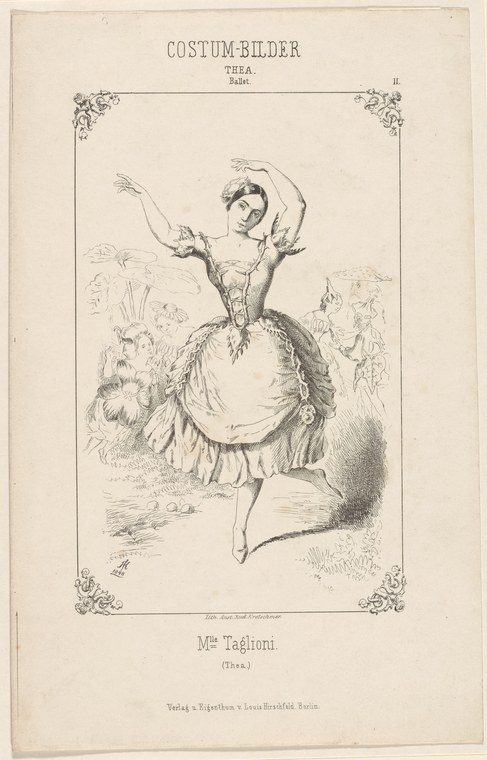
Mlle. Taglioni. (Thea.)
Unknown artist
- Collection:
- Prints depicting dance
- Source:
- New York Public Library
- Rights:
- Public domain — free to use, share and adapt.
- Recorded as:
- Public Domain
Taglioni was the first great international ballet celebrity and the dancer most closely associated with the invention of Romantic ballet technique, including the development of pointe work as an expressive rather than acrobatic tool. This image is documentary evidence of how a canonical figure in dance history was visualized and celebrated during her own lifetime, and it shows the public face of a revolution in movement vocabulary that still structures ballet training today.
What you are looking at
A young woman in a pale, high-waisted dress with puffed sleeves stands in a graceful pose against a naturalistic background of foliage and distant scenery. Her body is arched in a balletic attitude, one arm raised above her head in a curved line while the other extends outward; her weight appears to rest on one leg while the other bends beneath her skirt. The dress, with its gathered skirt and delicate proportions, is typical of early 19th-century theatrical costume. The composition is framed by decorative corner flourishes in the rococo style. In the background, partially rendered attendant figures watch from the wings or garden setting, establishing this as a performance or entertainment rather than a private moment.
The dancing
A single dancer is shown in a lyrical, supported pose — the body arched backward with one leg raised, the supporting leg straight but not locked, and both arms positioned in graceful curves above and to the side of the body. The pose suggests a moment of elevation or suspension, characteristic of Romantic-era ballet technique. The figure occupies most of the frame, emphasizing the importance of the dancer's line and the balletic silhouette. No partner or support is visible, though the pose is one that would typically be achieved in partnered work.
The dance depicted
This is almost certainly a representation of Marie Taglioni, the Swedish dancer who revolutionized ballet in the 1830s by introducing the ethereal, weightless aesthetic of Romantic ballet and establishing pointe work as a central technique. The pose — an arabesque penché or similar attitude — exemplifies the elevated, spiritualized movement vocabulary she championed. Taglioni was the prototype of the Romantic ballerina: ethereal, technically accomplished, and associated with supernatural or otherworldly roles. The image captures the visual hallmark of her era: the focus on verticality, elongation, and an almost gravity-defying elegance that distinguished Romantic ballet from the more grounded classical vocabulary of the preceding generation.
How it was made
This is an engraving or possibly a lithograph, printed in black line on cream paper and hand-colored or naturally aged to a warm tone. The technique allowed for fine linear detail in the figure and the decorative framing while suggesting landscape and atmosphere through cross-hatching and selective line work. The ornamental borders and the title cartouche in the rococo style are typical of mid-19th-century theatrical and costume prints, which were mass-produced, affordable, and circulated widely among theater-goers and dance enthusiasts. The print medium made celebrity dancers like Taglioni accessible to audiences who could not attend live performances.
About this work
This is a celebrity portrait of Marie Taglioni, the dominant figure of Romantic ballet, presented as a theatrical print in the style common to the 1830s–1840s. The image documents both the physical vocabulary of early Romantic ballet — the verticality, the apparent weightlessness, the lyrical arm placement — and the popular appetite for images of famous dancers. Taglioni's influence on ballet technique and aesthetic was so profound that she became the template for an entire generation of dancers and artists. This print is both a record of how an individual dancer moved and of the ideal of feminine movement that Romantic ballet created and disseminated.
How to look at it
The pose is not a frozen moment of everyday movement but an idealized moment of stillness within a sequence of balletic positions — an attitude or arabesque at its fullest extension. The arched back, the lifted supporting leg, and the curved arms are designed to emphasize verticality and lightness despite the pull of gravity. Note how the artist has rendered the dress as both revealing the line of the body beneath and suggesting its own buoyant, ethereal quality. The landscape background and the attendant figures situate this as a theatrical moment, not a studio exercise, allowing the viewer to understand this as the appearance the dancer created before an audience.
The artist
The artist is unrecorded on the catalogue entry. The style and printing technique are consistent with mid-19th-century French and European theatrical print makers, and the inscription "Taglioni. (Thea.)" suggests this is from a published series of theatrical costume or celebrity portraits. Such prints were often created by multiple hands — designer, engraver, printer — and were frequently anonymous or credited only to a publishing house. The rococo decorative border and hand-coloring technique point to a European printmaking workshop accustomed to producing fashionable theatrical imagery.
The period
This print dates to the height of Romantic ballet, approximately the 1830s–1840s, when ballet underwent a profound shift away from the classical virtuosity of the late 18th century toward an aesthetic of otherworldliness, narrative, and feminine grace. Marie Taglioni's 1832 debut in La Sylphide established the new vocabulary: pointe work, ethereal costuming, narrative ballet d'action, and a spiritual rather than sensual ideal of the female body in motion. The same period saw a surge in the production and consumption of theatrical prints, which served as a primary means by which dancers' images and reputations circulated beyond the opera house. This print is a product of that culture of celebrity and visual documentation.
Where it lives
The work is held in the New York Public Library's collection of prints depicting dance (possibly the *Theatre Collection* or a related dance-specific holding). It is part of a broader cultural archive of theatrical imagery that documents both the history of dance and the visual culture of 19th-century entertainment.
Dance in this work
Questions about this work
Was this Marie Taglioni herself, or is this just a costume print?
This is a portrait of the specific dancer Marie Taglioni, identified by name on the print, created during her lifetime or shortly after. It is not a generic costume plate but a celebrity image — it documents how this particular dancer was remembered and sold to the public. Whether it is based on a live observation, a sketch from performance, or a studio sitting is unknown from the record alone.
What is the pose she is in?
The pose is an arabesque penché or attitude, fundamental positions in ballet vocabulary. In both, the dancer stands on one straight supporting leg while the other leg is raised behind or to the side. The arched torso and curved arms add lyricism to the geometric geometry of the leg line. This pose exemplifies Romantic-era ballet aesthetics: it looks effortless, weightless, and spiritual — precisely the qualities Taglioni introduced to ballet.
What made Taglioni so important?
Taglioni was the first internationally famous dancer and the figure most closely associated with Romantic ballet. She made pointe work central to ballet technique (previously it had been a minor embellishment), revolutionized costume design by introducing the short, ethereal tutu, and created or performed in narrative ballets like *La Sylphide* that became the template for ballet for the next century. Her influence on how dancers move and how they are imagined remains fundamental.
Why are there other figures in the background?
The background figures — attendants, courtiers, or fellow dancers — establish this as a theatrical scene rather than a studio portrait. They may be part of the narrative of the ballet being danced, or they may simply indicate that this is a performance moment being captured for public consumption. The composition privileges Taglioni in the foreground while acknowledging the context of theater and spectacle.
More dance artwork





