49 works in this view — arrow keys or swipe to move between them.
Dance in Art
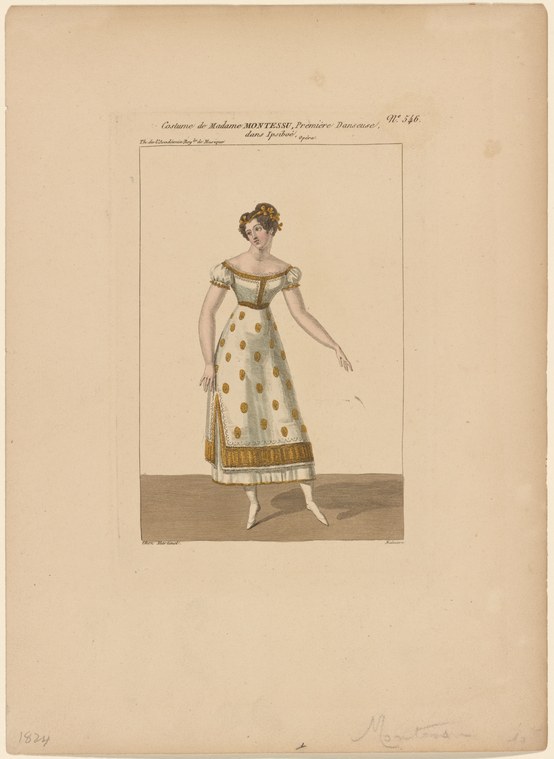
Costume de Madame Montessu, premiere danseuse, dans Ipsiboé, opéra, Th. de l'Académie roy'le de musique
Unknown artist
- Collection:
- Prints depicting dance
- Source:
- New York Public Library
- Rights:
- Public domain — free to use, share and adapt.
- Recorded as:
- Public Domain
This is evidence of how early 19th-century ballet was presented to the public through the celebrity of named dancers and the allure of costume design, rather than through records of choreography. The print shows the sophisticated intersection of fashion, printmaking, and theatrical marketing in the Romantic era, and tells us who Madame Montessu was and how she was valued by her audience and her theatre.
What you are looking at
A single female dancer stands in a contrapposto pose against a neutral background, wearing the formal dress of a Parisian opera dancer of the early 19th century. Her costume consists of a high-waisted muslin gown with a cream ground decorated with golden-brown motifs arranged in a scattered pattern across the skirt; the bodice is fitted with a bronze or gold-coloured band at the waist and a darker crossover drape at the bust. Her short puffed sleeves sit off the shoulders in the Regency fashion. She wears her hair up in a classical arrangement with curled tendrils framing her face. Her posture is relaxed and graceful, with her weight resting on one leg while the other is lightly posed; her arms hang at her sides with hands delicately positioned. The figure is rendered in hand-coloured engraving or aquatint, with careful attention to the fall of fabric and the subtle modelling of the skin. A narrow line frames the composition, and the ground beneath her feet is rendered in a soft grey wash.
The dancing
A single dancer occupies the frame in a standing pose that suggests ease and display rather than active movement. Her weight is settled into one leg while the other is placed lightly forward, a disposition common in Romantic-era ballet for showing the line of the leg and foot. The torso is held upright but without visible tension; the arms rest naturally at the sides. The pose is not one of violent action but of presentation — the kind of moment a dancer might hold while the audience admired her costume and carriage. The proportions and posture suggest training in the academic ballet technique of the period.
The dance depicted
This is a costume study for a named performer (Madame Montessu, described as a première danseuse) in a specific opera-ballet production (*Ipsiboé*, performed at the Théâtre de l'Académie Royale de Musique, the Paris Opéra). The image is not a record of a particular choreographic moment but rather a costume design or reference, showing what the dancer would have worn and how she presented herself to the audience. The standing pose and theatrical dress align with the conventions of Romantic ballet and opera-ballet hybrids of the 1820s–1830s. No specific dance style or technique is depicted here; instead, the work documents the visual spectacle and costume as an element of theatrical dance production.
How it was made
This appears to be a hand-coloured engraving or aquatint on paper, a standard medium for theatrical costume documentation and distribution in the early 19th century. The technique allowed for precise rendering of textiles and fine detail while remaining economical to print and circulate among theatregoers, subscribers, and collectors. The hand-colouring was applied after printing, giving each impression individual character and allowing the artist to suggest the richness of actual fabrics. Such prints served as both promotional material and a record of celebrated performances, and were often collected in albums or bound volumes dedicated to particular seasons or theatres.
About this work
This is a hand-coloured costume study of Madame Montessu, a leading dancer of the Paris Opéra in the early 19th century, as she appeared in *Ipsiboé*, an opera-ballet performed at the Théâtre de l'Académie Royale de Musique. The work is a professional print—probably created for circulation among theatre patrons and collectors—that documents both the dancer's status as a celebrated performer and the visual conventions of Romantic opera-ballet costume. Rather than depicting a moment of choreography, it presents the dancer as a figure of elegance and refinement, dressed in high-waisted muslin in the neoclassical taste, a costume aesthetic that dominated French opera and ballet in the 1820s–1830s. The print is a valuable record of how celebrated dancers were visually marketed and remembered, and of the dialogue between fashion, fine art, and theatrical spectacle in this era.
How to look at it
Look at the precision with which the engraver has rendered the texture of the muslin and the patterning of the embellishment—these details were as much a part of the spectacle as the dancer herself. Notice the careful balance of the pose: the body is at ease, not in a moment of exertion, which suggests that this is how Madame Montessu would have appeared to the audience during entrances, curtain calls, or moments of display between active dancing. The hand-colouring, applied to each impression by hand, gives this print an individual quality; if you could compare two impressions, you would see variation in how the gold of the embellishment was rendered. The narrow frame and plain background emphasize the figure herself, making her the sole object of attention—a convention of portrait printmaking adapted here to the theatre.
The artist
The artist is not recorded. The print was made for the Théâtre de l'Académie Royale de Musique (the Paris Opéra) and likely issued by a commercial theatrical print publisher active in Paris during the 1820s–1830s. Such prints were often drawn from stage observation or from designs made by costume designers and theatre painters, then engraved and hand-coloured for sale. The anonymity of the maker is typical for such commercial work, which was valued as a record and souvenir rather than as the expression of an individual artistic identity.
The period
This print dates to the height of Romantic ballet in Paris, a period when the Paris Opéra was the most prestigious dance theatre in Europe and when dancers such as Marie Taglioni and other étoiles became celebrities whose images were widely circulated in prints. The neoclassical high-waisted muslin costume seen here reflects both the lingering influence of Regency fashion (c. 1810–1820) and the Romantic interest in delicate, ethereal femininity. The format of the costume print—a single figure against a plain ground—became standardized as a way of promoting both the dancer and the theatre. *Ipsiboé* is an early example of the opéra dansante, the hybrid form that mixed sung narrative with extended dance sequences and was increasingly popular in Paris in the 1820s–1830s.
Where it lives
This print comes from the New York Public Library's collection of prints depicting dance. It is catalogued as a costume study or design document for a specific production, rather than as a general illustration or fine art print. Such prints were often collected in albums or sold individually as souvenirs.
Dance in this work
Questions about this work
Who was Madame Montessu?
She is identified in this print as a première danseuse (leading dancer) at the Paris Opéra. Beyond that, little is recorded beyond this image and possibly a few other prints and references in theatre records. Like many dancers of the era, she is known to us now primarily through theatrical imagery and archival fragments rather than through written biography.
What is *Ipsiboé*?
It was an opéra dansante (opera-ballet) performed at the Théâtre de l'Académie Royale de Musique in Paris, likely in the 1820s or early 1830s. No detailed record of its plot or choreography appears to have survived, but the title suggests an exotic or colonial subject, a popular theme in French opera and ballet of this period.
Why is the costume designed this way?
The high-waisted muslin gown, puffed sleeves, and neoclassical silhouette reflect both fashionable dress of the 1810s–1820s and the Romantic aesthetic that was beginning to dominate ballet design. Muslin was prized for its delicate appearance and its ability to move with the body, and the scattered golden embellishment suggests wealth and theatrical spectacle without overwhelming the line of the figure.
How was this print made and distributed?
It was engraved (or aquatinted) from a design, then hand-coloured. Such prints were sold individually or collected in albums, and were affordable to theatregoers of moderate means. They functioned as both souvenirs and promotional material, helping to build the celebrity of celebrated dancers.
More dance artwork





