49 works in this view — arrow keys or swipe to move between them.
Dance in Art
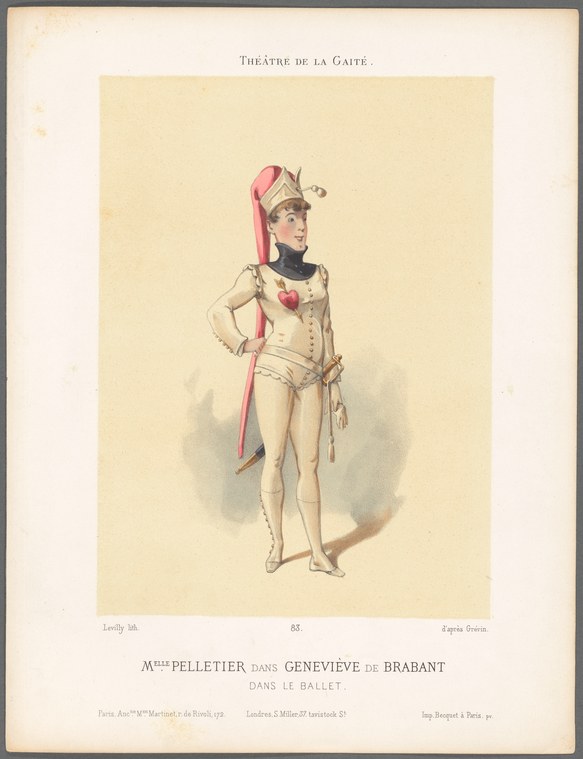
83. Melle. Pelletier dans Geneviève de Brabant dans le ballet, Théâtre de la Gaité
Unknown artist
- Collection:
- Prints depicting dance
- Source:
- New York Public Library
- Rights:
- Public domain — free to use, share and adapt.
- Recorded as:
- Public Domain
Melle. Pelletier and *Geneviève de Brabant* are now largely forgotten, yet this image preserves her in the exact form her contemporaries would have seen her—not as a historical fact but as a theatrical fantasy. Costume prints like this one are invaluable to historians of ballet, performance history, and material culture because they document what was actually worn, worn, how bodies were shaped by fashion and corsetry, and what visual identity a particular dancer and role commanded on stage.
What you are looking at
A young female dancer stands in three-quarter view against a pale yellow background, her body angled slightly to the right. She wears a fitted white tunic or bodice with short sleeves, decorated with gold or metallic trim at the neckline and cuffs, and a high gold belt at the waist. Her lower legs are bare and elongated, rendered in the idealized proportions of theatrical costume. A striking pink or red drapery swags from her left shoulder down her back—a cape or plume-like element that adds movement and drama to the static pose. Her headdress is military or classical in style, with a gold circlet and an upright plume or feather. She stands in a relaxed contrapposto, weight on one leg, one hand resting on her hip and the other at her side. The composition is a formal costume study: a single figure against neutral space, lit evenly to emphasize the cut and colour of the garment.
The dancing
A solitary dancer presents herself to the viewer as if in a formal portrait or costume plate. The weight is shifted onto the back leg, creating a gentle forward tilt of the torso and a graceful curvature through the spine. The arms are held naturally at the sides, with no sense of active partnering or dynamic movement. The bare legs are extremely elongated and refined, typical of theatrical idealization rather than naturalistic representation. There is no indication of pointe work or turnout; the stance is upright and relatively neutral, somewhere between standing and a theatrical fifth position.
The dance depicted
This is a costume study for a romantic ballet or operatic dance of the mid-to-late nineteenth century. The work is identified in the catalogue as documenting Melle. Pelletier performing in the ballet *Geneviève de Brabant*, a theatrical production mounted at the Théâtre de la Gaité in Paris. The costume—a classical or martial tunic with draped fabric—suggests either a heroic female role, a warrior, or a character from historical or legendary drama adapted for the ballet stage. The image is a record of costume and stage presence rather than a moment of choreography, but it tells us that Pelletier was a soloist of sufficient prominence to be documented in theatrical prints for public circulation.
How it was made
This is a hand-coloured lithograph or colour lithograph, a reproductive medium that allowed theatres to disseminate costume and performance records at relatively low cost. The technique involved drawing on stone and printing in successive layers of colour—here a pale cream ground with selective application of gold, white, pink, and flesh tones. Hand-colouring may have been added afterward. Lithography was the dominant technology for theatrical prints and dance costume documentation from the 1830s onward, allowing for large print runs that reached audiences, collectors, and archive institutions. The refined linework and tonal subtlety visible in the face and fabric indicate a skilled lithographic draughtsman working from a costume sketch or studio study.
About this work
This is a theatrical costume print documenting a dancer and a specific ballet performance at a major Parisian venue in the nineteenth century. It belongs to a rich tradition of dance ephemera—prints that served both as promotional materials and as a historical record of what bodies wore on stage. The work captures not choreography but presence: the silhouette, the carriage, the luxury and idealization of theatrical dress that made a performer recognizable to her public. Such prints circulated in albums and loose-leaf collections, and were acquired by theatregoers, dance enthusiasts, and institutional collectors; they represent one of the primary visual records of nineteenth-century European ballet before the age of photography.
How to look at it
Observe the extreme refinement of the legs and the subtle contrapposto, which convey grace and nobility without showing active motion. Notice how the draped pink fabric is rendered in soft gradation, giving it weight and elegance—it reads as actual silk, not a flat graphic element. The face is rendered with delicate precision, making the figure a portrait as well as a costume study. The print is meant to be studied as a souvenir: it preserves not what Pelletier did on stage, but what she was, what she wore, and how she was remembered by the theatre-going public of Paris.
The artist
The artist is not recorded in the catalogue, a common situation with theatrical prints of this era. The work carries a credit line indicating Paris publishers and a printer or lithographer ('Imp. Brocq à Paris, pr.' or similar), which suggests it was produced by a commercial theatrical print house rather than a fine artist working under a personal signature. The refinement of the execution indicates a professional atelier accustomed to producing costume studies for actors and dancers.
The period
This print dates to the period of French Romantic ballet, when Paris was the epicentre of European dance. The Théâtre de la Gaité was a major venue for popular ballet and opéra comique, distinct from the more prestigious Opéra. The costume style—simplified classical tunic with modern stage embellishment—reflects the mid-nineteenth-century taste for historicizing and orientalizing female roles while maintaining the refined silhouette demanded by contemporary aesthetics. Lithographic colour prints of dancers and performers were a booming market: they were affordable, collectable, and highly valued by audiences for preserving the memory of beloved performers and ephemeral productions.
Where it lives
The work is held in the New York Public Library's collection of prints depicting dance, a significant repository of theatrical ephemera from the nineteenth century. It is one of many such costume prints that were collected as souvenirs, pasted into albums, and preserved by theatregoers and dance enthusiasts.
Dance in this work
Questions about this work
Who was Melle. Pelletier?
Melle. (Mademoiselle) Pelletier was a dancer at the Théâtre de la Gaité in Paris, known for performing in the ballet *Geneviève de Brabant*. Beyond this theatrical print, little is documented about her career or life. She represents the class of working professional dancers who were celebrated during their time but left little archival trace beyond costume prints and occasional mentions in playbills.
What is *Geneviève de Brabant*?
This was a ballet produced at the Théâtre de la Gaité, likely in the mid-nineteenth century. It drew on the legend of Saint Genevieve of Brabant, a popular subject for theatrical adaptation in France. The ballet combined narrative, spectacle, and dance roles, with Pelletier apparently dancing a heroic or martial female character, judging from her costume.
How were theatrical prints made and distributed?
Lithographic prints like this one were drawn on stone and printed in colour, often with hand-finishing. They were sold in theatres, in print shops, and by subscription; they cost a few francs and were affordable to middle-class theatregoers. They served as souvenirs, were collected in albums, and were used as publicity material, making them one of the primary ways a performer's image reached the public before the age of photography.
More dance artwork





