49 works in this view — arrow keys or swipe to move between them.
Dance in Art
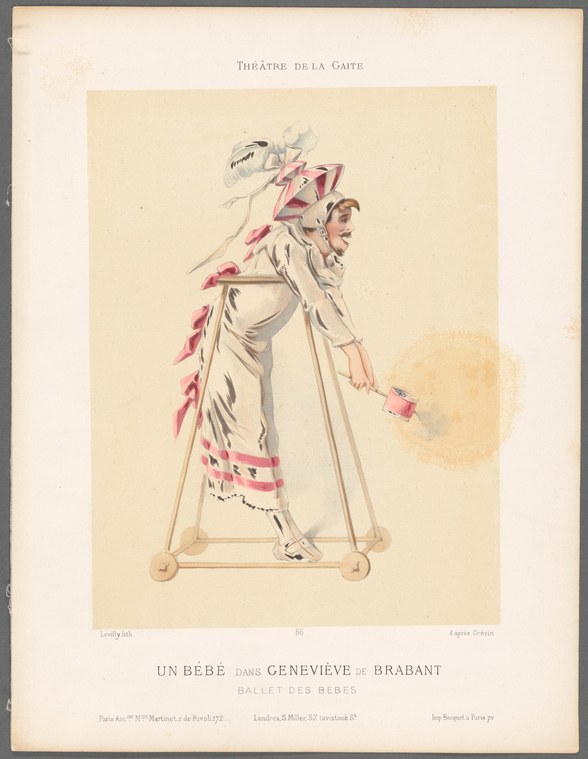
86. Un bébé dans Geneviève de Brabant, ballet des bébés, Théâtre de la Gaité
Unknown artist
- Collection:
- Prints depicting dance
- Source:
- New York Public Library
- Rights:
- Public domain — free to use, share and adapt.
- Recorded as:
- Public Domain
This print is a rare surviving document of 19th-century theatrical ballet at the Théâtre de la Gaité, a popular Parisian venue. It shows how costume and pose were designed as a unified visual statement, not incidental decoration—the ribbons are integral to the choreographic or aesthetic intention. For historians of dance costume and Romantic ballet pedagogy, the image demonstrates the close collaboration between designer, costumer, and dancer in realizing a theatrical vision.
What you are looking at
A single dancer in classical dress stands posed on an elevated platform supported by four legs, as if mounted on a theatrical apparatus or pedestal. The figure wears a pale, flowing tunic or chemise gathered at the waist, with elaborate pink and crimson ribbons cascading down the back and sides—suggesting movement or decoration in the manner of Romantic ballet. The dancer is captured in three-quarter profile, one arm extended, the other bent, the body angled to suggest mid-gesture. The platform beneath is rendered in simple line-work; the background is a warm cream-yellow wash with a diffuse golden-orange glow at lower right, creating an ethereal, stage-lit atmosphere. The entire composition is framed within a rectangular border. The image is a hand-colored print, likely a theatrical illustration or costume design document.
The dancing
A single dancer (appearing to be female, given the tunic and ribbons) stands in a contrapposto pose on the platform, with the weight shifted to one leg. The torso tilts slightly forward; the arms are raised and bent, positioned as if in an arabesque preparation or mid-gesture of Classical movement. The flowing ribbons obscure the lower body, but the upper frame suggests a lifted, elongated line—the posture typical of early Romantic ballet pedagogy. The platform isolation emphasizes the dancer as a sculptural object, separating her from ground contact in a manner that reads as either theatrical convention or a deliberate pedagogical device.
The dance depicted
The work is associated with *Geneviève de Brabant: Ballet des Bébés* (*Ballet of Babies*), a theatrical production staged at the Théâtre de la Gaité. This appears to be a costume or character study for that work. The inclusion of 'bébé' (baby) in the title suggests a children's or juvenile performance, though the technical posture and fabric treatment indicate professional or semi-professional execution. The style is consistent with mid-to-late 19th-century Romantic or post-Romantic theatrical ballet: the tunic, soft pointe-work readiness, and decorative ribbonry are hallmarks of the period's aesthetic. Without additional context, it is difficult to determine the specific narrative role or choreographic style, but the formal isolation and pose suggest this is either a principal character study or a design document for costume construction and performance execution.
How it was made
This is a hand-colored lithographic or engraved print, characteristic of 19th-century theatrical documentation and costume illustration. The delicate line-work of the figure and platform, combined with the soft watercolor or chalk wash of the background and ribbon detail, suggests a print colored after initial publication—a common practice for distributing designs to costumers, choreographers, and theatre archives. The technique allowed for rapid reproduction and wide distribution among theatrical professionals, making this a functional design document as well as a commemorative image. The inscription at the foot—*Theatrè de la Gaité* and credit lines—confirms its role as an official theatrical record.
About this work
This is a costume or character design for a dancer in *Geneviève de Brabant: Ballet des Bébés*, a 19th-century theatrical production. The print documents a single figure in Classical ballet posture, adorned with flowing ribbons, isolated on a stage platform. It belongs in a dance archive as evidence of Romantic-era theatrical practice: the intersection of costume design, choreographic documentation, and the visual culture of professional ballet. The image records how a specific body and costume were conceived to be seen—a frozen moment of professional dance practice.
How to look at it
Observe the relationship between the body and the platform: the dancer is isolated, not grounded, suggesting either a theatrical trick or a pedagogical isolation device. Look at the ribbon treatment—are they static decoration or implied movement? The artist has rendered them as if in motion, falling away from the body, which reads as either a moment of active turning or simply as visual embellishment designed to elongate and etherealize the figure. The soft background glow is a theatrical lighting effect, framing the figure as a stage-lit spectacle. The pose itself—neither fully extended nor in repose—captures a transitional moment, consistent with Romantic ballet's emphasis on effortless, floating movement.
The artist
The artist is not recorded in the catalogue. The inscription credits the Théâtre de la Gaité and includes printing details (*Librairie E. Minot, successeur à J. Guérin et Cie*) suggesting commercial publication. The hand-coloring was likely executed by studio assistants or colorists attached to the theatre or publisher, a standard practice for theatrical illustration of the period.
The period
This work dates to the mid-or-late 19th century, during the era of Romantic ballet's decline and the emergence of theatrical spectacle as a primary draw for popular audiences. The Théâtre de la Gaité was known for lavish, accessible productions targeting a broad public rather than the elite operatic clientele of the Opéra. The inclusion of 'bébés' in the title suggests a children's or juvenile entertainment, reflecting 19th-century theatre's expansion into family and youth audiences. The soft, ethereal aesthetic of the costume and pose—the ribbons, the lifted posture—echoes Romantic ballet conventions even as commercial theatre increasingly prioritized novelty and spectacle over narrative ballet.
Where it lives
The print is held in the New York Public Library's collection of prints depicting dance. It was originally published by the Théâtre de la Gaité or its associated publisher, *Librairie E. Minot*, as part of official theatrical documentation and promotional material. Such prints were distributed to theatres, costumers, and archives as working documents.
Dance in this work
Questions about this work
What is a 'Ballet des Bébés' and who performed in it?
A 'Ballet des Bébés' (Ballet of Babies) was a theatrical entertainment, likely featuring child or juvenile dancers, popular in 19th-century Parisian theatre. The Théâtre de la Gaité specialized in spectacular, accessible productions for broad audiences. Beyond this print, specific details of the production—choreography, performers, and narrative—are not established here.
Why is the dancer standing on a platform?
The elevated platform may represent a theatrical device or stage element used in the production, or it may be a convention of costume illustration—isolating the figure for clarity. Some 19th-century pedagogical and performative contexts used platforms to emphasize posture or to create visual isolation. Without additional context, its exact function cannot be determined.
Is this a design sketch or a finished performance record?
This is most likely a printed design document, produced after or during the production run, for distribution to costumers, choreographers, and theatre archives. It combines the precision of a costume illustration with the soft, stage-like atmospheric rendering typical of theatrical prints. It served as both a working document and a commemorative image of the production.
More dance artwork





