49 works in this view — arrow keys or swipe to move between them.
Dance in Art
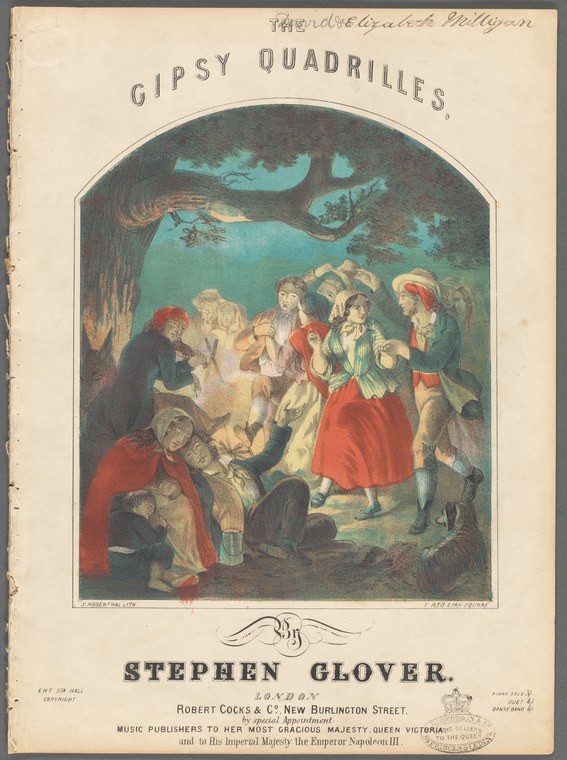
The Gipsy quadrilles by Stephen Glover [includes score]
Unknown artist
- Collection:
- Prints depicting dance
- Source:
- New York Public Library
- Rights:
- Public domain — free to use, share and adapt.
- Recorded as:
- Public Domain
Quadrilles dominated social and theatrical dance from the 1830s through the 1860s, yet they are often invisible in dance history because they are neither ballet nor folk. This image makes visible the narrative and theatrical dimensions of quadrille culture—the theatrical themes, exotic fantasies, and dramatic storytelling that attended fashionable social dance. It demonstrates that mid-century dance entertainment relied as much on narrative spectacle and visual design as on dance technique itself.
What you are looking at
A moonlit outdoor gathering in a woodland setting, rendered in the dramatic tones characteristic of 19th-century color printing. A group of figures in Romantic-era costume assembles around a central bonfire or light source, their forms silhouetted and highlighted against a turquoise-tinted night sky. The composition is framed within an arched border, suggesting a theatrical tableau. The figures wear the dress of the period—women in full skirts with fitted bodices, men in dark jackets and hats—and their poses suggest animation and social interaction rather than formal arrangement. The scene conveys a sense of narrative moment: this appears to be a dramatic or romantic episode involving multiple characters, with the outdoor setting and nocturnal lighting creating an atmosphere of adventure or transgression. The foreground shows several figures in closer detail, while others recede into shadow, creating depth and focus.
The dancing
The figures occupy varied positions suggesting movement and social engagement rather than aligned formation. Some stand upright in conversation or observation; others lean or bend toward the central light. The postures are naturalistic rather than balletic—these are social bodies in informal interaction, not dancers arranged in concert. Skirts and clothing occupy substantial visual weight, constraining and shaping the movement visible. The grouping suggests multiple dyads or small clusters rather than a unified ensemble, and the relative positions imply narrative relationships—attention, courtship, conflict, or conspiracy—rather than choreographic pattern.
The dance depicted
This is The Gipsy Quadrilles, a Romantic-era theatrical dance or theatrical music work published as a quadrille suite. Quadrilles were the dominant social and theatrical dance form of the 1830s–1860s, typically performed in sets of five figures by four couples (or eight dancers). This image illustrates a dramatic moment from a narrative quadrille, likely titled or themed around 'gypsy' motifs and exoticism popular in Romantic ballet and theatre. The scene captures not the dance itself in technical form but rather the theatrical context and narrative moment the quadrilles were meant to evoke—a gypsy encampment, an encounter, a gathering of outsiders. The quadrilles would have been performed to music like that printed below, and the narrative framing suggests a spectacle blending social dance technique with staged drama.
How it was made
This is a hand-colored engraving or lithograph, typical of mid-19th-century music publication design. The theatrical scene and title appear above the image, and the musical score and publication details (Robert Cocks & Co., New Burlington Street, music publishers to Queen Victoria) appear below. The color palette—particularly the distinctive turquoise night sky and warm flesh tones—was applied by hand or via chromolithography, a labor-intensive process that made colored dance prints luxury objects circulating among music teachers, piano students, and theatre-goers. The medium and presentation indicate this was a commercial publication tied to theatrical performance or fashionable drawing-room entertainment, with high production values suitable for display in genteel homes.
About this work
The Gipsy Quadrilles is a mid-19th-century theatrical music publication illustrated with a romantic narrative scene rather than instructional dance notation. Stephen Glover, the composer, supplied both the music and (implicitly) the narrative framework—a gypsy gathering by night—for a quadrille suite that blended fashionable social dance form with theatrical spectacle and Romantic-era fascination with exotic and transgressive subject matter. The image sits at the intersection of music publishing, dance culture, and theatre design: it is not a record of how the quadrilles were danced, but rather a window into how mid-century audiences imagined the theatrical narratives their dances evoked, and how commercial publishers marketed dance music through visual fantasy.
How to look at it
Attend to the narrative and theatrical staging rather than the dance technique. Notice how the figures are grouped to suggest relationship and drama—who looks at whom, who stands apart, who is illuminated and who recedes. The moonlit, otherworldly setting and the 'gypsy' costume and milieu are the real subjects; the dance itself is secondary to the fantasy. Observe also that this is a design object meant to be owned, looked at, and referred to while playing the music on a piano at home—the image is inseparable from the score and publication details below it. The colored printing and theatrical framing transformed a piece of social dance music into a luxury object and a window onto Romantic theatrical fantasy.
The artist
Stephen Glover (1812–1870) was an English composer, pianist, and theatrical musician known for works in the lighter genres—ballets, operettas, farces, and dance music. He was active in theatre and concert life, composing extensively for performance and publication. His quadrille suites were among the most popular and commercially successful dance music of the mid-century, published by Robert Cocks & Co. and circulated throughout Britain and the English-speaking world. The Gipsy Quadrilles exemplifies the theatrical and commercial strategy of mid-century dance music: a fashionable social dance form paired with exotic narrative themes and sumptuous visual presentation.
The period
The 1830s–1860s were the height of both Romantic ballet and quadrille culture. While theatrical ballet audiences saw supernatural and exotic narratives on stage (Giselle, La Sylphide, Le Corsaire), drawing-room dancers and piano students engaged with similar narratives through published quadrilles and cotillions. 'Gypsy' themes were particularly fashionable in Romantic art and theatre, signifying freedom, passion, exoticism, and moral transgression—qualities the respectable middle classes could experience vicariously through music and dance in the home or ballroom. The theatrical context of this image—a nocturnal outdoor scene lit by firelight, a gathering of exotic outsiders—mirrors the visual and thematic language of Romantic ballet design.
Where it lives
Published by Robert Cocks & Co., music publishers at New Burlington Street, London, and appointed music publishers to Queen Victoria. The work appears in the New York Public Library's collection of dance-related prints. The inscription at the top indicates presentation or ownership, suggesting this was a valued and circulated object within 19th-century music and dance culture.
Dance in this work
Questions about this work
What is a quadrille and how was it danced?
A quadrille is a social dance in five figures (sections) typically performed by four couples facing each other in a square formation. It dominated fashionable ballrooms from the 1820s through the 1870s. Unlike ballet, quadrilles relied on simple walking steps, turns, and coordinated group movement that ordinary dancers could learn, making them ideal for social entertainment. They were danced to live music, often in themed suites with narrative titles like this one.
Why did Victorian dance music have 'gypsy' or exotic themes?
Romantic-era culture was fascinated by the idea of 'gypsies' (Romani people) as symbols of freedom, passion, and otherness. These themes appeared in Romantic ballet (Carmen, La Bohémienne) and in theatrical entertainment more broadly. Publishing quadrilles with exotic titles and illustrated scenes allowed middle-class dancers to imagine themselves living out Romantic fantasies of adventure and transgression in a controlled, respectable setting.
How did people learn these dances?
Dance masters published instruction books with notation and diagrams, but most people learned from live teachers or by observing others in ballrooms and at assemblies. The music publication itself, with its theatrical illustration, was a supplement—a souvenir and reference object for someone who had already learned the dance, or a stimulus to imagination while playing the music at home.
Who was Stephen Glover?
Stephen Glover (1812–1870) was a prolific English composer and pianist specializing in theatrical music, ballets, operettas, and dance music for social performance. His quadrille suites were among the most popular published dances of the mid-19th century, and this work exemplifies his skill at combining fashionable dance forms with theatrical narrative and visual appeal.
More dance artwork





