49 works in this view — arrow keys or swipe to move between them.
Dance in Art
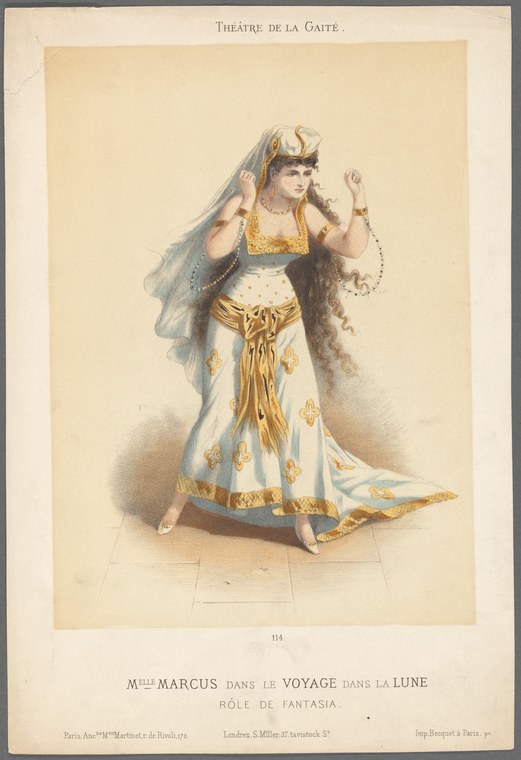
114. Melle. Marcus dans Le voyage dans la lune, rôle de Fantasia, Théâtre de la Gaité
Unknown artist
- Collection:
- Prints depicting dance
- Source:
- New York Public Library
- Rights:
- Public domain — free to use, share and adapt.
- Recorded as:
- Public Domain
This print captures the aesthetic and economics of 19th-century theatrical spectacle, where dance and pantomime were vehicles for elaborate costume, set design, and visual fantasy rather than technical virtuosity. It documents a specific performer and production now largely lost to history, preserving the character design and the way contemporary audiences experienced and collected theater. For historians of dance, dress, and theater, it reveals how commercial entertainment defined and deployed the female body on stage.
What you are looking at
A single female dancer stands in a three-quarter pose against a neutral cream background, her body angled to the left while her gaze is directed toward the viewer. She wears an elaborate costume combining classical and fantastical elements: a white pleated or gathered skirt with gold embroidered borders, a fitted gold bodice, and a diaphanous blue-grey veil or drapery that cascades from her hair and floats behind her shoulders. Her hair is crowned with an ornate tiara or headdress, and she wears bracelets on both wrists. Her left arm is raised to adjust or hold the veil near her face in a gesture of theatrical refinement, while her right arm rests lower. The figure is rendered in soft pastels and watercolor, with careful attention to the translucency of the fabrics and the modeling of light across the pleated skirt. This is a costume study or character portrait rather than a narrative scene.
The dancing
The dancer is a soloist, presented in a static or transitional pose rather than mid-motion. Her weight appears to be centered, legs straight and close together, with no visible turnout or balletic positioning. The raised left arm creates an elongated vertical line from shoulder to the veil she touches; the gesture is graceful but sustained rather than dynamic. There is no evidence of pointe work, elevated positions, or balletic technique. The pose emphasizes the costume and character above the body's technical capability, characteristic of theatrical tableau vivant or romantic-era stage portraiture.
The dance depicted
This is Mlle. Marcus in the role of Fantasia from 'Le Voyage dans la Lune' (A Trip to the Moon), a spectacular theatrical production at the Théâtre de la Gaité. The work depicts a performer in costume rather than in the midst of choreography; it documents the fantastical character design and theatrical apparatus of late 19th-century Paris opera-ballet. The costume itself—a fusion of classical drapery, orientalist elements (the veil, tiara, bracelets), and contemporary stage fantasy—suggests that Fantasia was a character role in a féerie or spectacular drama rather than a classical ballet. The pose is one of refined repose or entrance, capturing the visual spectacle the audience would have seen rather than active dance technique.
How it was made
This is a hand-colored lithograph or chromolithograph, evident from the soft gradations of color, the chalky texture of the pastels, and the gentle shading that models form without line. The technique was ideal for theatrical costume documentation and celebrity portraiture, allowing broad circulation as prints. The coloring appears to have been added after printing, with individual attention to each impression—the fluency of the blue veil and gold embroidery could not have been achieved through print alone. This form of theatrical souvenir was standard in Paris during the 1870s–1880s, allowing audiences to collect images of favorite performers and productions.
About this work
This is a costume portrait of a performer in a major Parisian spectacular theater production. The work documents not a dance in the classical sense but a character role within the elaborate féerie or fantasy-drama that dominated the Théâtre de la Gaité's repertory. It is evidence of how 'dance' in late 19th-century Paris encompassed theatrical spectacle, pantomime, and character work alongside pure choreography. The image circulated as a printed souvenir, a form of theatrical publicity and fan culture that was essential to the economics of commercial theater. Its value to a dance historian lies not in technique but in costume, character, and the lavish visual culture of Parisian stage entertainment.
How to look at it
Observe the costume in detail: the tiara is neither purely classical nor orientalist, but a hybrid fantasy element meant to signal 'otherworldly' on stage. The veil functions both as drapery (lending grace) and as practical stage apparatus (it could move, float, obscure). The pose is not natural but composed—the raised arm and angled torso create an elegant silhouette meant to be read from the front rows of the theater. The soft rendering of the fabrics, especially the translucency of the veil, shows what the artist understood about how stage lighting would interact with the costume. This is a designer's document as much as a performer's portrait.
The artist
The lithograph is credited to the Théâtre de la Gaité production archive and printed by a commercial Parisian press (likely Imp. Boquet based on the imprint notation). The artist of the costume design or portrait drawing is not recorded. Such theatrical costume prints were a significant industrial output in Paris during this period, produced by specialist printers working with stage photographers or costume illustrators. The prints were sold in theater foyers and through print sellers, creating a mass market for theatrical ephemera.
The period
This image dates to the heyday of the féerie and the grandes productions at theaters like the Gaité and Châtelet (1870s–1890s). The Voyage dans la Lune, likely based on Jules Verne's novel, exemplified the spectacular theater that competed with ballet and opera during the Belle Époque. Ballet itself was in transition: the Romantic era's emphasis on ethereal, story-driven choreography was giving way to the technical virtuosity of the Cecchetti method and the rise of the *ballets russes*. At the Gaité, however, dance was subordinate to visual spectacle, mechanized stage effects, and character pantomime. This print reflects an aesthetic distinct from the concert stage—theater for pleasure and amazement rather than artistic refinement.
Where it lives
This print is held in the New York Public Library's collection of theatrical and dance prints. It is part of the broader archive of 19th-century Parisian stage ephemera—the cheap, mass-produced images that audiences bought at the theater door. The notation '114' suggests it is part of a bound or numbered collection, possibly a compiled portfolio of productions from the Gaité or a general collection of theatrical costume studies.
Dance in this work
Questions about this work
What was the Théâtre de la Gaité?
A major commercial theater in Paris, particularly famous for elaborate spectacular productions (féeries) and pantomimes, as opposed to straight drama or classical ballet. It was known for visual excess, machinery, costume, and popular entertainment.
Is this a ballet?
No, not in the classical sense. 'Le Voyage dans la Lune' was likely a spectacular theater piece or féerie—a theatrical genre mixing pantomime, music, dance, and elaborate stage effects. Mlle. Marcus's role as Fantasia was probably a character part involving movement and gesture rather than choreographed dance.
Why is there no motion in the pose?
This is a costume portrait designed for circulation as a souvenir print, not a documentary image of choreography. It captures the character and visual effect the audience would see, frozen in an elegant, readable pose rather than mid-movement.
Who was Mlle. Marcus?
A performer at the Théâtre de la Gaité whose name appears in this production. Beyond this credit, little is recorded. Like most performers in commercial theater of the era, she is known mainly through surviving prints and playbills.
More dance artwork





