49 works in this view — arrow keys or swipe to move between them.
Dance in Art
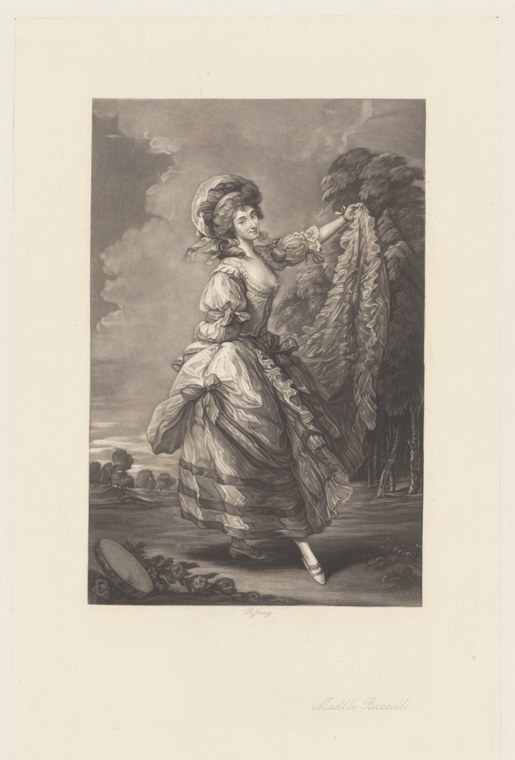
Madlle Baccelli
Unknown artist
- Collection:
- Prints depicting dance
- Source:
- New York Public Library
- Rights:
- Public domain — free to use, share and adapt.
- Recorded as:
- Public Domain
As a named record of an individual professional dancer, this print preserves evidence of how women performers were visualized and celebrated in the 18th-century theatre, and it demonstrates the continuity between social grace and theatrical technique in the period. The engraving is a primary source for understanding the posture, costume, and aesthetic ideals of Romantic-era ballet, before the invention of photography made such prints less central to theatrical fame.
What you are looking at
A young woman in 18th-century dress stands alone in a pastoral landscape, her body angled sharply to the left in a pose of deliberate elegance. She wears a pale muslin gown with high waistline and puffed sleeves, the skirts caught and gathered at one hip to reveal the shape of her legs and the delicate curve of her calf. A gauzy scarf or mantle drapes from her shoulders and sweeps dramatically across the composition, the fabric caught mid-motion as if she has just twisted or turned. Her left arm is raised and extended, the hand grasping the flowing drapery; her right arm hangs at her side. Her head is turned back toward the viewer, her expression serene, her hair arranged in loose ringlets beneath a close-fitting cap or bonnet. Behind her stretches a calm landscape with distant trees and water, rendered in soft grey tones that place the figure clearly in the foreground. The engraving is executed with fine cross-hatching that creates strong contrasts between the pale flesh and pale fabric, and the deeper tones of the background and shadows. The print is mounted on cream paper and bears a title inscription at the bottom.
The dancing
A single dancer stands in a pose of classical equilibrium and grace, her weight appearing settled on her right leg while her left extends slightly forward and to the side, the knee softly bent. Her body is held upright and composed, the spine extended, creating the elongated line valued in academic dance training. The raised left arm frames the upper body; the right arm hangs naturally, both hands participating in the gesture of the draping fabric. The pose suggests a moment of stillness within or after motion—a position that would be recognizable to anyone trained in the formal dance of the late 18th century.
The dance depicted
This is a portrait of theatrical dancing in the Romantic era, most likely depicting the technique and style of professional ballet as performed on the London and Paris stages in the 1780s–1790s. The figure's dress, posture, and the carefully composed moment suggest the formal vocabulary of demi-caractère or noble style dancing—the intermediate genre between pure classical ballet and the more exuberant comic or character forms. The pose itself demonstrates the alignment, turnout, and refined carriage expected of a professional dancer, with the raised arm and extended leg positioned according to the balletic frame of the period. The theatrical draping of the scarf or mantle (likely a prop or costume element worn by dancers of the era) adds both visual drama and narrative ambiguity—is she pausing in a dance, or has she stepped out of it into a moment of contemplation?
How it was made
This is an engraving, created using fine linear hatching and cross-hatching to model form and create tonal gradation. The technique is characteristic of 18th-century reproductive print-making, in which skilled engravers translated paintings or drawings into black-and-white images for wide circulation. The delicate quality of the line-work, particularly in rendering the translucent fabric and the subtle modeling of the face and neck, suggests the work of an accomplished printmaker. The scale and mounting suggest this was a commercial print produced for sale to a broad audience—dancers, patrons of dance, collectors of theatrical imagery, and the general public interested in fashionable subjects. The inscription at the foot of the sheet, in the style of Georgian publishing practice, would have identified both the subject and the maker(s).
About this work
This engraving captures a moment of theatrical dancing in the late 18th century through the figure of a single, named performer. The woman is shown in a pose of composed grace and technical refinement, her body aligned according to the balletic principles of her era, her costume and setting establishing her as a professional dancer of the stage rather than a participant in social dancing. The print circulated as a commercial object—a record of a celebrated performer, a demonstration of fashionable elegance, and evidence of how the dancing body was understood and valued in Romantic-era Britain. It belongs to the tradition of theatrical portraiture through dance, in which prints served as the primary medium for disseminating images of celebrated dancers to a public that could not always attend the theatre.
How to look at it
Observe the dancer's posture: the alignment of head, shoulders, and spine; the placement of the feet; the angle and lift of the raised arm. Notice how the artist has chosen to freeze the figure at a moment that emphasizes stillness and control rather than explosive movement—a deliberate choice that emphasizes the technical and aesthetic mastery required by professional dance. Watch how the fabric catches light and shadow, giving the dancing body a sense of volume and three-dimensionality. The landscape background, though distant and calm, anchors the figure in a narrative space—she is not merely an abstract body, but a particular person, in a particular place, at a particular moment.
The period
The late 18th century saw the consolidation of ballet as a professionalized theatrical form, distinct from social dancing and pantomime, with its own codified technique and aesthetic ideals. The Romantic ballet movement was beginning to emerge, emphasizing grace, weightlessness, and often exotic or otherworldly subjects. At the same time, the late 1700s saw an explosion in printed theatrical imagery—engravings, aquatints, and hand-colored prints depicting famous performers. These prints served both as souvenirs for theatre-goers and as fashion and beauty guides for a broader public. The period also saw women dancers achieving unprecedented fame and earning substantial fees, though they remained constrained by strict social codes governing female respectability and propriety. The pose and presentation in this print reflects both the technical ideals of the period and the complex negotiation of feminine beauty, bodily display, and artistic legitimacy that professional female dancers had to navigate.
Where it lives
This work is held in the New York Public Library's collection of prints depicting dance, a collection assembled to document the visual history of dancing bodies across periods, genres, and cultures.
Dance in this work
Questions about this work
Who was Mademoiselle Baccelli?
The catalogue record does not identify her beyond the inscription on the print. However, the formal presentation and the professional quality of the engraving suggest she was a celebrated performer of the late 18th century, likely active on the London or Paris stage. Without additional research beyond the image itself, her identity cannot be confirmed from this print alone.
What is she wearing?
A pale muslin gown in the neoclassical style of the 1780s–1790s, with a high waistline, short puffed sleeves, and ankle-length skirt. Over this she wears a gossamer drape or mantle, likely a theatrical costume element or fashion accessory. Her hair is loosely curled and confined by a close bonnet or cap. This outfit represents both fashionable dress of the period and the costume conventions of professional ballet.
What dance is this?
The pose does not depict a recognizable choreographed movement from a specific ballet, but rather demonstrates the refined posture and carriage expected of a professional ballet dancer. It is more likely a portrait of the dancer as such—showing her technical training and elegance—than a scene from a particular dance or narrative.
Why is the fabric flowing so dramatically?
The swirling drapery serves multiple purposes: it adds visual dynamism and interest to the composition; it suggests motion and energy even in a pose of stillness; it was likely a costume element or prop worn by the dancer; and it demonstrates the engraver's skill at rendering translucent fabric and complex folds. In theatrical portraiture, such drapery also connotes elegance, grace, and refinement.
More dance artwork





