49 works in this view — arrow keys or swipe to move between them.
Dance in Art
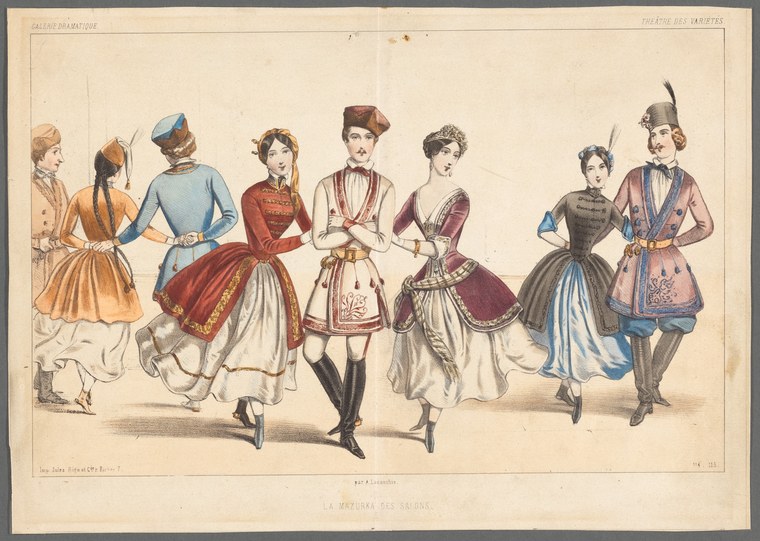
Théâtre des Variétés. La mazurka des salons: [Nos.] 114, 115
Unknown artist
- Collection:
- Prints depicting dance
- Source:
- New York Public Library
- Rights:
- Public domain — free to use, share and adapt.
- Recorded as:
- Public Domain
The mazurka was the defining couple dance of the Romantic ballet and ballroom era; its presence in the salon—the refined, theatrical version—tells us how professional and amateur dance were intertwined in the 19th century. This print is direct evidence of what the mazurka looked like in performance: the silhouettes, the costumes, the spatial arrangement, and the style of movement that influenced both ballroom dancing and theatrical choreography.
What you are looking at
Nine dancers in elaborate mid-19th-century costume are arranged in a loose procession or social formation across a pale stage. The figures progress from left to right with rhythmic spacing. All wear richly decorated dresses and jackets typical of the 1840s–50s: the women display full skirts, corseted waists, and ornate headdresses or bonnets; the men wear tailcoats, high-collared shirts, and decorated vests. The color palette is soft—ochres, blues, reds, burgundies—applied with fine hand-coloring to what appears to be a lithographed base. The poses suggest movement: several dancers are captured mid-stride or in turning positions, their bodies angled into the composition. The foreground shows a small figure (perhaps a child or page) in orange on the far left. The setting is indeterminate—neither ballroom nor stage is explicit, though the arrangement and the parade-like quality suggest a theatrical or formal social presentation. The drawing style is witty and economical: faces are lively and characterful, gestures are clear without being stiff, and the figures have genuine weight and presence on the ground.
The dancing
The dancers are arranged in a social grouping rather than a closed hold, typical of promenade or processional choreography. Several women are caught mid-turn or mid-stride, skirts swinging, with upright posture and controlled arm positions; their weight appears lightly distributed. The men stand more formally, with arms at their sides or gesturing. The composition suggests that the dance is itself a display or show—the dancers are arranged to be seen, not locked in partner work, though some couples appear to be dancing in social contact. The spacing and progression imply a choreographed sequence rather than improvised ballroom movement.
The dance depicted
The title identifies this as 'La mazurka des salons'—the Mazurka of the Salons. The mazurka was a Polish couple dance that became one of the most fashionable dances of the Romantic era, and the 'salon' variant was its refined, theatrical version, performed for display in aristocratic drawing rooms and on the professional stage. The image shows the dance in its mid-century salon context: the costumes, the arrangement, and the lightness of the movement all point to how the mazurka was adapted for theatrical performance and polite society rather than folk practice. The figures' poses—the turned-out legs, the controlled upper body, the rhythmic spacing—are consistent with the mazurka's character as a dance of elegance and social prestige.
How it was made
This is a hand-colored lithograph, a technique well-suited to theatrical illustration and fashion journalism of the 1840s–50s. The base print was lithographed (note the characteristic grain and the way fine lines hold their crispness), then painted or tinted by hand in oils or watercolor to add the local colors and shading. This hybrid process was standard for illustrated theatrical publications and costume prints of the period, allowing rapid reproduction while preserving the elegance of color illustration. The technique implies a wide circulation—this was affordable, collectible, and made for a non-specialist audience of people interested in dance, fashion, and theater.
About this work
This is a theatrical illustration of the Mazurka of the Salons, one of the most popular and prestigious ballroom dances of the Romantic era. It is a hand-colored lithograph, likely from a series documenting fashionable dances or theater pieces of the 1840s–50s. The image shows not folk dance but its refinement: the mazurka as it was performed on the stage and in aristocratic drawing rooms, with elaborate costumes, deliberate staging, and a focus on elegance and display. The print belongs to a rich visual tradition of dance documentation from the pre-photographic era, when lithography and hand-coloring were the primary media for recording and circulating images of contemporary dance practice.
How to look at it
Observe the careful distribution of the nine figures and the way their poses are staggered in time—they are not all in the same moment of the dance, but rather frozen at intervals in a choreographed sequence. Notice the lightness of the upper body and the evident control in the legs and feet; the mazurka is a dance of pride and elegance, not abandon. Look at how the artist has used color and line to convey fabric, weight, and movement: the full skirts are rendered in warm tones with visible shading, giving them volume and swing; the men's tailcoats are defined by crisp edges and darker tones. The composition itself—the procession, the rhythmic spacing, the parade-like quality—was as much a part of the salon mazurka as the steps themselves.
The period
The mazurka rose to international fame in the 1830s and 1840s, largely through the artistry of the Polish composer Frédéric Chopin and the visibility of the dance in Romantic ballet. Marie Taglioni and other great dancers of the era performed the mazurka in theatrical contexts, and it became a prestige dance for the European ballroom. By the time this print was made, the mazurka was a symbol of taste and artistic refinement. The salon version was distinct from the folk dance: it was slower, more controlled, and choreographed for display rather than social participation. The illustrated dance prints and theatrical costumes of this period served both documentary and aspirational purposes—they showed what was fashionable and made that fashion available visually to a wide public.
Where it lives
The New York Public Library's collection of dance-related prints. This is part of a series (the numbering suggests it is prints 114–115 of a larger sequence) documenting fashionable dances or theatrical scenes, likely from a French or Continental European publication of the mid-19th century.
Dance in this work
Questions about this work
What is a mazurka and why was it so fashionable?
The mazurka is a Polish couple dance in triple meter, characterized by a characteristic accent on the second beat and a proud, spirited character. It became one of the defining dances of the Romantic era through its adoption by the European ballroom and its appearance in Romantic ballet. Chopin's mazurkas for piano brought it international prestige, and it was danced by the aristocracy and featured in theaters across Europe.
What is a 'salon' mazurka and how does it differ from the folk version?
The salon mazurka was the refined, theatrical adaptation of the Polish folk dance, performed in aristocratic drawing rooms and on the professional stage. It was slower and more controlled than the folk version, with emphasis on elegance and display. The choreography was often set or standardized, and the costume and context transformed it from a social dance into a performance art.
How do we know this is a dance print and not just a fashion illustration?
The title explicitly identifies it as a dance ('La mazurka des salons'), and the poses and arrangement are characteristic of ballroom choreography rather than static fashion display. The staggered positioning and the way the figures are frozen at different moments in a sequence indicate that the artist was documenting movement and choreographic structure.
Why is this hand-colored and not printed in full color?
Hand-coloring was the standard method for adding color to prints in the 19th century before chromolithography became widespread. The process allowed for fine control and variation while keeping production costs lower than multi-plate color printing. These hand-colored prints were luxury items—collectible, affordable, and widely circulated among the middle and upper classes.
More dance artwork





