49 works in this view — arrow keys or swipe to move between them.
Dance in Art
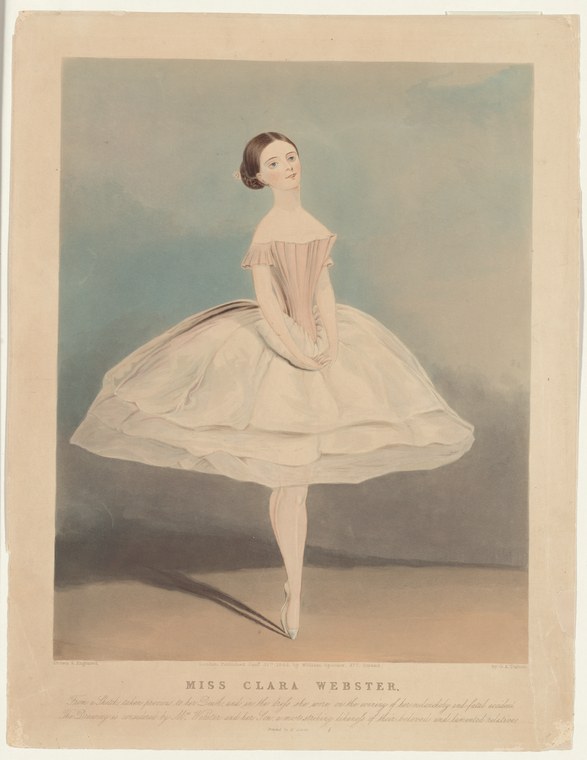
Miss Clara Webster: from a sketch taken previous to her death and in the dress she wore on the evening of her melancholy and fatal accident. The drawing is considered by Mrs. Webster and her son, a most striking likeness of their beloved and lamented relative
Unknown artist
- Collection:
- Prints depicting dance
- Source:
- New York Public Library
- Rights:
- Public domain — free to use, share and adapt.
- Recorded as:
- Public Domain
This print is a rare visual document of a working mid-nineteenth-century ballet dancer in performance costume, and it commemorates a specific tragic event in theatre history that otherwise might have left no trace. For historians of ballet and of women's performance, it provides evidence of how dancers were remembered and mourned, and what visual conventions were used to honour them.
What you are looking at
A young woman in Romantic-era theatrical dress stands alone against a soft, neutral background in a three-quarter pose. She wears a pale pink off-shoulder bodice with delicate short sleeves and a voluminous white tulle skirt of the kind associated with mid-nineteenth-century ballet. Her dark hair is styled close to her head in the period fashion. She stands on the ball of one foot in a pose suggesting weightlessness, with her other leg extended behind her; her arms are held softly at her sides and front. The composition isolates her against the background, presenting her as a solitary figure rather than in a narrative scene. The print is hand-coloured, with careful attention to the translucency of the skirt and the modelling of her pale skin against the grey-blue background. The inscription below identifies her as Miss Clara Webster and notes that this is drawn from a sketch made before her death, commemorating her in the dress she wore on the evening of her fatal accident.
The dancing
Webster stands in a pose of apparent rest or preparation, her weight primarily on one leg with the other foot pointed and extended behind. Her upper body is upright and composed, her gaze directed upward. Her arms hang naturally, without the theatrical extension characteristic of many Romantic ballet poses. The posture and the extreme lightness of the skirt suggest ballet training, but the pose itself is contemplative rather than dynamic—a moment of stillness rather than movement.
The dance depicted
This is almost certainly a Romantic ballet image, produced as a commemorative print following the death of a known dancer. The costume—pale tulle skirt, pale silk bodice, soft shoes—matches the conventions of mid-nineteenth-century ballet, and Webster's pose suggests familiarity with ballet technique. However, without additional documentation, the specific roles or ballets she performed cannot be confirmed from the image alone. The print functions as a memorial portrait rather than a documentation of a particular choreographic moment.
How it was made
This is a hand-coloured engraving or lithograph, characteristic of mid-nineteenth-century theatrical portraiture. The soft modelling of flesh tones, the careful rendering of translucent tulle, and the subtle tonal background suggest a lithographic base with careful hand-colouring applied afterward. The technique allowed for relatively rapid production of multiple copies, making such commemorative prints economical to distribute to theatre-goers and collectors. The quality of execution indicates a professional theatrical print house.
About this work
This is a commemorative portrait of Clara Webster, a mid-nineteenth-century dancer, drawn and printed after her death in what the inscription describes as a fatal accident. It documents her in the ballet costume she wore on the evening of that accident—a record of both a performer and a tragedy. The work belongs to a tradition of theatrical portraiture common in Britain and Europe during the Romantic era, when ballet rose to unprecedented cultural prominence and dancers became celebrities whose likenesses were collected and displayed. The print preserves not only Webster's image but also the conventions of Romantic ballet costume and the sentimentality with which the period commemorated its performers.
How to look at it
Attend to the pose: Webster is not captured mid-leap or in a dramatic arabesque, but in a moment of stillness and composure. This choice—not to show her performing, but remembering—is characteristic of commemorative portraiture. Notice the extreme delicacy of the tulle skirt and the rendering of her pale neck and shoulders; the artist emphasizes the ethereal quality associated with Romantic ballet. The upward gaze suggests both aspiration and distance, a conventional device for suggesting the otherworldliness that Romantic ballet audiences valued.
The artist
The artist is not recorded. The print bears no visible signature. The quality of execution and the theatrical subject matter suggest a professional lithographer working for a London theatrical print publisher, but without further research the maker cannot be identified. The work was clearly produced quickly after Webster's death, as a commercial memorial.
The period
This print dates from the height of the Romantic era in ballet, roughly the 1830s–1850s, when ballet was dominated by the figure of the sylph—weightless, ethereal, tragic. The pale, delicate costume Webster wears is the uniform of this aesthetic. During this period, ballet had become a major commercial theatrical art in London, Paris, and across Europe, and dancers were celebrities whose images were widely collected. At the same time, the cult of the beautiful, tragic female performer was at its peak; dancers were frequently idealized as victims of circumstance or fate. The inscription's reference to a fatal accident aligns Webster with this Romantic association of the dancer with vulnerability and pathos.
Where it lives
Held by the New York Public Library in its collection of prints depicting dance. This is a commercial theatrical print, one of a likely series of similar portraits of popular performers of the period, produced for purchase and display by private collectors and theatre enthusiasts.
Dance in this work
Questions about this work
Who was Clara Webster?
Webster was a dancer active in mid-nineteenth-century British theatre. The inscription on this print states that she died in a fatal accident, and that this image was drawn from a sketch made before her death. Beyond this commemorative print, little biographical information survives. Her son and mother apparently owned or commissioned this portrait, suggesting she came from a theatre family.
What kind of ballet did dancers perform in this era?
The Romantic era (roughly 1830–1860) was dominated by a particular aesthetic: ballets about supernatural or otherworldly female characters—sylphs, spirits, ghosts. The choreography emphasized weightlessness, delicacy, and apparent effortlessness. Dancers trained in the Italian Cecchetti method or under French teachers; pointe work was becoming standard. The pale, delicate costume Webster wears was the uniform of this style.
How do we know this is ballet and not another form of dance?
The costume—pale tulle skirt, pale silk bodice, soft shoes, close hair—matches exactly the conventions of mid-nineteenth-century ballet. The pose, with weight on one leg and the other extended and pointed, suggests ballet training. The theatrical framing and the focus on ethereal delicacy align with ballet's aesthetic values in this period. No other dance form of the era used this costume or posture.
Why is this a print rather than a painting?
Theatrical portraiture in this period was almost always produced as prints—engraved, lithographed, or both—because prints could be reproduced cheaply and sold to a wide audience. A dancer's portrait as a unique oil painting would have been far more expensive and available only to the wealthy. Prints allowed performers to become celebrities and allowed theatre-goers to own images of their favourite performers.
More dance artwork





