49 works in this view — arrow keys or swipe to move between them.
Dance in Art
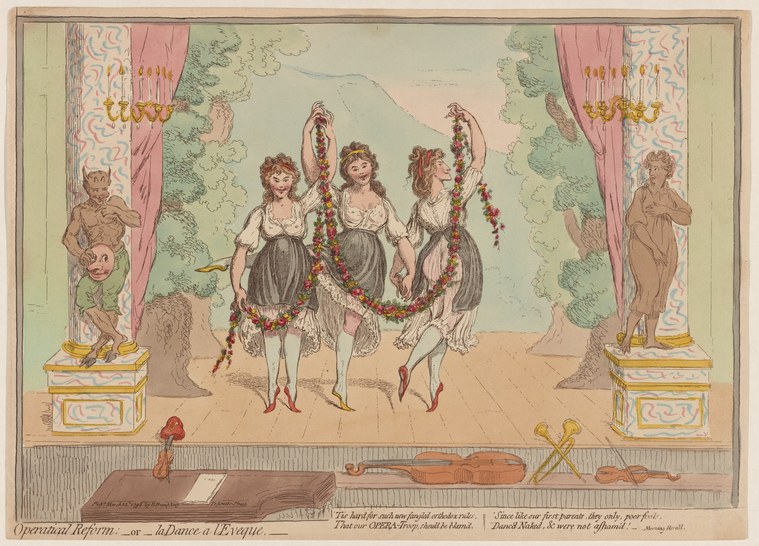
Operatical reform; or la dance à l'évêque
Unknown artist
- Collection:
- Prints depicting dance
- Source:
- New York Public Library
- Rights:
- Public domain — free to use, share and adapt.
- Recorded as:
- Public Domain
This print records a moment when dance reform and operatic aesthetics were contested enough to warrant public satirical attack. It is rare visual evidence that dance was a subject of serious enough disagreement to merit this kind of visual polemic, suggesting that choreographic philosophy had consequences for educated audiences. The print also illustrates the visual conventions by which 18th-century engravers communicated about bodily practice and performance: pose, symmetry, costume, and setting were the legible vocabulary.
What you are looking at
A satirical theatrical scene set within a proscenium stage bounded by pink drapery and ornamental architectural frames. Three female dancers occupy the center, each holding aloft a garland or floral chain—a classical attribute—while executing a dance step. Their bodies are turned outward in a parade-like formation. The setting includes classical elements: nude male statuary flanks the stage (left and right), ivy or foliage adorns the upper portions, and the floor is rendered in perspective. The composition is shallow and frontal, addressed directly to the viewer. Below the stage platform, on the foreground floor, lie scattered props—a lute, an hourglass, a pair of cymbals or similar percussion—suggesting abandoned or discarded implements. The entire scene is rendered in the hand-colored engraving technique typical of 18th-century satirical prints: pale washes of color, careful line work, and deliberate caricature.
The dancing
The three dancers are aligned in a shallow line parallel to the picture plane, executing an identical or near-identical movement: each has one leg raised or extended, arms elevated symmetrically to shoulder or head height, holding floral garlands. Their bodies show the turned-out posture and lifted carriage of trained court dance. The poses are symmetrical and decorous, emphasizing vertical lift and decorative display rather than dramatic movement. No close hold is visible; the dancers are separated and self-contained in their presentation.
The dance depicted
This appears to be a satirical commentary on theatrical or operatic dance reform, specifically on the movement toward more naturalistic or 'reformed' ballet. The title 'Operatical reform; or la dance à l'évêque' (Operatic reform; or the bishop's dance) suggests mockery of a specific choreographic innovation or philosophical position in dance, possibly one advocated by a prominent figure in dance theory (the 'évêque' reference may be a personal or institutional jab). The dancers' poses—stilted, symmetrical, and heavily reliant on classical attributes—are the target of satire. The discarded musical and temporal instruments below imply that the reform has abandoned music or proper timing in favor of visual display. The scene represents ballet or operatic dance of the mid-to-late 18th century, but presented as an object of ridicule.
How it was made
This is a hand-colored engraving, likely from the mid-to-late 18th century, executed in the popular style of satirical prints of that era. The technique allows for sharp linear detail in the figures and architectural framing while the hand-coloring adds wit through tonal distinction (the pink drapery, the flesh tones, the pale stage floor). Engravings of this type circulated widely among literate audiences and theatergoers, serving as portable commentary on current artistic controversies. The shallow stage space and frontal address are characteristic of theatrical prints designed to be 'read' as a picture of a performance—a convention that bridges print culture and theater culture.
About this work
This is a mid-18th-century satirical engraving lampooning a controversial figure or movement in operatic and theatrical dance reform. It presents three dancers in a formal, classicized idiom—posed symmetrically with floral garlands in the manner of court ballet—but frames them as objects of ridicule by situating the scene within an ornate stage box and scattering abandoned musical instruments at its base. The print belongs to a vigorous culture of artistic satire in 18th-century Europe, where prints mocked philosophical or aesthetic fashions and their advocates. It is a document of a specific historical controversy now obscure to us, but its visual language—the exaggerated symmetry, the displaced props, the theatrical framing—speaks clearly to anyone viewing it: this is an absurdity being exposed.
How to look at it
Observe how the three dancers are presented identically and frontally, as if they were objects on display rather than agents of expression. Notice the ornamental frame and theatrical proscenium: the artist is saying 'this is what is being offered as art,' and inviting you to judge it. The contrast between the dancers' formal, lifted posture and the jumble of rejected props (lute, hourglass, cymbals) at the stage's base is the crux of the satire: those instruments represent music, time, and sound—all supposedly abandoned or mishandled by this reformed approach. The satire works through visual incongruity and formal exaggeration, not through grotesque caricature of individual bodies.
The period
The 18th century witnessed intense debate over the future of ballet and theatrical dance, particularly following the reforms initiated by figures like Jean-Georges Noverre, who advocated for expressive, dramatic dancing freed from rigid courtly conventions. Operatic dance was a central form in this argument: should ballet serve decorative and symmetrical ends, or should it tell stories and express emotion? This print satirizes one position in that debate—possibly a purist or pedantic stance that clung to classical formal poses at the expense of expressiveness. The scattered instruments suggest a critique of empty formalism divorced from music and rhythm. The date and authorship remain uncertain, but the style and subject place the work squarely within the mid-to-late 18th-century culture of artistic critique.
Where it lives
The work is held in the NYPL Prints collection, classified as 'Prints depicting dance.' It is a page from a larger archive of visual materials on dance in art and culture, which positions it as evidence for how dance was represented, understood, and critiqued in its own time.
Dance in this work
Questions about this work
What is 'la dance à l'évêque'?
The title is a satirical jab, using 'bishop's dance' as a stand-in for a target figure or faction in dance reform. Without additional documentation, the specific reference is now obscure, but the print was clearly responding to a recognizable position or person in theatrical circles. The satire turns on the visual presentation: these formally posed dancers, far from being reformed or progressive, are presented as absurdly rigid and decorative.
Why are the musical instruments scattered on the floor?
The lute, hourglass, and cymbals represent music, time, and rhythm—foundational elements of dance. Their placement on the stage floor, discarded and neglected, suggests the satirist's accusation that this reformed dance has abandoned proper relationship to music or temporal structure in pursuit of purely visual or formal effects. It is a visual argument against the reform being mocked.
Is this ballet or opera dance?
The title specifies 'operatical reform,' so this is a comment on theatrical dance within opera—the danced interludes or divertissements that were standard in 18th-century opera. Opera dance sat at the intersection of high court tradition and popular spectacle, making it a flashpoint for debates about artificiality and reform. The formal poses and classical attributes (garlands) reference that tradition.
How do we know this is an engraving?
The technique is visible in the image itself: fine linear detail, areas of hand-coloring applied in flat washes (pink drapery, flesh tones), and the characteristic visual style of 18th-century satirical prints. No catalogue record identifies the medium, but the visual evidence is decisive.
More dance artwork





