49 works in this view — arrow keys or swipe to move between them.
Dance in Art
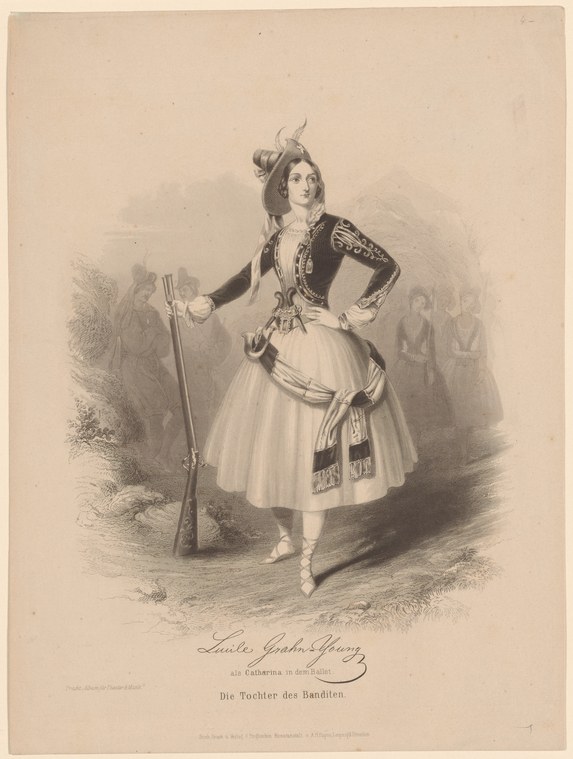
Lucile Grahn-Young [facsimile signature] als Catharina in dem Ballet Die Tochter des Banditen
Unknown artist
- Collection:
- Prints depicting dance
- Source:
- New York Public Library
- Rights:
- Public domain — free to use, share and adapt.
- Recorded as:
- Public Domain
Grahn was one of the great ballerinas of the Romantic period and appeared in all the major capitals of Europe; this print documents her presence in the German-speaking theatre and her range beyond the ethereal sylph roles for which Romantic ballet is often remembered. The image is evidence that Romantic choreography and casting included dramatic, authoritative female characters—often in trouser roles—that required a different physical and dramatic presence than the weightless, otherworldly ideal conventionally associated with the era.
What you are looking at
A young female dancer stands alone in a theatrical pose against a soft, atmospheric background with shadowed figures visible behind her. She wears a dark velvet jacket with ornate braided or embroidered decoration across the chest and sleeves, paired with a full romantic-era tutu in white tulle. A decorative belt or sash cinches her waist, and she wears pointe shoes. Her left arm is raised and bent, her right hand rests on her hip in a confident stance. She wears a feathered or plumed headdress characteristic of mid-19th-century theatrical costume. A rifle or long gun leans against the ground beside her left leg. The composition is a three-quarter-length portrait study, posed and theatrical rather than documentary, with the dancer presented as a named performer in a specific role.
The dancing
The dancer stands in a frontal, self-assured pose with her weight centered and legs in a neutral position rather than an active step. Her left arm is raised with the elbow bent, the right hand placed on her hip—a port de bras suggesting confidence and authority rather than the ethereal, off-balance positions typical of Romantic ballet vocabulary. The posture and directness of her gaze suggest a character role requiring dramatic presence rather than the weightless, sustained quality of a sylph. Her body alignment and the static nature of the pose indicate this is a costume portrait of a named performer in character rather than a representation of choreographic movement.
The dance depicted
This is a character role from the romantic ballet era, performed by Lucile Grahn (identified by the facsimile signature), in the ballet *Die Tochter des Banditen* (The Bandit's Daughter). Grahn was a principal Danish dancer of the mid-19th century. The presence of the rifle and the martial costume—military-style jacket with braid, feathered headdress—indicates a trouser role or a character requiring both dramatic authority and a degree of masculine or martial styling. The ballet belonged to the Romantic period's interest in exotic and dramatic narratives, and Grahn was known for technical virtuosity and dramatic power in such roles. The pose and presentation emphasize the character and costume rather than pure classical ballet technique.
How it was made
This is a lithographed print, identified by its characteristic crayon-drawn quality, tonal gradations, and soft edges. The printing technique allowed for rapid and affordable reproduction, making it ideal for theatrical publicity and circulation among audiences and collectors in the 1840s-50s. The artist has achieved atmospheric depth through careful use of stone tone, with the background dissolving into shadow and the foreground figure emerging with clarity. The facsimile signature of the dancer herself is printed into the image, a common practice for theatrical prints of the period to authenticate and promote the named performer.
About this work
This is a theatrical costume portrait of Lucile Grahn, a celebrated Danish ballerina of the Romantic era, in a character role from *The Bandit's Daughter*. The work is a lithographed print designed for distribution among the theatre-going public, serving as both a record of the dancer's performance and a promotional image. It captures the aesthetics and narrative interests of mid-19th-century Romantic ballet, in which dancers performed not only classical vocabulary but also dramatic, often exotic or military character roles that required personality and authority as much as technical skill. The work belongs to the substantial body of theatrical prints that documented the stars and spectacles of 19th-century European dance.
How to look at it
Notice the confident, frontal stance and the placement of her hand on her hip—this is not the off-balance, ethereal pose of a Romantic heroine yearning for transcendence, but a character assuming authority and presence. The rifle beside her is not decorative but essential to reading the role: this is a woman of action and danger, not a victim or a spirit. The ornate military jacket and feathered headdress signal theatricality and costume rather than everyday dress. The lithographic technique, with its soft tonal modeling and atmospheric background, creates a sense of the stage lighting and the theatrical moment, rather than documentary realism.
The period
This print dates to the height of the Romantic ballet era in Europe, approximately 1840–1860. Lucile Grahn's career flourished in this period, when Danish and European ballet companies maintained a robust touring culture and a hungry audience for lithographed theatrical prints. The role of the bandit's daughter reflects the Romantic era's fascination with dramatic narratives set in exotic or marginal worlds—bandits, gypsies, sylphs, odalisques—and the casting of principal female dancers in strong character roles, often wearing costumes that combined classical tutu with military, folk, or fantasy elements. German theatres were major venues for Romantic ballet, and this print's German-language title and inscription reflect that cultural context.
Where it lives
This print is held in the New York Public Library's collection of prints depicting dance. It is a lithographed theatrical publicity portrait, part of the substantial archival record of 19th-century European dance performance.
Dance in this work
Questions about this work
Who was Lucile Grahn?
Lucile Grahn (1819–1907) was a Danish ballerina who became one of the most celebrated performers of the Romantic era. She danced in the major theatres of Europe, including Copenhagen, Paris, London, Milan, and Germany. She was known for both her technical skill and her dramatic presence, and she performed in the great Romantic ballets of her time, including *La Sylphide* and *Giselle*. She later became a respected ballet teacher and choreographer in Munich.
What is a trouser role in ballet?
A trouser role is a female character costume that includes breeches, military dress, or masculine clothing instead of a skirt or tutu. These roles often conveyed dramatic authority, heroism, or ambiguous gender, and were a regular feature of Romantic and later 19th-century ballet. Principal female dancers often performed trouser roles to showcase their dramatic range and physical power.
What ballet is this print advertising?
*Die Tochter des Banditen* (The Bandit's Daughter) is a Romantic-era ballet, likely choreographed for or performed by Grahn during her European engagements. The narrative—a bandit's daughter—fits the Romantic taste for dramatic, exotic characters and marginalized worlds. The presence of the rifle indicates that this was an action role, not a passive or ethereal one.
Why was this print made?
Lithographed portraits of famous dancers were mass-produced and sold as souvenirs to theatre audiences, much like modern celebrity photographs or posters. They served as promotional material for the theatre, documented the star dancer's appearance and costume, and gave fans a keepsake of the performance. The facsimile signature authenticates the image as an official portrait of the named performer.
More dance artwork





