49 works in this view — arrow keys or swipe to move between them.
Dance in Art
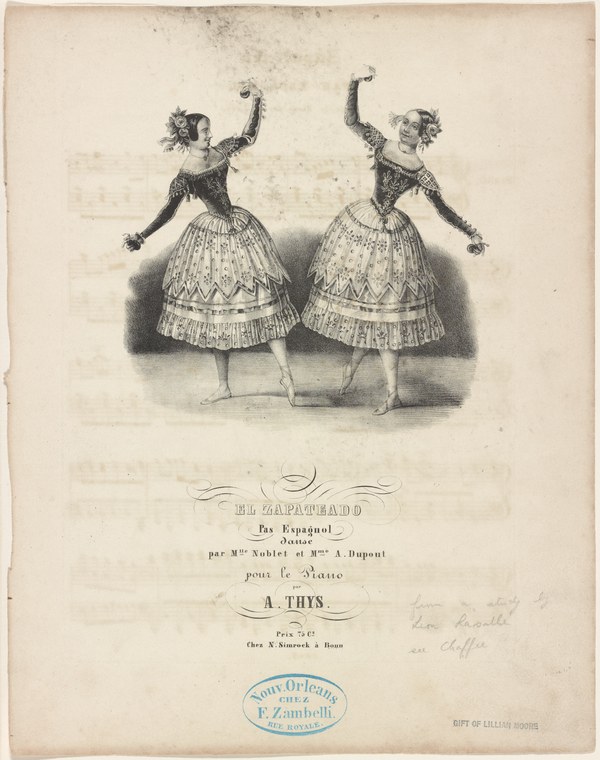
El zapateado, pas espagnol dansé par Mlle. Noblet et Mme. A. Dupout [sic] pour le piano par A. Thys
Unknown artist
- Collection:
- Prints depicting dance
- Source:
- New York Public Library
- Rights:
- Public domain — free to use, share and adapt.
- Recorded as:
- Public Domain
This work is a rare visual record of how Spanish dances were staged and imagined in mid-19th-century European theaters, showing the tension between the exotic subject matter and the balletic vocabulary used to perform it. For dance historians, it documents the repertory and casting practices of theaters during the height of the Romantic era, and the international circulation of choreography through published music.
What you are looking at
Two female dancers in identical poses face the viewer in this engraved print. They wear mid-19th-century theatrical dress: fitted bodices with short puffed sleeves and voluminous skirts constructed in multiple tiers with decorative zigzag or scalloped trim. Both have their arms raised in symmetrical positions—one arm bent upward, the other extended to the side—and their bodies are angled in contrapposto stance. The dancers wear their hair styled in the fashion of the period, parted and pulled back. The composition is spare: the figures are centered and isolated against a plain background with light shading beneath them to suggest the stage floor. A decorative flourish appears below the figures, followed by the title and publication information.
The dancing
Both dancers stand in a mirrored, frontal position with weight distributed evenly on both feet, suggesting a posed moment rather than a captured mid-movement instant. Their raised arms—one lifted high, one extended laterally—create an open, expansive frame typical of Romantic-era ballet vocabulary. The symmetry is absolute, presenting the two dancers as a matching pair rather than a narrative interaction. The visible posture shows the upright carriage and elongated line expected of trained ballet dancers, with no visible heel elevation or evidence of pointe work.
The dance depicted
This is a Spanish dance pas (a choreographed solo or duet) performed by the named dancers Mlle. Noblet and Mme. A. Dupout. The title *El zapateado* refers to a Spanish theatrical dance characterized by rhythmic footwork and heel-striking (zapateado literally means 'stamped' or 'heel-struck' in Spanish), though the prints shows the dancers in a formal, static pose rather than mid-movement. The composition suggests this is a title page or advertisement for a published piano score by A. Thys, rather than a documentary record of the actual performance. The work represents a type of "Spanish dance" or exotic national dance that was popular in European theaters during the Romantic era, though performed in ballet vocabulary rather than authentic Spanish flamenco.
How it was made
This is an engraving or possibly a lithograph, identifiable by the fine line work, the tonal modeling achieved through cross-hatching and stippling, and the formal printing conventions of the period. The technique allowed for multiple copies to be distributed and sold as sheet music covers or standalone prints, making this a commercial theatrical product. The presence of a publisher's mark (F. Lombardi, New York) at the bottom indicates this was circulated internationally, possibly in America as well as Europe. The quality of the execution and the careful rendering of costume detail suggest this was made from a drawing by a skilled artist, though the artist's name does not appear on the print.
About this work
This engraved print documents a Spanish-themed dance pas as performed in the mid-19th-century European theatrical tradition. *El zapateado* belongs to the category of exotic or national dances that Romantic-era ballet companies incorporated into their repertories, featuring trained ballet dancers performing stylized versions of non-European dance forms. The work survives as promotional material for a published piano arrangement—evidence of the commercial apparatus surrounding theatrical dance and the role of music publishing in circulating dance culture. The print reveals how such dances were presented visually to audiences: through symmetrical, posed compositions that emphasize the elegance and refinement of the performers rather than the characteristic footwork that gave the dance its name.
How to look at it
Look at the absolute symmetry of the two figures and the formal, heraldic quality of their pose: this is not a moment captured mid-dance, but a presentational image designed to advertise and celebrate the dancers and the choreography. The rigid mirroring suggests the print is meant to represent the dignified finale or salutation rather than the spirited footwork the title promises. Notice the costume detail—the precise rendering of the tiered skirt trim and the sleeve construction—which would have been the visible marker of a well-produced theatrical work. The plain background and careful centering are typical of dance prints intended for use as music-cover illustrations or distributed as souvenir engravings.
The period
The Romantic era (c. 1830–1870) in European ballet was characterized by a fascination with exotic and national dances as a form of theatrical spectacle. Companies in Paris, London, and other major cities commissioned choreographies based on Spanish, Italian, Hungarian, and Oriental themes, performed by featured ballerinas in modified tutus and pointe shoes. This impulse was partly aesthetic—a hunger for novelty and the picturesque—and partly commercial, as such divertissements drew audiences. Music publishing became a major industry in this period, with piano reductions of theatrical music sold widely to amateurs and concert performers. The print's publication in New York indicates the rapid transatlantic circulation of European theatrical culture in the mid-19th century.
Where it lives
This print is held in the Prints Depicting Dance collection at the New York Public Library. It survives as an artifact of the music publishing industry, bearing a publisher's mark (F. Lombardi) and pricing information ('Prix 2 fr'), indicating it was sold as a commercial product, likely as a cover for or supplement to a sheet music edition.
Dance in this work
Questions about this work
What is zapateado?
Zapateado is a Spanish dance characterized by rhythmic, percussive footwork created by striking the heels and ball of the foot against the floor—the word comes from *zapato*, Spanish for shoe. In European Romantic-era theaters, it was adapted into ballet form, performed by trained dancers in tutus, though the emphasis on footwork remained central to the choreography. This print shows the formal pose, not the actual heel-striking that defined the dance.
Who were Mlle. Noblet and Mme. A. Dupout?
The catalogue record identifies them only by name as the performers of this particular pas, but provides no further biographical information. Both appear to have been professional theatrical dancers of the mid-19th century, likely working in Paris or another major European theater. The fact that two dancers are named suggests this was a celebrated or notable performance worth recording in print.
Is this a primary source for what the dance actually looked like?
Only partially. The print serves primarily as an advertisement and souvenir, designed to be elegant and commercially appealing rather than to document the actual movement. The posed, symmetrical composition represents an idealized or concluding moment rather than the dynamic footwork that the title emphasizes. To understand the actual choreography and technique, one would need to consult other sources—reviews, notated scores, or accounts by the dancers themselves.
Why were exotic and national dances popular in Romantic ballet?
The Romantic era's fascination with the exotic, the distant, and the picturesque extended to dance. National and folk-themed divertissements offered visual novelty and emotional variety within a ballet, and they allowed choreographers to introduce different movement vocabularies and costumes. They were also commercially successful, as audiences were eager for spectacle and variety. These dances were, however, typically performed by trained ballet dancers in modified ballet vocabulary rather than in their original forms.
More dance artwork





