49 works in this view — arrow keys or swipe to move between them.
Dance in Art
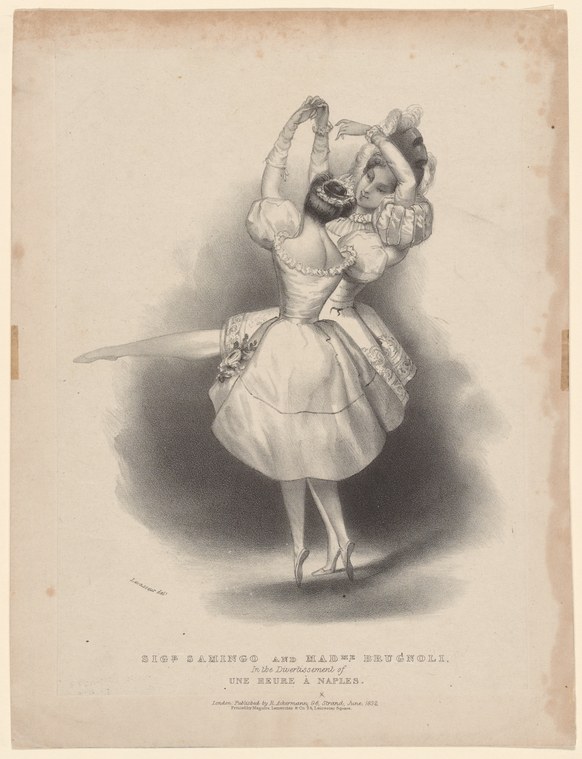
Sigr. Samingo and Madme. Brugnoli in the divertissement of Une heure à Naples
Unknown artist
- Collection:
- Prints depicting dance
- Source:
- New York Public Library
- Rights:
- Public domain — free to use, share and adapt.
- Recorded as:
- Public Domain
This work documents a specific historical performance by named dancers and preserves the choreographic and stylistic vocabulary of Romantic ballet at a moment when that vocabulary was being codified and celebrated across Europe. For historians of dance, it provides concrete visual evidence of how Romantic ballet was actually performed and presented to its audiences.
What you are looking at
A single female dancer in Romantic-era theatrical dress executes a dramatic pose on pointe, her body angled sharply backward with arms lifted and head thrown back in an attitude of exultation or rapture. She wears a white tulle skirt, fitted bodice, and pointe shoes; her dark hair is styled up in the fashion of the 1840s. The figure is rendered in pencil or chalk with careful shading that creates strong volume and highlights the musculature of her extended leg and torso. The composition isolates the dancer against a neutral background with subtle shadow beneath her feet, emphasizing the virtuosity and intensity of the moment. This is a study of technical skill and emotional expression rather than a narrative scene—the focus is entirely on the dancer's body at the apex of a demanding movement.
The dancing
The dancer stands in a sustained arabesque or attitude position with her weight forward on the supporting leg in pointe. Her working leg is extended behind and slightly lifted; her torso arches backward dramatically, with both arms raised and bent. The pose demonstrates the balletic vocabulary of épaulement (shoulder work) and the characteristic lifted port de bras (carriage of the arms) of Romantic ballet. The extension and flexibility required are considerable, and the drawing captures the tension and control necessary to sustain such a position.
The dance depicted
This is Romantic ballet, almost certainly depicting a moment from the divertissement (entertainment interlude) *Une heure à Naples* (*An Hour in Naples*), a popular theatrical vehicle of the 1830s–1840s. The dancers named in the title—Signor Samingo and Madame Brugnoli—were celebrated Italian ballet dancers of that era, known for their virtuosity in pas de deux and showcpieces. The costume, pointe work, and aesthetic place this firmly in the vocabulary of Romantic ballet as danced in Paris and London. The drawing captures the idealized, ethereal quality central to the period—the dancer as a creature of grace and technical mastery simultaneously.
How it was made
This is a lithograph or engraving, rendered in black and gray crayon or chalk tones on paper with careful cross-hatching to model form. The technique—likely lithography based on the tonal range and finish—allowed for wide circulation as a reproducible print, making this type of image a primary vehicle for documenting and promoting ballet performances and dancers to the paying public. The paper shows age and handling (foxing and creasing visible at edges), consistent with a mid-19th-century theatrical print intended for sale or display.
About this work
This is a lithographic print documenting a moment from a ballet divertissement performed by celebrated Italian dancers in the 1840s. It captures the Romantic ballet aesthetic at its height: the idealized female dancer in pointe work, the emphasis on weightlessness and technical command, and the emotional intensity of the pose. The print functioned as both artistic record and commercial promotion, allowing audiences and admirers to possess an image of a celebrated performance they may have witnessed or heard about.
How to look at it
Attend to the extreme backward arch of the torso and the lifted quality of the pose—this is not a passive demonstration of flexibility, but an expression of emotion and spiritual transcendence, central to Romantic ballet's artistic aims. The artist has chosen the apex of the movement, the moment of maximum extension and exposure, rather than a transitional or grounded position. Notice how the shading beneath the feet and the subtle modeling of the body create a sense of the dancer hovering or suspended, an illusion the lithographic technique reinforces through its tonal subtlety.
The period
This print dates to the height of European Romantic ballet, a period (roughly 1830–1850) when ballet shifted its focus from courtly spectacle and male virtuosity to the idealization of the female dancer, weightlessness, and narrative pathos. Lithography and engraving were the primary media for disseminating images of celebrated dancers and performances to the middle-class public; such prints were collected, displayed, and exchanged as souvenirs and records. The 1840s saw intense international competition among European ballet centers (Paris, London, Milan, Naples) for dancers and premieres, reflected in the prominence given to these Italian dancers in Parisian theatrical production.
Where it lives
The print is held in the New York Public Library's collection of prints depicting dance, catalogued with minimal attribution information. Such theatrical prints were produced in large numbers for sale to the public and for preservation in archives and private collections; they survive in relatively good numbers in major institutional collections.
Dance in this work
Questions about this work
Who were Samingo and Brugnoli?
Signor Samingo and Madame Brugnoli were celebrated ballet dancers of Italian origin active in European theaters during the 1830s and 1840s. Brugnoli in particular was known for her technical skill and dramatic performance. They performed in major theatrical centers including Paris, where this divertissement was likely mounted, and were celebrated enough to merit their names in print publicity.
What is a divertissement?
A divertissement is a theatrical entertainment or interlude, often inserted into a longer ballet or opera to showcase dancers' virtuosity. *Une heure à Naples* (An Hour in Naples) is a divertissement—a self-contained showcase featuring dance, mime, and music inspired by Neapolitan life and character.
How was this print made and distributed?
This is a lithograph or engraving, a reproductive print technique that allowed the image to be produced in multiple copies and sold or distributed to the public. Such theatrical prints were common merchandise, sold at theaters, in print shops, and through subscription; they allowed audiences to own images of celebrated dancers and moments from performances.
What does the pose tell us about Romantic ballet technique?
The deep arch of the back, the lifted extension, and the lifted port de bras all demonstrate the Romantic era's emphasis on ethereal, weightless movement and extreme flexibility. The pointe work, though not the focus here, was becoming standard vocabulary for female dancers by this period. The pose itself—more about emotional expression than pure virtuosity—reflects the period's fascination with the dancer as a creature of feeling and transcendence.
More dance artwork





