49 works in this view — arrow keys or swipe to move between them.
Dance in Art
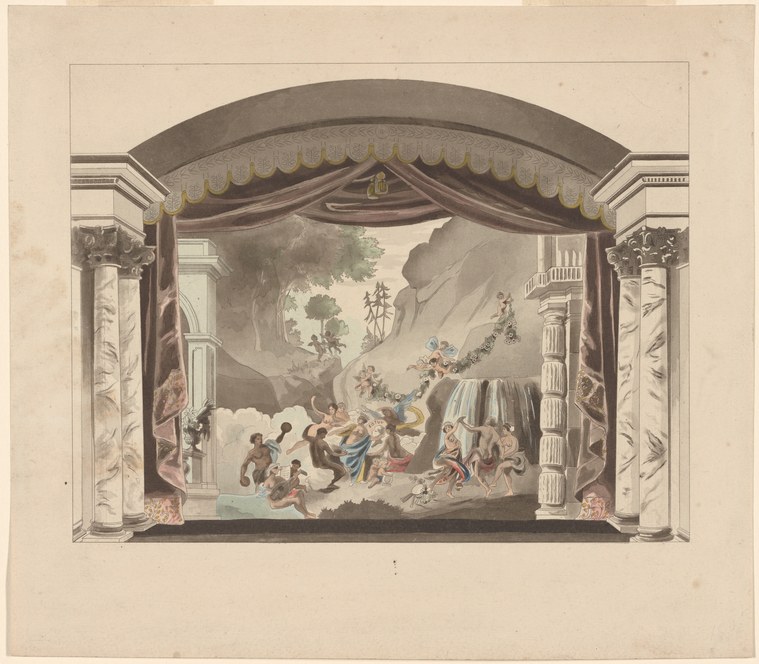
Stage décor for unidentified production
Unknown artist
- Collection:
- Prints depicting dance
- Source:
- New York Public Library
- Rights:
- Public domain — free to use, share and adapt.
- Recorded as:
- Public Domain
This work documents the visual language of early 19th-century theatrical dance—the architectural setting, costumes, and gestural vocabulary through which ballet and opera-ballet created fantasy worlds. Stage design prints like this were how choreographers and designers communicated their visions before photography; they are primary sources for understanding what Romantic-era dance actually looked like on stage, from costume detail to the spatial arrangement of the ensemble.
What you are looking at
This is a stage design rendering for a theatrical production, shown from the audience's perspective. The composition frames a proscenium opening with classical architecture: fluted Corinthian columns support a barrel vault ceiling, and the columns are richly decorated with acanthus capitals and relief ornament. Draped fabric swags in muted purple and gold frame the arch, with a scalloped valance hung along the soffit. The stage floor recedes into a misty, atmospheric landscape with rocky outcrops, trees, and classical architectural elements—a balcony or temple structure visible on the upper right. A large gathering of figures occupies the stage: roughly thirty to forty figures in various states of movement and repose, rendered in pale watercolor tones. Some appear to be dancing or in animated conversation, others recline or sit in groups. The figures wear classical dress—simple drapes and tunics. A procession or formal grouping leads diagonally into the distance. The overall palette is warm and dusty—creams, pale ochres, soft grays, and muted blues—creating an atmosphere of Arcadian leisure or mythological assembly.
The dancing
The bodies display the fluid, elongated proportions and gestural ease typical of Romantic-era theatrical illustration. Individual figures are rendered at small scale and with minimal anatomical detail, but their poses suggest swaying, stepping, and turning movements distributed across the stage space. Some figures stand in pairs or small groups with arms raised or extended; others bend forward in conversation; a few appear to be in motion, with their weight shifted and legs extended. The composition lacks the rigid geometric arrangements of formal court dance, instead showing a more naturalistic scatter of bodies engaged in simultaneous, varied movement.
The dance depicted
This does not depict a specific recognizable dance form but rather a theatrical ensemble scene of classical or pastoral character. The gathering appears to represent a mythological or Arcadian subject—a bacchanal, festival, or assembly of nymphs and satyrs. The loose, undirected quality of movement and the mixed standing and reclining poses suggest theatrical dance-theater rather than ballroom or social dance. The classical architectural framing and mythological subject matter point to Romantic-era ballet or opera-ballet of the early 19th century, when such Arcadian fantasy scenes were standard theatrical fare. The costumes and setting are consistent with European theatrical production of roughly 1800–1840.
How it was made
This is a hand-colored engraving or aquatint, recognizable by the fine parallel lines and cross-hatching that model form and shadow, particularly visible in the architectural elements and drapery. The coloring is applied in translucent washes—watercolor or colored ink—allowing the engraved line work to remain visible beneath. This technique was standard for theater design and scenery documentation in the late 18th and early 19th centuries, when printed stage designs circulated to theaters, patrons, and subscribers as both record and inspiration. The scale and finish suggest a published work—likely from a print series or theatrical periodical—rather than a unique preparatory sketch.
About this work
This is a stage design for an unidentified European theatrical production, most likely a ballet or opera-ballet of the Romantic era (roughly 1800–1840). It records both the architectural framing of performance—the proscenium, columns, and drapery—and the choreographic or narrative action occurring within it: a classical ensemble gathering rendered in soft, luminous color. The work belongs to a long tradition of theater documentation through prints, which allowed designs, performers, and spectacles to be circulated, studied, and replicated. For dance historians, it offers evidence of how Romantic-era theaters conceived mythological spectacle and how ensemble movement was conceived and represented in design.
How to look at it
Attend first to the framing: the proscenium columns and drapery establish this as a record of a real stage space, not a fantasy composition. Then observe the distribution of figures across depth—how the artist uses atmospheric perspective and scale change to suggest the stage receding away from the viewer. Notice how individual bodies are posed: the raised arms, the tilted heads, the stepping legs suggest choreographed ensemble movement, though the moment is not a frozen tableau but rather a snapshot of ongoing activity. The soft coloring and misty landscape are characteristic of how Romantic designers rendered otherworldly or dreamlike scenes.
The period
This design dates to the height of the Romantic ballet era, when European theaters staged elaborate spectacles of classical, medieval, and pastoral fantasy. The mythological subject, classical architecture, and soft, atmospheric rendering reflect Romantic taste for escape into imagined worlds. Stage design prints were a major form of art production and circulation in this period, rivaling history painting in prestige and reach. Theaters employed specialist designers, and their work was published, exhibited, and collected. The technique of hand-colored engraving or aquatint was ideal for theater designs: quick enough to produce and distribute, precise enough to communicate architectural and costume detail, and colorable to suggest atmospheric effect and mood.
Where it lives
This work is held in the NYPL's collection of prints depicting dance. The object is unattributed and undated by the holding institution; it is catalogued as a stage design for an unidentified production.
Dance in this work
Questions about this work
What is being depicted—a real performance or a design proposal?
This is a design rendering, likely created to record or document a stage production after it was conceived and possibly performed. The level of finish and the printing technique suggest it was made for publication or circulation, not as a working sketch. It may represent an actual production that was mounted, or it may be a speculative design; the unattributed state makes this impossible to determine.
How do I know this is from the Romantic era?
The mythological subject, the soft atmospheric rendering, the Arcadian landscape, and the Corinthian neoclassical framing all point to early 19th-century taste. The technique of hand-colored engraving and the style of the theatrical framing are consistent with European theater design prints from roughly 1800–1840. The lack of any identifying inscriptions makes precise dating uncertain.
Can you identify the specific dance being performed?
No. The ensemble is too loosely arranged and heterogeneous in pose to correspond to any recognizable social, ballroom, or formal theatrical dance. It represents a generalized theatrical ensemble or bacchanal, likely from a ballet or opera-ballet on a classical or pastoral subject. The specific work and its choreography remain unknown.
More dance artwork





