49 works in this view — arrow keys or swipe to move between them.
Dance in Art
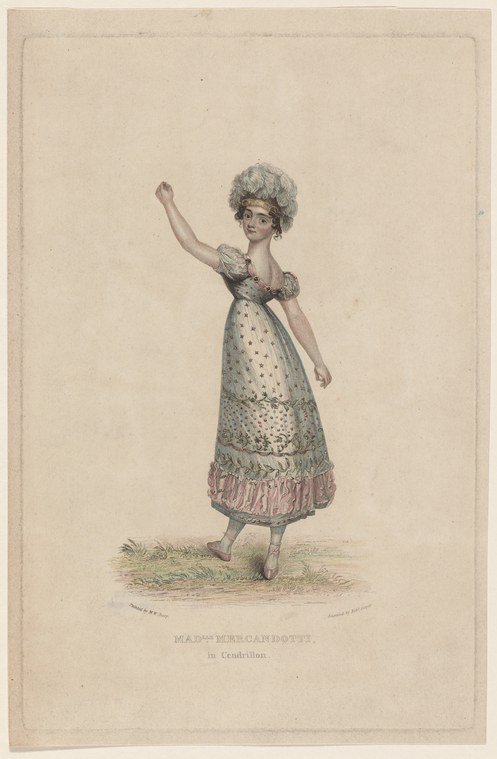
Mad'lle Mercandotti in Cendrillon
Unknown artist
- Collection:
- Prints depicting dance
- Source:
- New York Public Library
- Rights:
- Public domain — free to use, share and adapt.
- Recorded as:
- Public Domain
Named images of nineteenth-century professional ballet dancers are invaluable historical documents: they show us how actual performers moved and were posed, not how choreographers imagined them or how later dancers chose to interpret the role. The specificity—the named dancer, the named role, the dated style of dress and technique—anchors Romantic ballet in the real world of theater labor and celebrity rather than leaving it as pure legend.
What you are looking at
A single female dancer occupies the center of the composition, shown in three-quarter view against a plain cream background. She wears a high-waisted empire gown of pale muslin or cotton with a dotted or patterned bodice and fitted short sleeves finishing at the elbow; the skirt falls to just below the knee and is trimmed at the hem with a deep band of rose-pink pleated or gathered fabric. Her hair is elaborately dressed in the Regency style, gathered up and curled on top of the head. She stands with her weight forward on her left leg, her right leg extended behind her in a balletic attitude, and her left arm raised in an elegant arc above her head while her right arm extends outward at shoulder height. The figure is rendered with delicate hand-coloring in watercolor or tint over the engraved line, and a small amount of green suggests grass beneath her feet, grounding her in a theatrical rather than domestic space.
The dancing
The dancer's frame is upright and buoyant, with the torso held high and the shoulders relaxed. Both arms are positioned in the classical ballet aesthetic—the raised left arm forms a graceful line above the head, slightly angled back, while the right arm extends to the side at or just below shoulder height, palm facing gently forward. The working leg is extended behind the body in what appears to be a battement or attitude, with pointed foot. The weight distribution suggests the dancer is either suspended in a jump or held in a balanced standing position on the supporting leg, a pose characteristic of Romantic-era ballet technique.
The dance depicted
This is a theatrical dance image, most likely depicting Romantic ballet of the early-to-mid nineteenth century. The title indicates the subject is Mademoiselle Mercandotti performing in 'Cendrillon' (Cinderella), a role that would have required a trained ballet dancer skilled in the five positions, turnout, and the ethereal quality prized by Romantic aesthetics. The costumes and technique align with the Romantic period's celebration of delicate, otherworldly female dancers in classical ballet. The pose itself—with its lifted arm line and extended leg—follows conventions of ballet's vocabulary as it was danced in the 1840s or 1850s.
How it was made
This is a hand-colored engraving or aquatint, a reproductive print technique that allowed inexpensive circulation of images of celebrated performers to a wide audience. The delicate line work shows the skill of the engraver in rendering the texture of fabric and the definition of the face, while the tinted watercolor has been applied afterward by hand or in a workshop, lending subtle color without the expense of color printing. The technique was standard for theatrical portraiture of the era and suggests this was a popular or commercially successful image—prints of celebrated dancers were sold as souvenirs to theater audiences.
About this work
This is a portrait print of a named professional ballet dancer captured in a moment from a specific theatrical role. Mademoiselle Mercandotti is presented in the idealized vocabulary of Romantic ballet: a corps de ballet or soloist role in the fairy-tale ballet 'Cendrillon,' shown in a pose that demonstrates her training and the technical demands placed on female dancers of the period. The image belongs to the large body of theatrical ephemera that documented the lives and repertory of professional dancers in the nineteenth-century theater, circulating among audiences and building the celebrity culture around the art form. It is simultaneously a record of a dancer's practice, a snapshot of Romantic-era ballet aesthetics, and evidence of how theatrical performance was marketed and memorialized.
How to look at it
Look closely at the pose: the dancer is captured in a moment of suspension or weightless extension, with the free leg extended and the arms arranged in an open, presentational line rather than a functional one. This is a 'portrait' pose designed to show off the dancer's elegance and training rather than a moment of vigorous action or interaction. Note the slight forward tilt of the torso and the lightness of the raised leg—the engraver has understood and conveyed the aesthetic of Romantic ballet, which prized an illusion of effortlessness and flight. The pose would have been familiar to any theater-goer of the era as the kind of moment a dancer would hold briefly before or after an enchainement of steps.
The artist
The engraver is not recorded. Hand-colored engravings of theatrical performers were produced in workshops, often by skilled but uncredited artisans who specialized in theatrical portraiture. Such prints were frequently issued by theater print publishers or distributed by the theaters themselves, making them collaborative commercial products rather than works of fine art bearing a single artist's signature.
The period
This image dates to the height of Romantic ballet in the mid-nineteenth century, when ballet had moved decisively toward narratives of the supernatural and the exotic, and when the female dancer had become the primary vehicle for expressing Romantic ideals of beauty, transcendence, and melancholy. 'Cendrillon' (choreographed by Jean Coralli in 1841) was a celebrated vehicle for prima ballerinas and corps dancers alike, combining narrative interest with opportunities for the display of technical skill. The widespread circulation of images like this—theatrical prints colored by hand and affordable to middle-class theater-goers—was central to building the mythology of the Romantic ballerina.
Where it lives
The work is held in the Prints collection at the New York Public Library, part of their holdings of theatrical prints and dance-related imagery. Such prints were often collected as series or individual souvenirs, and this example has survived in the institutional collections that systematically preserved theatrical ephemera.
Dance in this work
Questions about this work
What ballet is Cendrillon and who danced it?
'Cendrillon' (Cinderella) was a three-act ballet choreographed by Jean Coralli with music by Adolphe Adam, first performed at the Paris Opéra in 1841. It was one of the major narrative ballets of the Romantic era and was danced by many prima ballerinas over several decades. Mademoiselle Mercandotti's role—likely a secondary or corps role rather than the title role—would have required solid classical training and the ability to execute the steps of Romantic ballet technique.
What does the pose tell us about Romantic ballet?
The elevated, extended leg and the open arm positioning reflect the Romantic aesthetic of weightlessness and ethereal beauty. The pose emphasizes turnout, the lengthening of the line of the leg, and the grace of the upper body—all hallmarks of classical ballet training as it was practiced in the mid-nineteenth century. The stillness and clarity of the pose also suggest a moment of presentation or display rather than continuous motion, which was characteristic of how Romantic ballet intermixed narrative pantomime with pure dance.
Why do we have this image and what does it tell us about theater history?
Theatrical prints like this were sold to audience members as mementos and helped build the celebrity of dancers. The existence of this image—with the dancer named and the role named—shows that even dancers in secondary roles were commercially valuable and marketable. It is evidence that nineteenth-century theater was a profitable industry with an active culture of celebrity, merchandise, and fan engagement.
More dance artwork





