49 works in this view — arrow keys or swipe to move between them.
Dance in Art
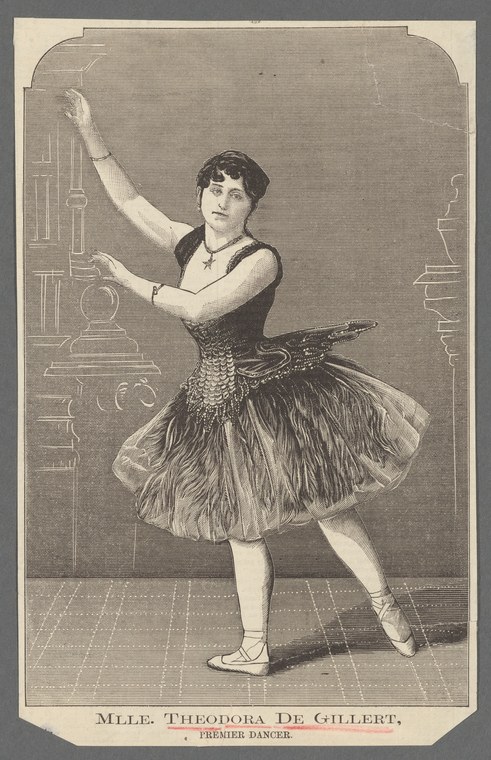
Mlle. Theodora de Gillert, premier dancer
Unknown artist
- Collection:
- Prints depicting dance
- Source:
- New York Public Library
- Rights:
- Public domain — free to use, share and adapt.
- Recorded as:
- Public Domain
Printed portraits of dancers are rare visual evidence of how actual bodies performed Romantic ballet—the silhouettes, the carriage, the specific costume details—rather than how painters and sculptors imagined them. This image documents both the physical technique and the commercial machinery by which nineteenth-century dancers built professional fame.
What you are looking at
A young female dancer stands alone against a neutral backdrop, posed in a balletic attitude. She wears a dark sleeveless bodice with an ornate jeweled or beaded belt at the waist, and a voluminous tulle skirt that falls to mid-calf, rendered with fine cross-hatching to suggest its diaphanous texture. She stands en relevé—on the balls of her feet—with her left arm raised gracefully overhead and her right arm extended to the side at shoulder height, both with the soft, rounded port de bras typical of Romantic ballet. Her dark hair is styled close to her head in the fashion of the 1840s–1850s. The setting is spare: a geometric floor pattern and faint architectural elements in the background suggest a stage interior. The overall composition is frontal and symmetrical, presenting the dancer as a figure to be admired rather than caught in narrative action.
The dancing
The dancer's pose is fundamentally balletic: she rises on the balls of both feet in a soft relevé, with her weight centered and her torso held upright with aristocratic carriage. Her left arm traces a curved line overhead; her right arm extends laterally with the palm softly rotated. Her legs appear straight and aligned, with the supporting leg firmly underneath her center. The pose suggests a moment of lyrical stillness rather than dynamic movement—a characteristic moment of Romantic ballet vocabulary where the dancer demonstrates elevation, line, and upper-body expressiveness.
The dance depicted
This is clearly a theatrical ballet dancer of the Romantic era, likely from the 1840s or 1850s based on the tulle skirt, bodice style, and the printed publicity format. The pose—a soft relevé with arms in an attitude of grace—belongs to the vocabulary of Romantic ballet as practiced in Paris and across Europe during this period. The inscription identifies her as 'Mlle. Theodora de Gillert, premier dancer,' suggesting she was a principal or soloist of some prominence. The image captures the idealized body and refined technique that characterized mid-nineteenth-century ballet performance, where dancers were expected to appear weightless and ethereal.
How it was made
This is a black-and-white engraving or lithographic print, evident from the fine parallel lines used to model form and create tonal gradation, particularly visible in the rendering of the tulle skirt. The technique allowed for mass reproduction and rapid circulation of celebrity dancer portraits, making this a commercial publicity print—the kind that would be sold to ballet enthusiasts and collected in albums. The careful attention to costume detail and the formal, centered composition are consistent with the conventions of mid-nineteenth-century theatrical portraiture.
About this work
This is a portrait of a professional ballet dancer in the mid-nineteenth century, captured in a moment of elegant repose that demonstrates the refined technique and ethereal aesthetic that defined the Romantic ballet tradition. The work belongs to a large body of printed celebrity dancer portraiture that circulated widely in the 1840s–1860s, serving both as documentation of contemporary performance practice and as collectible images for ballet patrons. It is a valuable record of how Romantic ballet bodies were shaped, dressed, and presented to the public eye.
How to look at it
Notice the specific moment the artist chose: not a dramatic leap or turn, but a quiet moment of technical display—a relevé, or rise onto the balls of the feet, that appears effortless but requires constant muscular control. The artist has captured the balletic principle of making difficult technique appear weightless and serene. The delicate rendering of the tulle skirt, with its many layers and gossamer texture, emphasizes the Romantic ideal of the ethereal dancer—a figure who should appear to float rather than merely stand.
The period
The 1840s–1850s were the apogee of Romantic ballet in Paris and across Europe, a period when ballet became the dominant theatrical dance form and dancers—particularly female soloists—achieved celebrity status. The tulle skirt visible here became the standard Romantic ballet costume following Marie Taglioni's success in La Sylphide (1832). Printed theatrical portraiture flourished during this period as a commercial product, allowing dancers to extend their fame beyond the theater and allowing audiences to collect and study images of celebrated performers.
Where it lives
The print is held by the New York Public Library in its collection of prints depicting dance, which includes theatrical portraiture, dance instruction images, and performance documentation from the eighteenth century onward.
Dance in this work
Questions about this work
Who was Theodora de Gillert?
The inscription identifies her as a 'premier dancer,' meaning a principal or leading soloist, but little else is recorded in standard dance histories. The print itself is the primary evidence of her professional status and the fact that she was prominent enough to have her portrait published and circulated commercially.
What is she wearing, and why does it matter?
She wears a Romantic-era ballet costume: a fitted bodice, a deep jeweled belt, and a tulle skirt that falls to mid-calf. This costume type became standard after Marie Taglioni's success in La Sylphide; the lightweight, translucent skirt allowed for the illusion of weightlessness and ethereality that was central to Romantic ballet aesthetics.
Is she en pointe?
No—she is en relevé, rising on the balls of her feet but not using pointe shoes. Pointe work became standard in Romantic ballet, but this image may predate its widespread adoption, or the artist may have chosen to depict a softer, less dramatic moment. The soft relevé was itself a standard position in Romantic ballet vocabulary.
What does this print tell us about how ballet was practiced?
The pose, costume, and presentation all document the Romantic aesthetic: the emphasis on grace, lightness, and refined technique rather than virtuosic display; the idealized female body; and the use of theatrical costume and lighting to create an effect of otherworldly beauty. This was how ballet actually looked and how it was marketed to audiences.
More dance artwork





