49 works in this view — arrow keys or swipe to move between them.
Dance in Art
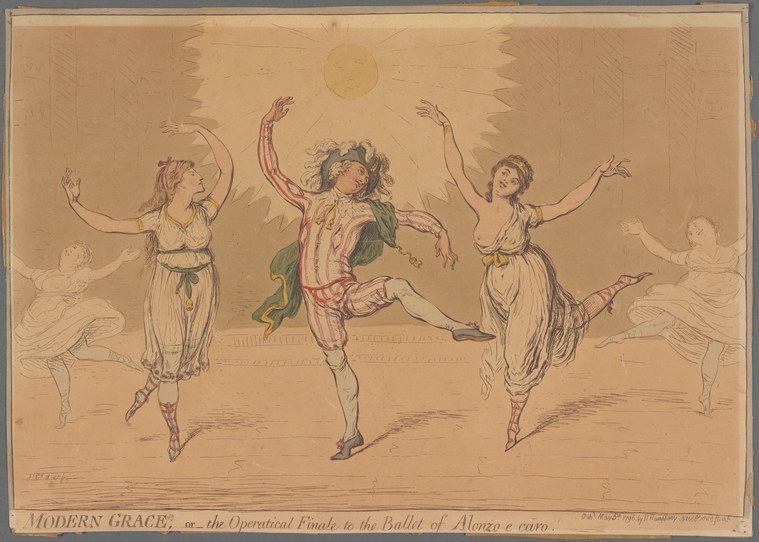
Modern grace, or the operatical finale to the ballet of Alonzo e Caro [sic]
Unknown artist
- Collection:
- Prints depicting dance
- Source:
- New York Public Library
- Rights:
- Public domain — free to use, share and adapt.
- Recorded as:
- Public Domain
This print is evidence of how early Romantic ballet choreography was understood visually by its own era, and of the conventions by which dancers' bodies were represented to audiences. The composition and the dancers' poses tell us what a contemporary viewer expected to see: uplifted, ethereal, unified figures—an ideal of grace very different from the technically differentiated individual roles that would dominate later 19th-century ballet.
What you are looking at
A theatrical scene with five figures in classical dress arranged dynamically across the stage. Three women in high-waisted muslin gowns dominate the composition: the figure at left raises both arms in an exultant gesture, the central figure in a red and green draped costume strikes an energetic contrapposto with one leg extended, and the figure at right mirrors the leftmost dancer's raised-arm pose. Two additional male figures, more lightly sketched, appear at the margins—one crouching at the lower left and another in the upper right. A sun or moon glows pale in the upper center. The ground is suggested by a faint line and crosshatching. The style is that of a hand-colored theatrical print: fine pen line, selective watercolor wash in reds, greens, and flesh tones on paper toned warm ochre-brown.
The dancing
The dancers display the balletic vocabulary of the Romantic era: high arm positions (épaulement), elongated limbs, and an emphasis on upward extension and lightness. The central figure's extended leg and tilted torso suggest a moment of elevation or ballon. The three principal women occupy different planes and attitudes—none are in closed partnership, and all direct their gaze and body weight upward, creating a unified vertical composition typical of early-19th-century theatrical corps de ballet. The marginal male figures are sketched with less detail, suggesting they are secondary to the action or perhaps represent attendants.
The dance depicted
This is a scene from a theatrical ballet, most likely from the early 19th century. The title indicates it is the operatic finale of a ballet called *Alonzo e Caro*, and the inscription "Modern Grace" appears to be ironical or descriptive of the aesthetic on display. The composition follows the Romantic ballet convention of female dancers in flowing skirts arranged in harmonious, uplifted poses—the so-called *tableau vivant* or massed corps effect. The raised arms and tilted heads suggest a moment of triumph, apotheosis, or joyful resolution. The dance vocabulary is consistent with the ballet d'action of the 1820s–1830s.
How it was made
This is a hand-colored engraving or etching on laid paper. The fine black line work defines forms with precision, while selective watercolor or ink wash adds volume and atmosphere—warm ochre for the paper ground and flesh, greens and reds for drapery. The technique of colored engraving was economical for theatrical prints: a single engraved plate could be hand-colored quickly, allowing small-scale circulation among patrons, dancers, and print collectors. The quality of line and restraint of color suggest a professional print workshop rather than a unique drawing.
About this work
This is a theatrical print documenting a moment from a European ballet-opera of the early 19th century. It is a colored engraving made for the theatrical market—a genre that recorded, advertised, and preserved ephemeral stage performances in an era before photography. The work exemplifies how Romantic ballet, with its emphasis on weightlessness, female beauty, and unified corps movement, was visualized and marketed to the public. As a document of dance practice and aesthetic it has the authority of a contemporary visual source, though the artist's hand and the work's specific provenance remain unrecorded.
How to look at it
Look first at the raised arms and open, upward-facing postures: these signal the aesthetic value the period placed on height, openness, and aspiration. Note the absence of weight or effort in the bodies—the feet are planted, but the torsos and limbs seem to float. Observe how the artist has arranged five figures to create a unified composition despite their individual attitudes: this is the Romantic corps de ballet, individuals submerged into a collective ideal. The inscription 'Modern Grace' should prompt you to ask: modern to whom? What did grace mean in 1820s theatrical dance, and how does this print teach us what it looked like?
The period
This work dates to the era of Romantic ballet's emergence and consolidation, roughly 1820–1840. In this period, the female dancer rose to unprecedented prominence, and the vocabulary of turnout, extension, and light upper-body carriage—codified in the emerging technique of pointe work—was being standardized across European theaters. The ballet d'action, in which narrative was carried through mime and dance rather than sung drama alone, was the dominant form. The visual arts of the period—prints, lithographs, and paintings—were deeply invested in recording and circulating images of celebrated dancers and celebrated roles.
Where it lives
The work is held in the New York Public Library's collection of prints depicting dance. It is part of a genre of theatrical ephemera—images made for circulation among theatergoers and collected as souvenirs or documents of performance.
Dance in this work
Questions about this work
What ballet is this from?
The inscription identifies it as the operatic finale to a ballet titled *Alonzo e Caro*. No record of this ballet has been traced in standard bibliographies, and it may be a minor or provincial work, or the title may be variant or misremembered. The print itself is the primary historical evidence for its existence.
Why are the figures so lightly dressed and posed so upright?
This is consistent with early Romantic ballet costume and aesthetic. The high-waisted muslin gowns and bare legs were fashionable in dance c. 1820–1840. The upright posture, raised arms, and emphasis on vertical extension reflect the emerging technique of ballet d'école and the cultural ideal of the ethereal, weightless female dancer.
Is this a record of an actual performance?
Probably. Theatrical prints of this kind were usually made after performances or in consultation with theater companies. However, the artist may have heightened the elegance or idealized the poses; prints were marketing tools as much as documents. This one should be read as a contemporary visual interpretation of the ballet's aesthetic, not a photographic record.
Who made this print?
The artist is not recorded in the catalogue. The signature or attribution, if present, is not legible in the available image. It was likely made by a commercial print workshop associated with a theater or print publisher.
More dance artwork





